

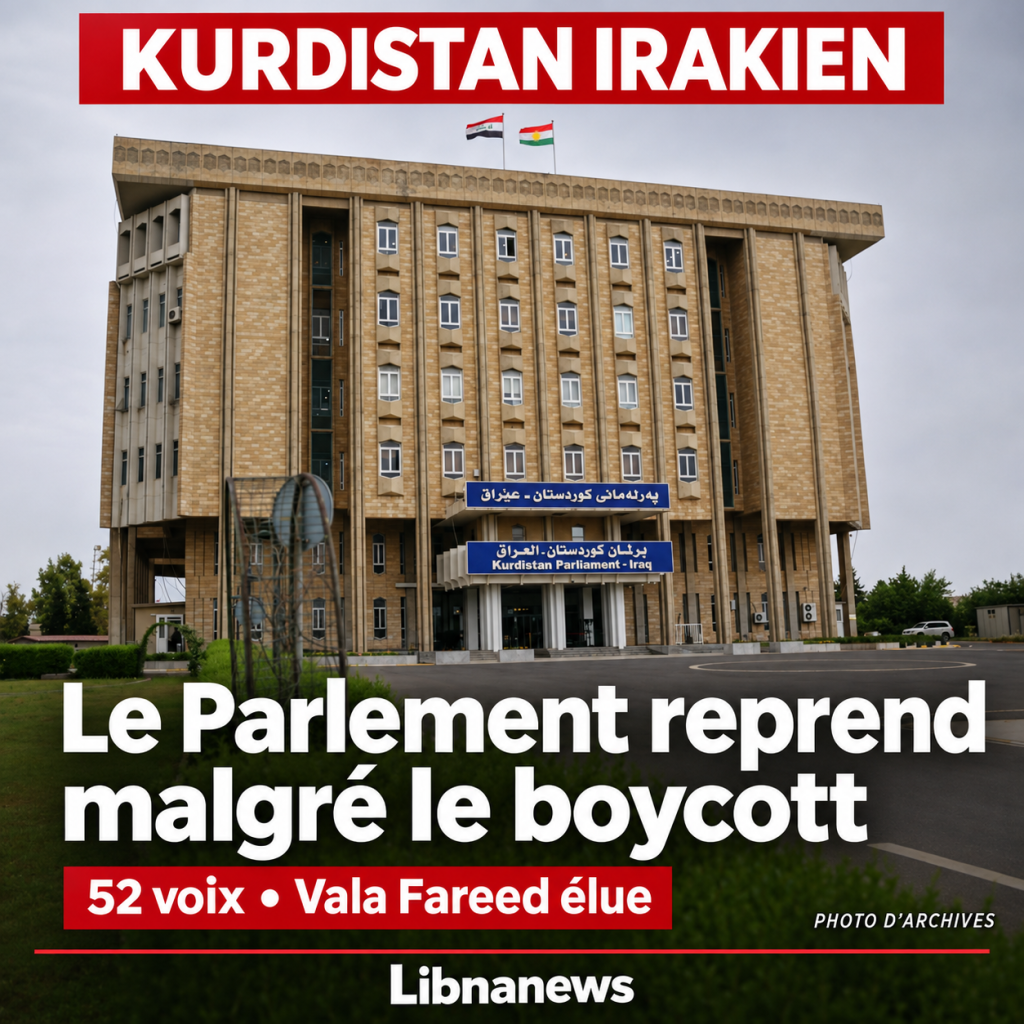
The Parliament of Iraqi Kurdistan elected Vala Fareed to its presidency, Wednesday 4 November 2026 in Erbil. Fifty-two out of a hundred MPs took part in the vote, despite the boycott of two large blocs. This recovery ended almost two years of parliamentary paralysis. However, it does not resolve the disagreement over the formation of the next regional government.
A candidate of the Kurdistan Democratic Party (KDP), Vala Fareed won the 52 votes of the elected representatives present. Rami Nouri was elected Vice-President and Muna Qahwachi Secretary of Parliament, with the same number of votes. The first represents the Chaldean, Syriac and Assyrian Christian component. The second belongs to the Turkmen component.
The official record of the meeting confirms these three elections. The new chair then asked the groups to promptly appoint their representatives to the committees. It set the Monday following the transmission of names for the Committee on Legal Affairs. The Commission’s re-starting is, in her view, a condition of legislative work.
Iraqi Kurdistan Parliament resumes sitting open in 2024
The regional election dates back to 20 October 2024. The PDK won 39 of the 100 seats, ahead of the Kurdistan Patriotic Union (UPK), with 23 elected. The New Generation movement won 15. None of these blocks alone had the majority necessary to impose all institutional choices.
The new deputies were sworn in on 2 December 2024 at the inaugural sitting. This did not allow the appointment of the parliamentary leadership to be completed. The disagreement between the main formations then blocked the work. The meeting on 4 November therefore resumed a procedure which had not yet been completed, rather than opening a new legislature.
Two negotiations were closely linked: the division of functions in Parliament and the composition of the future executive. The KDP wanted to relaunch the institution without waiting for a comprehensive agreement. The UPC defended the opposite approach, requesting prior agreement on the main positions. Wednesday’s vote reflects the choice of the PDK to dissociate these stages.
A majority gathered despite boycott instructions
LUCK and New Generation boycotted the session. Other training courses also refused to take part. However, the 52 participants exceeded the 51-member threshold required to convene the Parliament. This presence allowed the vote to proceed, without reflecting a rapprochement between the leaderships of the major parties.
Participation did not follow exactly the boundaries of the groups. Representatives of small groups and minorities joined the PDK elected representatives. MPs belonging to or belonging to the KUPK and New Generation also attended the meeting, according to reports from the Kurdish press.
Nishtiman Nawprdani, elected under the label of the UPK, participated by declaring himself now independent. Hardi Salah, a former member of this now independent bloc, was also present. These individual choices have helped to make recovery possible. They do not give their former trainings collective support to the result.
The PDK challenges the procedure, the PDK defends the recovery
On the eve of the vote, the UPK challenged the legality of the summons and requested prior political agreement. His representative Azad Mohammed Amin felt that only one party could decide to restart the work. The training called for dialogue and common understanding between political forces.
There was also controversy over the preparatory steps. The head of the parliamentary bureau, Ardalan Mohammed, had said that he had received only 43 signatures requesting a sitting. He challenged the origin of the invitation then broadcast. These objections, formulated on 3 November, precede the actual presence of 52 elected members the following day.
After the meeting, a PUK official, Salar Mahmoud, reiterated to a news agency his party’s commitment to consensus. He blamed the PDK for replicating the mistakes of the past. The disagreement therefore remains political as well as procedural. The result of the vote does not mean that the opponents withdrew their reservations.
On the contrary, the KDP External Relations Office welcomed the resumption of meetings. In his press release of 4 November, he presents this step as a restoration of institutional functioning. He hoped that it would facilitate the formation of a new government and call on groups to overcome their differences.
Vala Fareed refuses a provisional presidency
At its first press conference, Vala Fareed called on the absent Members to return to the Chamber. She assured that her designation did not cover any specific training and should serve all components of the region. She hoped that the elected representatives would resume their responsibilities in Parliament.
The President also stated that the elected leadership would remain in place, regardless of a future political agreement. The possible return of the groups boycotting the session would not, in her view, restore her functions to discussion. This position concerns the status of the parliamentary bureau; it does not constitute an agreement on executive posts.
Regional Prime Minister Masrour Barzani congratulated the three elected officials in a statement issued on Wednesday. He invited other parliamentarians to attend the next sessions. His message supports the revival of institutions while calling on all parties to cooperate.
Commissions and then institutional choices remain expected
In the evening, the president of the region, Nechirvan Barzani, also welcomed the recovery. He called on the political forces to resolve their differences in Parliament. He stressed dialogue, compromise and shared responsibility in the protection of regional institutions.
Parliamentary work must now continue beyond the election of the Bureau. The appointment of representatives in the committees will give an initial indication of the participation of the different groups. Parliament must also move forward on the choices concerning the regional presidency and the next Prime Minister.
The government led by Masrour Barzani, formed in 2019, remains in place pending a new executive. The vote on 4 November does not amount to the inauguration of a new cabinet or the resolution of the division of responsibilities. The next concrete deadline announced by Vala Fareed concerns the appointments to the Committee on Legal Affairs, which is due on Monday 9 November.
References
- Kurdistan Parliament, report and speech by Vala Fareed, 4 November 2026
- Presidency of the region, press release of 4 November 2026
- Regional Government, communiqué of Masrour Barzani, 4 November 2026
- KDP External Relations Office, 4 November 2026
- AFP, taken over by Naharnet, November 4, 2026
- Rudaw, updated record of the meeting, 4 November 2026
- Rudaw, quorum and disagreement on government formation, November 4, 2026
- PUKMEDIA, positions of the groups boycotting the session, 3 November 2026
- Shafaq News, statements by the new president, November 4, 2026
- Archive photography: Ahmad Zebari / VOA Kurdish, public domain, via Wikimedia Commons
Editorial cover Libnanews from a real photo archive. IA-assisted layout. The image does not represent the session of November 4, 2026.






Comments