


The most spectacular movement on Wall Street on Monday is also the one with the least direct effects on everyday life. Nasdaq Composite won 6.5% at the close of November 23rd; Tuesday morning, he already lost a part of it. In Beirut, the reference price of 20 litres of diesel fuel fell by 48,000 pounds between the last two published scales. And in Brussels, a regulation published on Tuesday fixes maximum import quantities for certain new hybrid cars from 1 December. A quotation, a retail price and an import ceiling: these three decisions or movements do not meet the same rules or the same clock.
This delay explains why stock market securities may decline while a full price is cheaper, or why a customs rule may affect delivery times without immediately changing a concession price. To read the day of November 24, it is necessary first to say what is measured, at what time and for what market.
On Wall Street, Monday’s rebound doesn’t fit everywhere
The three major U.S. indices had ended the session on Monday, November 23, in sharp increase. The Dow Jones Industrial Average had won 3.0%, at 49,595.31 points; S&P 500, 4.7% at 7,237.17; Nasdaq Composite, 6.5% at 24,089.56. It’s the Monday fences in New York. Tuesday’s data cited here are sitting observations, not a final review of the day.
On Tuesday, 24, at 10.45 a.m. in New York, or 5.45 p.m. in Beirut, Nasdaq Composite lost about 2.1% and S&P 500 lost about 1%. The Dow Jones was almost stable. At 1021 hours in New York, another survey showed a 1.8% decrease in Nasdaq Composite. These two observations do not prejudge the closure. The dispersion between the three markers is more instructive than the « Wall Street Decline » label: the weakness of several large technological capitalizations weighed more on some indices than on others. Neither Nasdaq Composite nor S&P 500 give the variation of each of the companies they bring together.
The session also received an American statistic which does not cover the results of companies: the Conference Board published on November 24 a household confidence index of 103.3 points, compared with 91.9 in October, based on 100 in 1985. The preliminary survey responses were collected from November 1-17. They thus precede Jensen Huang’s return and the stock market rebound of 23 ; They measure receipts, not expenditures recorded since the beginning of the week.
The business event has been known since Monday: the Nvidia board of directors announced Jensen Huang’s immediate return to management and board. The manufacturer also indicated that the investigation entrusted to an independent board of directors would continue. The return of the leader therefore does not end the examination. And the price movement does not allow us to determine how much of the increase is precisely the result of this decision: other shares have evolved in the same session and other information influences the price paid by investors.
What a rapid upturn can change is the value the market now attributes to expected benefits tomorrow. It does not exempt from verifying whether customers purchase the chips, whether data centres enter into service and whether the investments translate into revenue. A company can announce a profitable project in its eyes while the initial expenditure and contracts run over several years. A stock market session does not measure the income received during those years or the share of actual expenses incurred.
The starting point must also be taken into account. After a large loss, an increase of the same percentage is not enough to restore the original price. In purely arithmetic terms, a value of 100 which loses 20% falls to 80; a 20% increase to 96. The example does not seek to reproduce the Nvidia course. He recalls why the size of Monday’s rebound alone is not enough to talk about a return to previous levels.
Tokyo closed; Paris and New York do not read at the same time
The official supplier of the Japanese index gives a closing of 58 644.63 points for the Nikkei 225 on Tuesday 24 November, compared to 56 436.65 Friday, or about 3.9% increase. Tokyo was closed Monday for Labour Day. The first Japanese session of the week therefore incorporated information that New York had already been able to negotiate on Monday. Mechanically comparing Tuesday’s Japanese rise to the American technological downturn of the same day would mask this difference in timing.
In Paris, the first benchmark confirmed here is the Monday closing: Euronext gave 8,044.84 points for CAC 40, up 1.48%. On Tuesday, at 12.30 p.m. in Paris (13.30 p.m. in Beirut), ACC 40 stood at 8,046.69 points, virtually unchanged (+0.02%) from Monday’s closing. This observation is a meeting point, not the European closure of 24. The takeover agreement announced by Sanofi and Insmed provided information specific to a French company in the health sector, distinct from the semiconductor movement. The agreement provides for a price in cash but remains subject to the conditions of implementation announced by the companies.
On Tuesday, the German institute ifo published a landmark of another kind: its business climate indicator reached 90.6 points in November, compared with 90.1 in October. Services grew, but the climate in manufacturing deteriorated after six consecutive increases. This is a survey of companies about their situation and expectations, not a production figure already made. The difference between services and industry therefore indicates the overall movement, without the figure of the month being able to read the prospects of the automotive sector alone.
Nor is a national index a barometer of the country’s only domestic demand. It brings together companies that can carry out a significant part of their activity outside the market where they are listed. A price change over a large value can move the whole without comparable changes in employment or domestic consumption. Conversely, an event affecting households may take time to influence the performance of listed companies.
The ECB rate provides information on the exchange rate ; he does not fix the invoice
On Tuesday 24 November, the European Central Bank gives $1.0963, 174.39 yen and 0.83700 pound sterling for one euro. On Monday, the corresponding references were $1.0939, 174.01 yen and 0.83673 pound. The euro thus rises slightly against the dollar on these two observations, about 0.22%. The comparison includes two official values constructed using the same method, not the highest or lowest achieved during the day.
The ECB states that its consultation usually takes place at around 14.10 p.m. in Paris, i.e. 15.10 p.m. in Beirut, and that references are normally published around 16.00 p.m. in Paris, i.e. 17.00 p.m. in Beirut. They are established to inform, not directly serve as transaction courses. The distinction has a practical consequence: a customer can read the same figure as his bank without obtaining the same amount at the time of settlement. Conversion time, margin and commissions may differ.
A purely indicative conversion illustrates the size of the movement: a fictitious invoice of 10,000 euros represents $10,939 at Monday’s benchmark and $10,963 at Tuesday’s benchmark, which is $24 before fee difference. This is the arithmetic effect of the currency change alone, not the price of a conversion available. And if the invoice is already fixed in dollars, the reading ss inversely according to the currency in which the buyer must cover it. Before commenting on the increase or decrease in a cost, it is therefore necessary to identify the currency of the invoice, the currency of the payment and the date chosen to reconcile them.
This precaution is particularly important in Lebanon. The rate of £89,500 per dollar appears, for example, in the latest observations of the monthly series of the Bank of Lebanon consulted for this article, which ends in August 2026, and in its method of presenting monetary statistics. This is not an observation of the course actually offered to a client on 24 November. Applying mechanically this rate and that of the ECB at a book price would only give a theoretical value ; this value would not replace the established regulation.
Crude oil full in Lebanese pounds
On oil, the benchmark is that of the last session completed and precisely identified: the Brent for January 2027 was set at $89.37 per barrel in the rules of Monday, 23 November, down $3.20 from the previous session. The WTI for January was $80.17, down $3.24 from the same comparison. These are two separate references to the crude; their levels are not two estimates of the same world price. Nor do they indicate the price of a product delivered to a Lebanese station.
A futures contract is for a specified term. In November, dispatches may rate the Brent in January, the Brent in February or an indicator reconstituted from successive contracts. The three values can coexist without contradiction. The change in reference contract may also create an apparent gap between two statements: it should not be attributed to an increase or decrease in the gross amount without verifying that the maturity has remained the same. Today’s comparisons therefore retain the January contracts for the 23rd session and do not assimilate any price fluctuating Tuesday at a settlement price.
The Lebanese point is more concrete. According to the scale of 24 November, the 20 litres of 95 petrol are reduced to 2,242,000 pounds, compared with 2,291,000 on 20 November. The 98 is 2,260,000 pounds per 20 litres and diesel at 2,397,000, compared with 2,445,000 on Friday. The difference is about 2.1% on 95 and 2.0% on diesel, equal in quantity. The announced price of the gas bottle, 1,625,000 pounds, corresponds to another unit and is not included in the comparison per litre.
The reconciliation over time with the reflux of the crude oil does not make it possible to say that Monday’s change alone explains the fall in Tuesday’s scale. To verify this, it would be necessary to know the period and price of the refined products selected for revision, as well as the costs incorporated into the local price. An importer buys a specified fuel, with delivery conditions. Transport, insurance, applicable levies and distribution do not necessarily move at the same rate as crude oil. The detail counts: the price of a barrel of Brent is not the invoice of a litre of diesel returned to Lebanon.
The decline is also not passed on in the same way to two households. For those who fill up on the scale, the price is at the given quantity pump. For those who pay a private generator subscription, the expense depends on the applicable electricity rate, the number of kilowatt hours consumed and the fixed share of the subscription. A drop in the 20 litres may affect the cost of the supplier’s fuel, but it does not automatically reduce the fixed line on the customer’s invoice. The Ministry of Energy and Water states in its press release of 30 October that its target price for generators is based on a monthly end-of-month calculation based on diesel prices. It is this distinct mechanism, and the consumption actually invoiced, which should be examined before quantifying the effect of the scale of 24 on the next invoice.
The same applies to a trader who passes on his delivery or refrigeration costs. Inventory may have been purchased prior to the revision, transportation may be invoiced on a monthly basis and some of the expenses are not related to fuel. The decision to revise the selling price is therefore made on another calendar. Tuesday’s scale makes it possible to say what a unit costs today, not how much should cost tomorrow each product transported with diesel.
Hybrid cars: Brussels caps a quantity, not a price
The third mechanism is of another nature. European Implementing Regulation 2026/2614, dated 23 November and published in the Official Journal on 24 December, provides for a provisional safeguard from 1 December for certain new hybrid vehicles designed to carry up to nine persons, including drivers. Article 1 describes vehicles which combine a piston thermal motor with at least one electric propulsion motor, with or without charging on the mains. It adds the list of customs codes: « hybrid » on a trade sheet is not enough to say that a model enters the device. The provisional safeguard is set at 200 days. A monitoring mechanism, provided for separately in Article 3 for Annex III products, shall not be confused with the quota itself.
The Commission justifies the safeguard by increasing imports and the risk of serious injury to Union producers. This refers to the justification given by the Commission in the dossier, not a conclusion applicable to all European manufacturers or markets. The measure does not take the form of an additional charge to continue to import beyond the quota. Article 1 provides that, once a quota has been exhausted, imports of the vehicles concerned shall no longer be allowed into the Union under the scheme. Within the quota, the duties that would normally apply continue to apply.
The ceilings are broken down by periods and allocated for several countries separately according to the origin of the vehicles. For the first period, from 1 December 2026 to 28 February 2027, the Annex sets for example 86,301 units for China, 76,900 units for Japan and 47,431 units for the United Kingdom. The next one runs from March 1 to May 31, and then a shorter period from June 1 to 18. Unused quantities may be transferred according to the rules of the text to the following period. This is neither a sales target nor an indication of the number of vehicles actually delivered during each period.
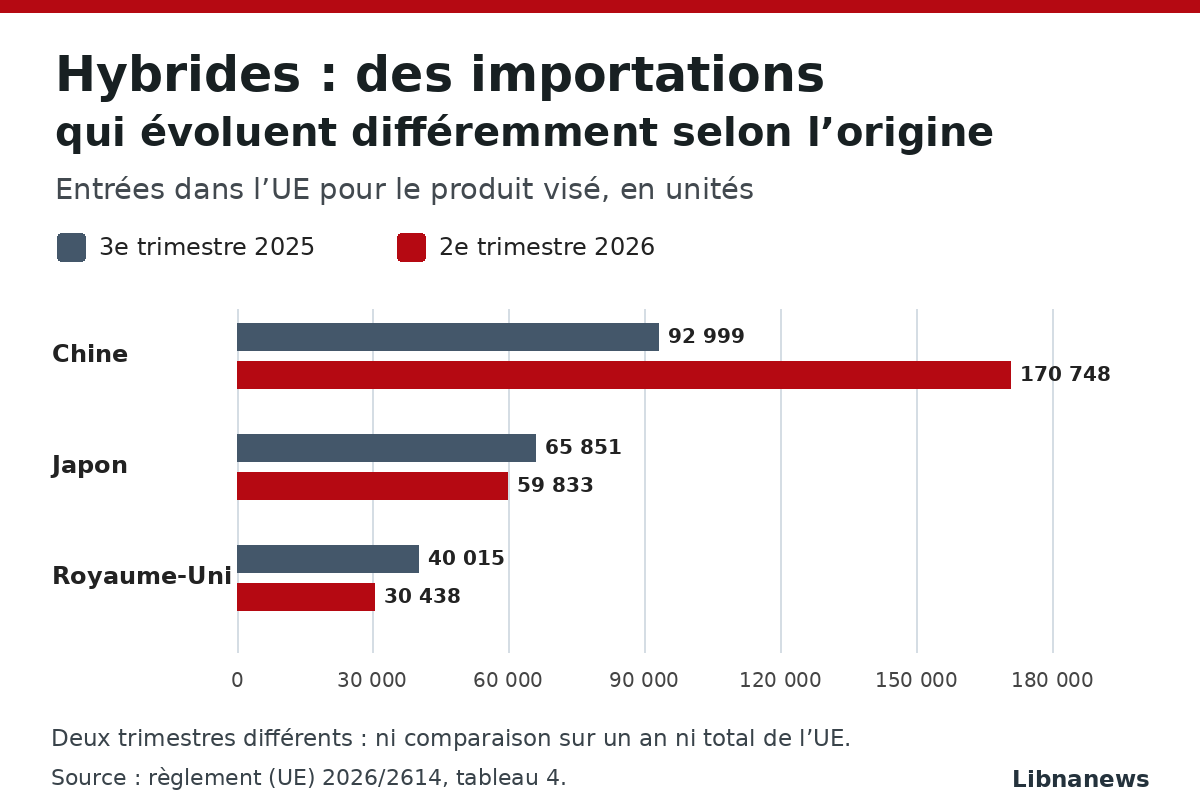
These ceilings have not been removed from a registration table. In its investigation, the Commission inter alia brought the customs entry of vehicles within the scope of the measure over several quarters. For China, it recorded about 93,000 units in the third quarter of 2025 and 171,000 in the second quarter of 2026. In the same two quarters, it shows lower volumes for Japan and the United Kingdom. The two columns are not an annual comparison with the same quarter ; They show why Brussels has documented and treated the origins separately. The schedule to the Regulations should not be divided by these figures to produce a sales reduction rate: neither the periods nor the nature of the data are identical.
The text also gives precise treatment to the last available place in a contingent. If the quantities requested exceed the balance at the time of allocation, the volumes allocated shall be prorated, rounded to whole units, and the quota shall then be closed. This mechanism explains why knowing the initial size of the quota is not enough, even to a professional who knows exactly what volume he ordered. A shipping announcement or presence at the port is not a customs assignment.
Customs origin is not deduced from the manufacturer’s head office or logo. A model of a European trade mark may be produced outside the Union; a Japanese brand can make cars in several countries. The Annex therefore reads first by product and by customs origin, not according to the nationality commonly attributed to the mark. The Regulation refers to the European non-preferential rules of origin and provides for the presentation of an export certificate under Article 5 for goods originating in China to qualify for the quota. It also provides for exclusions by origin. Presenting the measure as a blockage of all cars coming from outside or as an identical measure for all brands in the same country would lose the essential mechanism.
For an importer, a commercial order and a volume actually admitted to entry are two distinct steps. A ceiling can change stock arbitrations and delivery schedule. It does not fix the concession price: vehicles already in stock, comparable non-device vehicles and different costs depending on the model can amortize or shift the effect. No uniform increase in selling prices can be taken from the text alone. The first useful follow-up will be that of the quantities actually charged, stocks and deadlines recorded, not extrapolation from published ceilings.
Benchmarks: What date to attach to what number?
| Benchmark | Observation | Don’t measure |
|---|---|---|
| Nikkei 225 | 58 644.63 points, closure of Tokyo on 24 November | Tuesday’s New York session |
| Euro-dollar ECB | USD 1,0963 for EUR 1, reference 24 November | The executable course of a conversion |
| Brent January 2027 | USD 89.37 per barrel, 23 November settlement | The sale price of refined diesel oil in Lebanon |
| Gazole in Lebanon | LL 2,397,000 for 20 litres, scale of 24 November | The amount of an electrical subscription |
| Hybrids originating in Japan | 76,900 units for the first european period | Planned sales or registrations |
What the regulation means for Lebanon, and what it does not say
The European Regulation regulates the entry of certain vehicles into the Union. It does not directly apply to Lebanese imports and does not alter Lebanese duties or the fuel scale. An indirect effect would remain possible if a manufacturer shifted volumes destined for Europe to other markets. However, neither the text nor the data available today indicate that vehicles will be found in Lebanon, encrypt the possible volume or predict their selling price. Distribution decisions and verified orders are required before writing that the transmission took place.
This limit illuminates the difference between news of the day. The indices measure the price at which certain shares change hands. The ECB’s reference rates provide a basis for comparison. The Lebanese scale gives an amount for one product and one unit. The European Regulation sets a physical ceiling for certain trade flows. The rise in an index, the fall in a retail price and a new quantitative restriction can therefore coexist perfectly. It can only be concluded that the price, unit and timing of costs are falling or rising in general, and that they correspond to the concrete decision.
Cover: Palais Brongniart, Bourse de Paris, July 15, 1918. Autochrome by Léon Auguste, collection of the Albert-Kahn departmental museum (A14468), CC0. Image of archive framed and titled.





Comments