

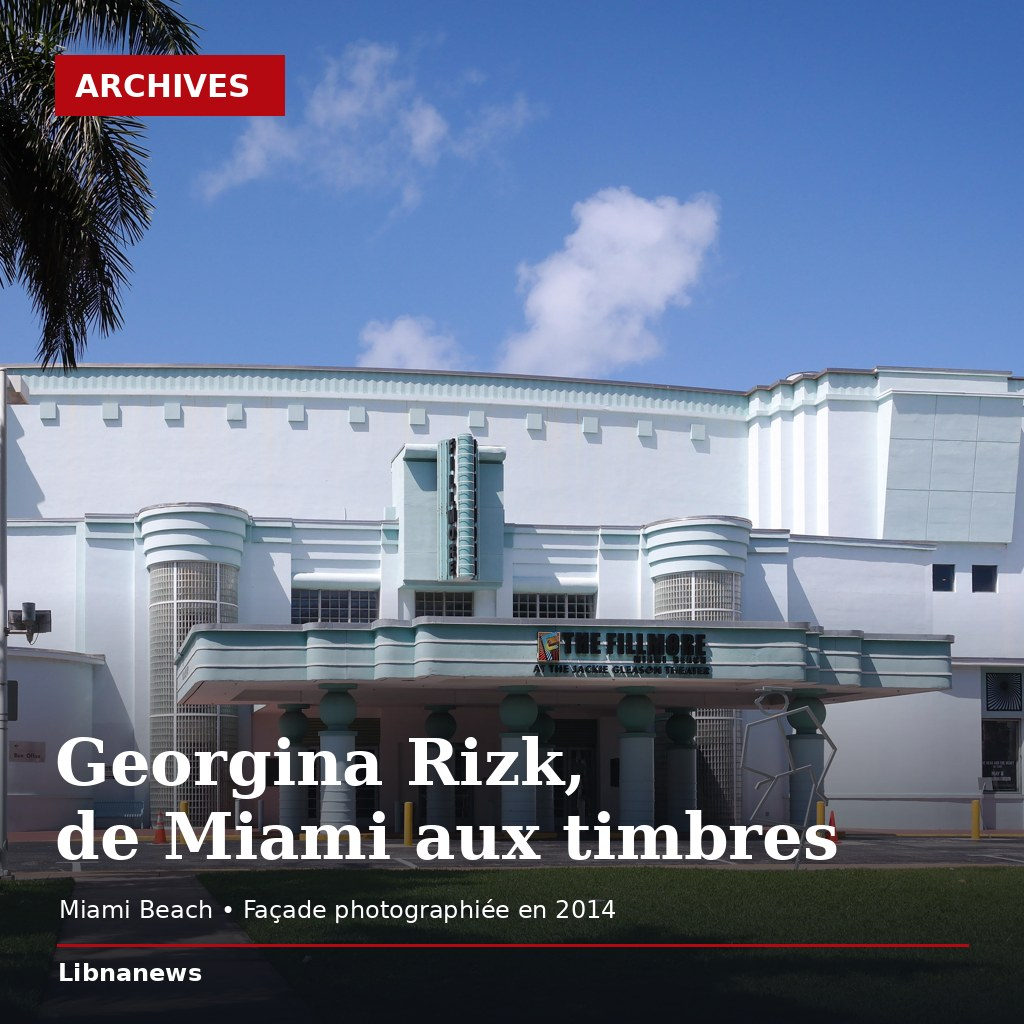
On July 24, 1971, Georgina Rizk won the Miss Universe competition in Miami Beach. At 18, the beyrouthin model became the first Lebanese mannequin to win the title. Victory is in front of American cameras. His reception in Lebanon leaves other traces: a return covered by photographers, official appointments and, in 1974, a series of stamps.
Georgina Rizk, from Beirut to Miss Universe
The competition takes place at Miami Beach Auditorium, a venue that hosts large television shows. In the filmed archive of the election, Puerto Rico’s Marisol Malaret, winner in 1970, gives its crown to Georgina Rizk. The date of July 24 is the date given by the organiser for the Florida ceremony. It makes it possible to distinguish the moment of the creek from the moment when the news arrives in Lebanese editorials.
The victory is not limited to passing before the jury. Four days after the competition, a television archive already located Georgina Rizk in New York, where she answered questions as Miss Universe. At Miami Beach, cameras show a candidate as she wins. In New York, they follow a winner who is also asked to talk about the country she has just represented.
In Beirut, a return followed by photographers
Photographer Harry Koundakjian recounts, in a testimony published in 2004, having covered in Lebanon the return of Georgina Rizk after the contest. His account, written more than thirty years after the facts, does not establish the exact day of arrival or the size of the crowd. He attests, however, that the return was the subject of an order for photographs, regardless of the images of the competition in the United States.
A report published in the spring of 1972 then described processions, meetings with the press, fireworks and official meetings, including a presidential hearing. These traces illuminate two forms of reception: visible demonstrations organized around his return and the attention of Lebanese institutions. They don’t say what the whole country thought of victory.
Stamps do not date from the contest
In 1974, Lebanon devoted a series of four postage stamps to Georgina Rizk. The copies retained show values of 5, 20, 25 and 50 piasters. Two motifs show it in Lebanese dress, the other two are based on another portrait. The series therefore does not simply capture the image of the coronation broadcast from Miami Beach.
The 1971 vintage associated with the series refers to the title won, not its year of issue. Between the film of the contest and these four stamps, Georgina Rizk’s portrait also changes media: it is no longer a matter of showing the seconds of the sacred, but of circulating a chosen image in Lebanon.





Comments