

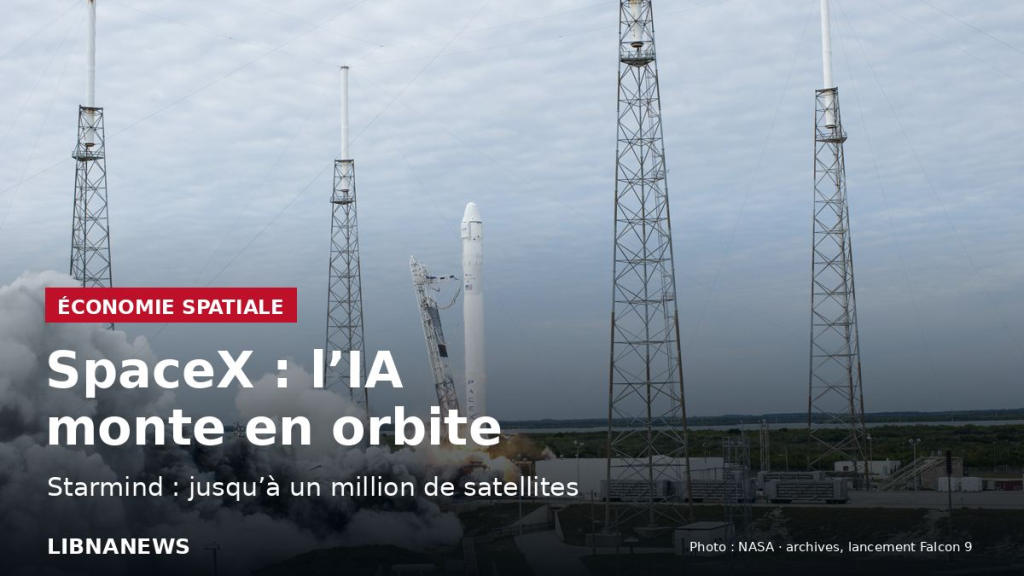
The American regulator gave Starmind a conditional green light. The US does not allow a global service, but Europe, China and countries without launchers would share the risk of massive deployment.
The million is a ceiling, not a fleet
On 25 November, the Space Office of the U.S. Federal Communications Commission (FCC) partially approved SpaceX’s Starmind project. Elon Musk’s group wants processors to work in low orbit and return results to Earth. The decision relates specifically to the emergency radio frequencies that would allow satellite tracking and piloting if their optical links were lacking. It does not qualify as a global licence to market the service or as a unconditional green light for all orbits envisaged.
The licence lapses if SpaceX fails to meet its milestones: at least one operational aircraft on November 25, 2033, 100,000 in 2035, 500,000 in 2038, and a million in 2040. In the interval between the first two milestones, switching from a single satellite to 100,000 would represent an average of nearly 137 updates per day, if SpaceX waited for the first delay. By comparison, the European Space Agency (ESA) has identified just over 4,000 new payloads in orbit by all global actors in 2025. The comparison measures the industrial gap to be crossed, not a launch forecast.
An American decision, a shared cost
ESA had about 15,800 satellites still functional on 17 November 2026. SpaceX’s ceiling is more than 60 times the global inventory. Even partial deployment would increase the number of reconciliations to be monitored. For a foreign operator, whether it operates a weather satellite, a scientific instrument or a small commercial constellation, programming a team-mobilized avoidance, can consume fuel and sometimes requires the interruption of an observation. There is no guarantee that its monitoring capacity or flexibility is comparable to that of a group capable of replacing its aircraft in series.
The FCC accepted the debris prevention plan for aircraft within 600 kilometres. Above, it requires an amending file with a final plan before deployment. It also postponed its decision on the exemption requested by SpaceX for certain modes of retirement at the end of life. The regulator requires biannual balance sheets, including the number of reconciliations and receipts. These data may make the risk measurable; they do not create funds to pay for the manoeuvres of other operators. Under international law, the responsibility of the launching State is in principle absolute for damage to the ground or aircraft in flight; In space, it depends on the fault. However, an additional cost of operation without a collision is not automatically compensated.
Frequencies give other countries a lever, not a general veto
The FCC requires SpaceX to respect its filings with the International Telecommunication Union (ITU). In authorized rescue bands, the company shall not be protected against interference and shall not cause interference. Documented harmful interference must result in the termination of the operation until it is resolved. For the other administrations, coordination of frequencies and authorisation of ground stations are concrete means of action. Denying a land bridge on its territory, however, does not prevent a satellite from flying over it or remove physical hazards in orbit.
Europe and China from different positions
The European Union has increased its IRIS2 project to 348 satellites, aimed in particular at securing its government communications. This network alone does not provide an equivalent to Starmind: owning a satellite link and owning the processors that perform the calculations are two different things. For a European administration, therefore, the choice is not simply to buy bandwidth. It is also about where its data is processed, who controls the encryption keys, what law governs the contract and whether the service can be transferred to another provider.
China has already launched, in May 2025, a first batch of twelve computing satellites for the Zhejiang Lab-led programme. This launch establishes the existence of a competing industry, not a computing capacity comparable to that promised by SpaceX. Countries without a launcher or a large internal market could gain access to new capabilities without building a large data centre right away. But if rockets, links and calculation depend on the same supplier, the cost of operator change increases and the ability to negotiate decreases. For these countries, data and software portability would count as much as the price displayed.
Solar does not regulate heat or price
In orbit, solar panels can power the machines, but the vacuum does not cool a processor by convection: the heat must be evacuated by radiators. The equipment must also withstand radiation and remain economically useful long enough to absorb its orbit. For some data captured in space, processing them up there can avoid large transfers. For training large models powered by terrestrial data, however, it is necessary to demonstrate the flow between machines, the cost of linking and the ability to continue calculations when part of the equipment fails.
The FCC has set a satellite schedule, no computer power. Its document does not give a price for calculation, consumption over the whole life cycle, or commercially available capacity by country. The first test of the project will therefore be less the number announced than the publication of comparable measurements: how much useful calculation the first batch provides, what cost, and how many manoeuvres or unexpected withdrawals.





Comments