

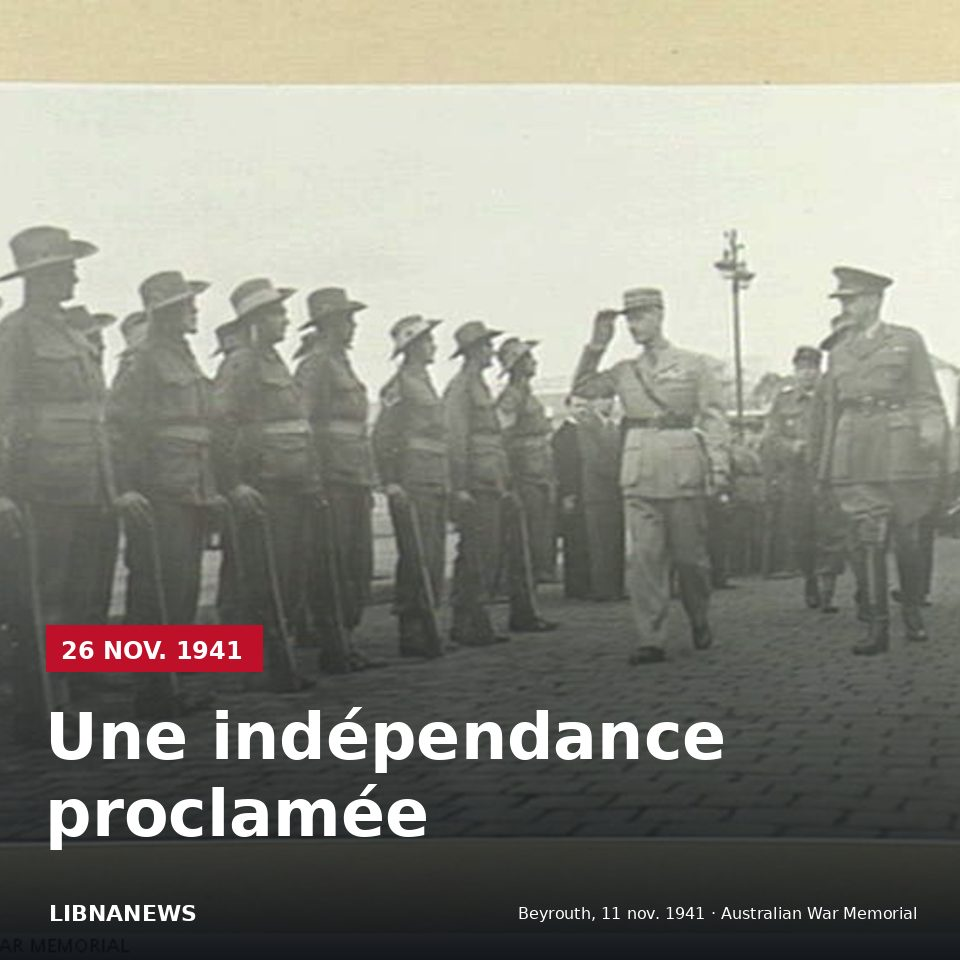
On 26 November 1941, Georges Catroux proclaimed in Beirut the independence of Lebanon on behalf of free France. President Alfred Naccache talks about a first step. The letter sent a few days later by de Gaulle to the Americans specifies the limit of the announcement: the legal status of the mandate does not change.
In Beirut, Naccache awaits a transfer of authority
General Georges Catroux reads the proclamation on the morning of November 26. At 1 p.m., the United States Consul General in Beirut, Cornelius Van H. Engert, reported to Washington. In his telegram, he records the response of Lebanese President Alfred Naccache: the country has just obtained a first manifestation of its sovereignty, but the transfer of all its prerogatives still depends on a treaty.
France then undertakes to guarantee the political unity and territorial integrity of Lebanon. Naccache called on the different regions and communities to participate in the affairs of the State, while war, he said, prevented representative institutions from functioning normally. In this speech, effective independence remains an objective to be achieved, even after the proclamation.
Free France recognizes independence without lifting the mandate
The announcement came after the campaign of summer 1941, during which the British and the Free French Forces took control of the Levant at the expense of Vichy’s forces. Free France entrusted Catroux with the powers previously exercised by the High Commissioner. On 27 September, he proclaimed the independence of Syria. Two months later, he announced Lebanon.
On November 29, de Gaulle set out his position in a letter intended to be brought to the attention of Washington. He affirms that the declared independence must, in fact, be limited to the limits imposed by war. In legal terms, his letter says something else: the act of mandate remains unchanged. According to de Gaulle, any amendment requires the agreement of the Council of the League of Nations, the consent of the United States under their 1924 convention with France, and the conclusion of treaties with the Governments of the Levant.
Washington waits until 1944
On 29 November 1941, the US State Department welcomed the progress towards independence, but reserved its formal recognition. The nuance counts: the US communiqué welcomes the declaration without giving it the value of diplomatic recognition. The French archives also describe, at this stage, a transitional regime of political cooperation.
The constitutional crisis of November 1943 changed the balance of forces. The Lebanese Parliament voted to abolish the mandate provisions. The French authorities arrest President Bechara al-Khoury, the head of government Riad al-Solh and several of their companions. Their release on 22 November becomes the date Lebanon commemorates.
The United States formally recognized Lebanese independence on 8 September 1944, following an exchange of notes with Beirut on existing American rights. On November 16, George Wadsworth presented his credentials. Almost three years separate these two diplomatic gestures from the statement read by Catroux.





Comments