

Temporary burials extend the exile of families in southern Lebanon. In a stand on 6 November 2026, the writer Mustafa Fahs reports a request for land to accommodate their dead. It highlights a documented difficulty for several months: how to bury a loved one when the family village remains inaccessible?
Mustafa Fahs’ request comes from a displaced friend, engaged in the life of his community. This man is looking for a public plot to create a cemetery for families in southern localities. Fahs does not specify his identity or the desired location. Its text does not refer to an administrative decision granting the ground.
This is evidence of a concrete concern. When the return disappears, we must find a place for the deceased. However, some families want to keep their burial in a temporary setting until they transfer to the village cemetery. The place of mourning then depends on the same obstacle as housing: the impossibility of returning.
Temporary burials from Tyre to Choueifat
From Tyre to Choueifat, the testimonies gathered in the spring and summer of 2026 describe families waiting for a transfer. No updated national balance sheet provides information on the number of burials still provisional in November.
In Tyre, a report on 9 April related the burial of Ahmad Saadeh from Kafra. According to the rescuers who had taken care of him, the strikes prevented his burial in his village. Sheikh Rabih Koubayssi explained that he had accomplished the rites in the absence of his family. Stakeholders provided for a transfer when security conditions permitted.
In the same report, Hussein Saleh said he wanted to bring his relatives back to Ramieh. He had lost his pregnant wife, daughter and several family members in a strike in Tyre. The on-site burial responded to the emergency. The wish for a funeral in the village remained.
After burial, families still have to arrange a new transport and bring relatives together. These steps remain suspended from access to the family cemetery.
Families Facing the Same Choice Far from the Front
The problem does not concern only those killed in their village. On 15 April, the brothers Ali and Wael Sabbagh explained to a news agency why they had temporarily buried their mother and brother in Beirut. Both had died in a strike on their building in Tallet al-Khayat. The family wanted to drive them to Nabatiyah, but considered the route too dangerous.
In Wardanieh, Mayor Ali Bayram described another local response in a report published on April 6. Since the war of 2024, the municipality had prepared land for up to 200 deceased. There were 51 temporary burials. Among those buried were also two elderly displaced persons who died of natural causes.
In Haret Saida, graves waiting for a transfer
In Haret Saida, Hassan Saleh, head of burials, described in June a temporary section created during the hostilities begun in 2023. Some families had still not been able to bring their relatives back after the ceasefire of November 2024. The resumption of the war in 2026 had again increased the need.
In an agency report of 11 June, he reported about 120 temporary burials since March. He stated that the deceased included first aid workers and unarmed persons.
Ghada Hussein, from Kfar Tibnit, visited the grave of his son Mohammed Tufayli, a Hezbollah fighter. She said she wanted to take him back to the village, even after a long wait. The same cemetery welcomed civilians.
The second funeral, a new ordeal
This practice is called wadi‘a, which refers to the idea of a trusted repository. A report published on 14 May described reserved areas in existing cemeteries and land used for this purpose. He also reported the case of Itaf Abu Saleh, from Kafra, who died seven decades ago from causes unrelated to the war. His family buried him temporarily in Choueifat.
His parent Youssef explained that the future transfer was an attachment to the place of origin. He recalled, however, that reopening a grave and organizing a new burial revived the loss. Other relatives interviewed in this report described a mourning suspended pending return.
Mustafa Fahs’ request for land puts this expectation at the forefront. For the families concerned, one must find a place in a reception cemetery, while maintaining the hope of a burial in the village.
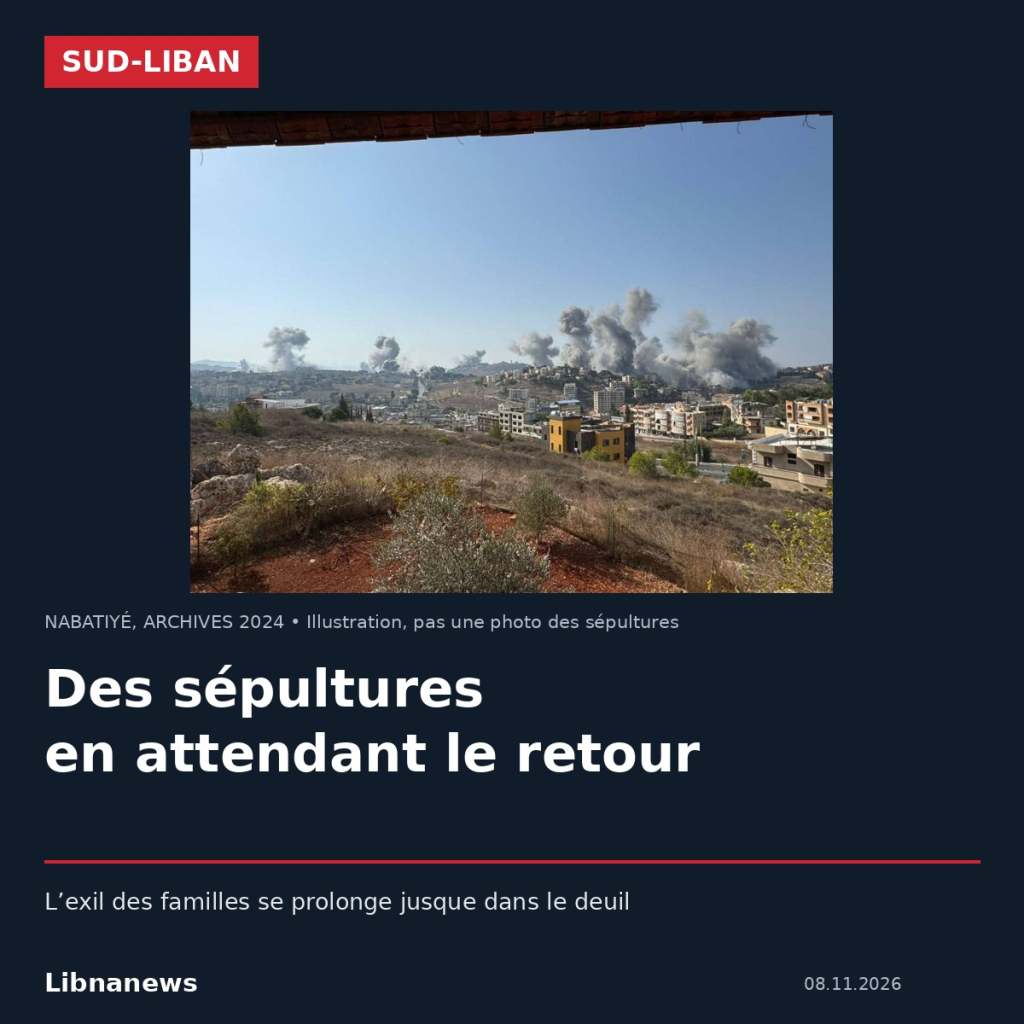
Photo: Libnanews photo. Hits on Nabatiyah, archive published in October 2024. This illustration does not represent the temporary burials or the families mentioned. Whole photograph preserved, assembly Libnanews.





Comments