

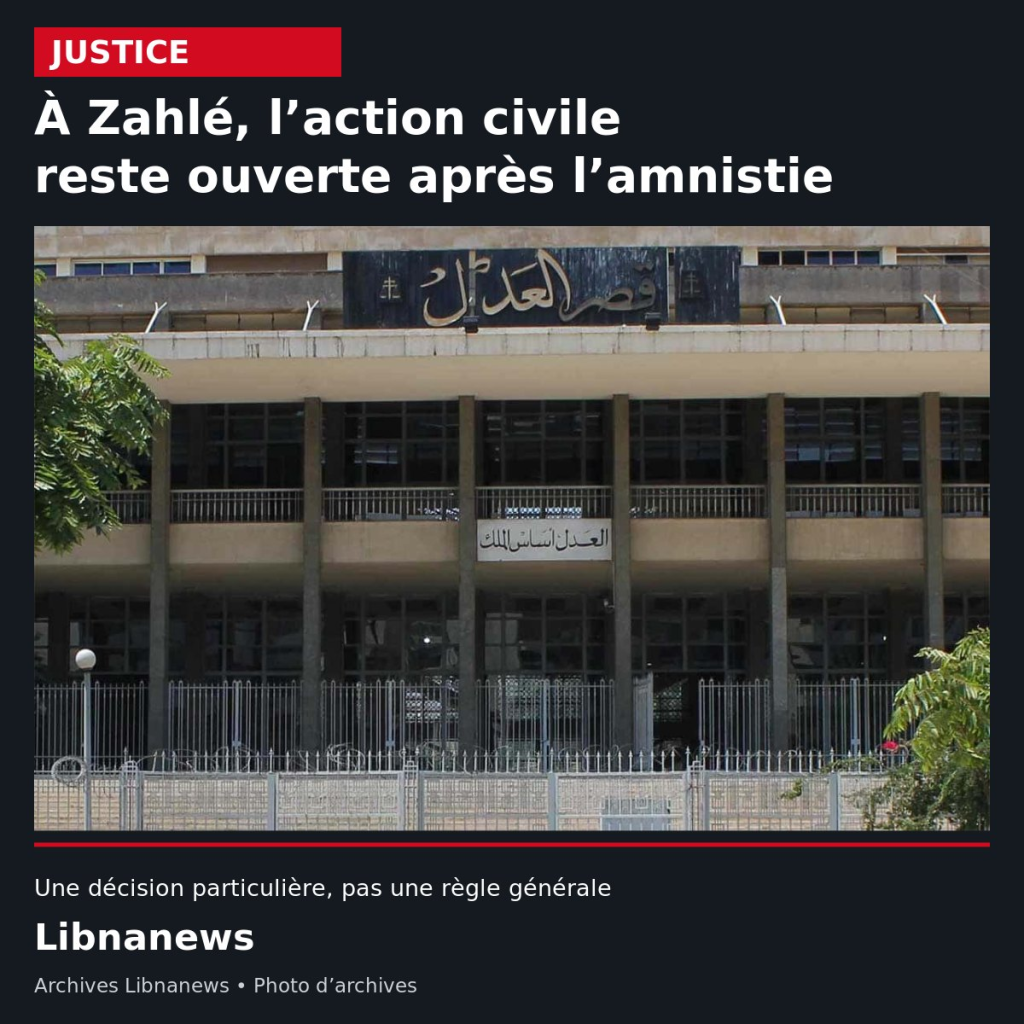
In Zahlé, a false certificate case continues on its civilian side despite the termination of criminal proceedings. The criminal judge Alaa Bachir applied the amnesty to the case before him and then fixed a hearing on 17 December 2026 to continue the examination of the personal action. The operative part of the decision, reproduced in a legal record, explicitly distinguishes these two stages.
Thus, the judgement does not declare a general termination of all the rights involved. He dismissed the public action in this case, but did not grant compensation. Nor does it constitute a decision stating that the facts complained of never existed.
Article 466 case
The case concerned the establishment of a false certificate, an offence covered by article 466 of the Criminal Code. The facts attributed to the accused are prior to March 1, 2026, on the grounds reproduced. This date is part of the reasoning followed to examine the application of the amnesty.
The judge accepts the exception raised by the defence, finds the termination of the public action by virtue of the amnesty law and terminates the corresponding proceedings. This conclusion concerns the file examined. It cannot be inferred that all falsifications, regardless of their date and purpose, would automatically benefit from the same treatment.
The reasoning includes offences excluded from the amnesties. The judge examines the place of forgery with regard to the provisions concerning counterfeiting of currency and infringements of the financial situation of the State. It adopts a reading which does not extend this exclusion to the false certificate in question.
The debate on the reservations of the Constitutional Council
The reasons discuss Constitutional Council decision 12/2026 of 12 October 2026. More specifically, they concern its interpretative reservations: the clarifications which the Council accompanies the recognition of the constitutionality of a text and their effect on its application by the courts.
The position of the Constitutional Council is explicit. In its official decision on Law 70 of 4 September 2026, it states that the exclusion of forgery offences covers all offences provided for in the Criminal Code. He also claims that his interpretative reservations are binding on public, judicial and administrative authorities. The false certificate cannot therefore be presented as benefiting from a general exception recognised by the Commission.
In the reasoning reproduced, Alaa Bachir considers that the application of the general exclusion of forgeries would lead to exceeding the scope desired by the legislator. He elaborates on the reasons why the false certificate may enter the scope of amnesty in this case. This reading departs from the reservation made by the Constitutional Council. It remains that of the judgment studied and does not constitute a general rule for ignoring this reservation.
Nor does the record indicate the outcome of a possible appeal. Without information on this point, the decision should not be presented as definitively confirmed or set aside. Its immediate interest lies in the procedural distinction it makes and in the interpretation debate it sets out.
Civil action continues on 17 December
The second part of the scheme provides for the continuation of personal action. The judge is based on article 10 of the Code of Criminal Procedure, which he recalls that the termination of the public action does not prevent the court seised from continuing to examine the application.
The hearing announced on 17 December 2026 concerns this aspect. It is not presented as a date of payment of a remedy. The accessible elements do not give any award or final decision on the damage claimed.
The distinction answers two different questions. Public prosecution concerns the State’s criminal response. Personal action allows the applicant to have his claims examined in the context of the file. The stop of the first does not automatically produce a favourable or unfavourable decision on the second.
For those affected by other proceedings, this ruling does not therefore offer a general answer based on the word « amnesty ». The classification of the facts, their date, the legal exclusions and the status of each case remain decisive. In Zahlé, the next known stage is the civil examination, after a criminal decision that leaves this issue open.





Comments