

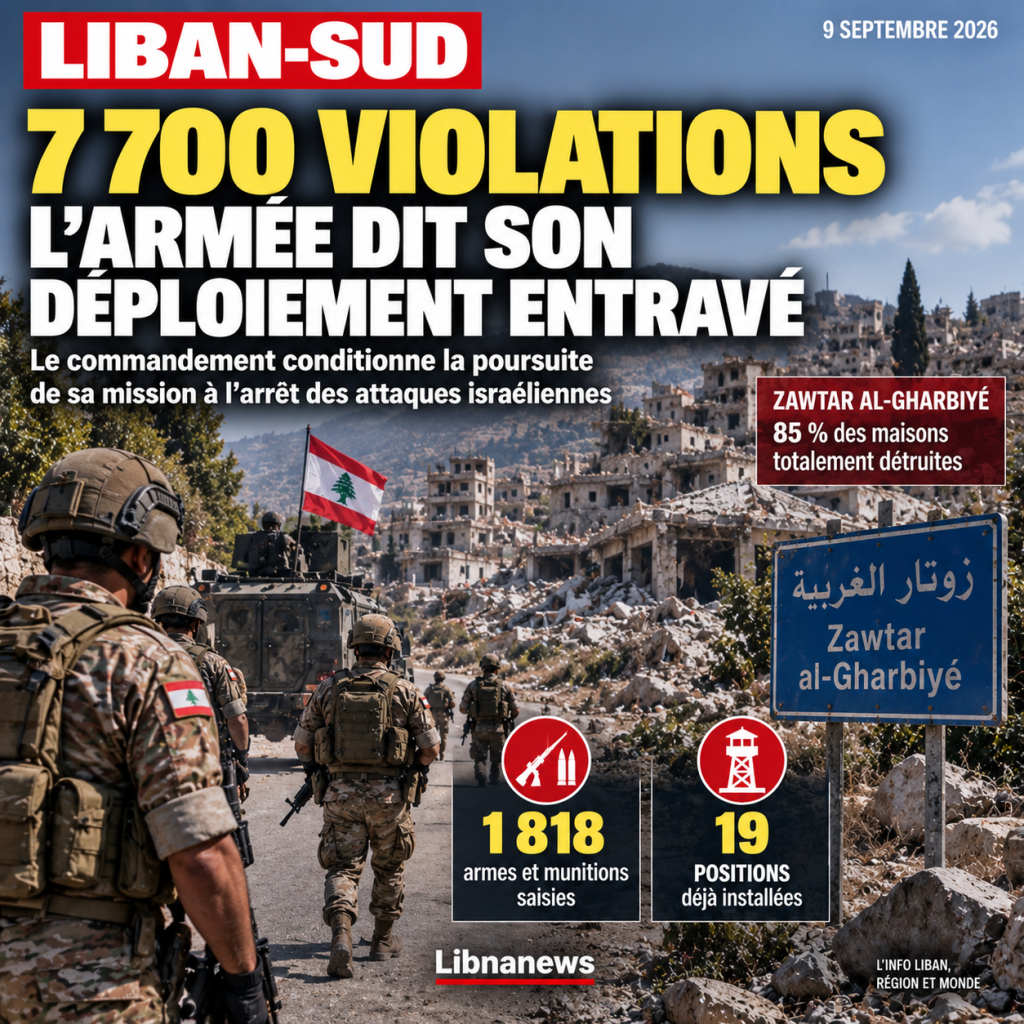
The Lebanese Army claims that the continuation of Israeli attacks and violations is now the main obstacle to the completion of its deployment in southern Lebanon under the framework agreement of 26 June 2026. In a detailed communiqué issued on Wednesday, 9 September, the command indicated that it had identified approximately7,700 israeli violations in less than two and a half monthswhile claiming to have taken operational control of several sectors. The army also announces the seizure of1,818 weapons and ammunitionthe deployment of six fixed dams and thirteen observation posts, as well as permanent patrols. It accuses Israel of jeopardizing these efforts with its strikes, destruction and firing near the Lebanese military.
Army conditions continued deployment upon cessation of attacks
The command’s message is particularly direct. For the Lebanese Armed Forces, the cessation of Israeli attacks and violations is a « essential factor » to enable the units to continue their deployment and to carry out the tasks provided for in the framework agreement.
This statement comes after several days of escalation in the Nabatiyah region. The army refers to a new wave of Israeli attacks on residential areas and public and private institutions, with a high death and injury rate.
The command quotes in particular the attack on Kfar Rummane in Nabatiyah District. At least 12 people were killed there, including women and children, according to the record mentioned by the military institution.
For the army, this sequence is not only a violation of Lebanese sovereignty. It directly threatens the security arrangements on which the mechanism established since 26 June is based.
Some 7,700 violations since 26 June
The most important figure communicated on Wednesday concerns Israeli violations since the signing of the framework agreement. Lebanese Armed Forcesapproximately 7,700 between 26 june and 9 september 2026.
Compared to about 75 days since the signing of the agreement, this balance sheet represents an average of more than100 violations per day. This arithmetic average does not mean that violations are regularly distributed, but it gives a measure of their frequency according to the Lebanese military count.
The release does not provide a complete breakdown of 7,700 incidents by category. Violations may include, inter alia, overflights, shooting, incursions, military operations or other actions considered by Beirut to be contrary to the arrangements reached.
The army specifically mentions Israeli fire near its soldiers and patrols. It believes that these actions directly endanger its military and complicate their movement in areas where they need to strengthen their presence.
The command also accuses Israel of continuing demolition and destruction operations in the South. According to the army, these actions are incompatible with the commitments intended to allow the region to gradually stabilize.
Six dams and thirteen observation posts already installed
In the face of questions about the application of the framework agreement, the army for the first time details the extent of its operations in several pilot areas. It states that it began implementing its plan immediately after the conclusion of the agreement.
Military6 fixed dams and 13 observation postsa total of 19 positions. These facilities are located on and within the roads leading to Zawtar al-Gharbiyah, Frun and Srifa.
The army also reported that it was conducting 24-hour, 24-hour, mobile patrols. The aim is to monitor movements, monitor the sectors concerned and prevent unauthorized armed activities.
The Command believes that these provisions have enabled it to obtain « operational control » of the area concerned. It now claims to be able to control the movement of entry and exit within the operational perimeter.
However, this does not mean that all stages of the agreement have been completed. The army itself states that the parties have not yet reached a full agreement on the different phases concerning the pilot zones and on the next steps.
1,818 weapons and ammunition seized
The press release also provides an exceptionally accurate inventory of material recovered or seized. Specialized army units announce that they have neutralized or confiscatedapproximately 1,818 weapons and ammunitionin the course of their operations.
The balance sheet includes10 rocket launchers, seven rockets and six drones. The army also recovered51 unspecified military translation projectiles, 10 aerial bombs and 1,560 pieces of light ammunition, plus many mines and explosive charges.
| Equipment announced by the army | Quantity |
|---|---|
| Rocket launchers | 10 |
| Roquettes | 7 |
| Drones | 6 |
| Various projectiles mentioned by the army | 51 |
| Air bombs | 10 |
| Light ammunition | 1 560 |
| Other mines and loads | Number not specified |
| Total announced weapons and ammunition | About 1,818 |
The army reported that it had withdrawn weapons and unexploded ordnance and prevented the presence of armed groups or activities not authorized by Lebanese law. This wording concerns the application of State control in the sectors covered by the Agreement.
Houses were also inspected in accordance with Lebanese law and with the agreement of their owners. The command stresses that the inhabitants have cooperated with these operations to eliminate weapons, ammunition and explosive remnants of war.
Twelve kilometres of recirculated roads
Military work is not limited to arms control. Army units claim to have reopened approximately12 kilometres of roads, in order to restore the movements to the localities concerned.
The military is also involved in the removal of rubble and operations allowing the return of residents. The command refers to civilian-military cooperation activities aimed at providing basic needs to the population.
Soldiers also participated in the recovery of bodies of killed persons. These missions take place in villages where destruction sometimes makes access to housing particularly difficult.
The stated objective is twofold: to establish security control and to allow the population to return. However, the figures provided for Zawtar al-Gharbiye show that the presence of the army is not sufficient when the magnitude of the destruction materially prevents families from resettling.
In Zawtar al-Gharbiyé, only 16 per cent of the population is resettled
TheZawtar al-Gharbiyéis one of the most precise examples given by the army. About 70 per cent of the inhabitants managed to return to the locality to see the condition of their homes or to recover their property.
But only16 per cent of the population was able to relocate sustainably. Command estimates this return to about 60 out of 450 families in the community.
This low rate is primarily explained by the extent of destruction. According to the military assessment,85% of houses in Zawtar al-Gharbiyé are completely destroyedand the remaining 15% suffered partial damage.
If these proportions apply to the entire residential park of the locality, virtually no housing would have escaped damage. Reconstruction therefore becomes an indispensable condition for the sustainable return of a large part of the population.
The contrast between the 70% population who can return on time and the 16% who can actually stay also illustrates the difference between a physical return to a village and real normalization. Access to a locality does not mean that it is once again habitable.
The army accuses Israel of causing a new wave of displacement
The army claims that the latest attacks caused further displacements from areas previously considered safe enough to accommodate the inhabitants. These developments call into question efforts to gradually stabilize the villages of the South.
The command goes further by assigning Israel a will to undermine the credibility of the army. According to his statement, the repeated violations would seek to undermine the institution both among the Lebanese population and before the international community.
This charge comes in a context where the Lebanese authorities present the deployment of the army as one of the main instruments of stabilization in the South. Any failure of this mechanism would therefore have political consequences far beyond the sectors concerned.
On the contrary, the army seeks to demonstrate, with supporting figures, that it has begun to carry out the planned tasks. It highlights established posts, patrols, equipment seizures and operations with the population.
The framework agreement still incomplete on its next steps
However, the communiqué contains an important clarification on the actual state of the June 26 agreement. The Army acknowledges that not all stages concerning pilot zones and subsequent phases have yet to be fully agreed.
The Lebanese units have therefore begun implementing their own operational plan in the agreed areas, in coordination with the Lebanese military coordination unit. But the continuation of the scheme remains dependent on further discussions.
This situation makes stopping attacks even more important from the point of view of command. Further security degradation can prevent the military from extending its presence to other sectors and delay the definition of the next steps.
The 9 September communiqué thus seeks to establish a clear equation: the army claims to be ready to assume its obligations, but considers that it cannot complete its mission if Israeli operations continue.
After three days of deadly climbing around Nabatiyah, the next test will therefore concern the ability of the various actors to preserve the accalmie. The Lebanese army believes that the continuation of its deployment now depends directly on the cessation of the strikes, the destruction and the violations it attributes to Israel.




