

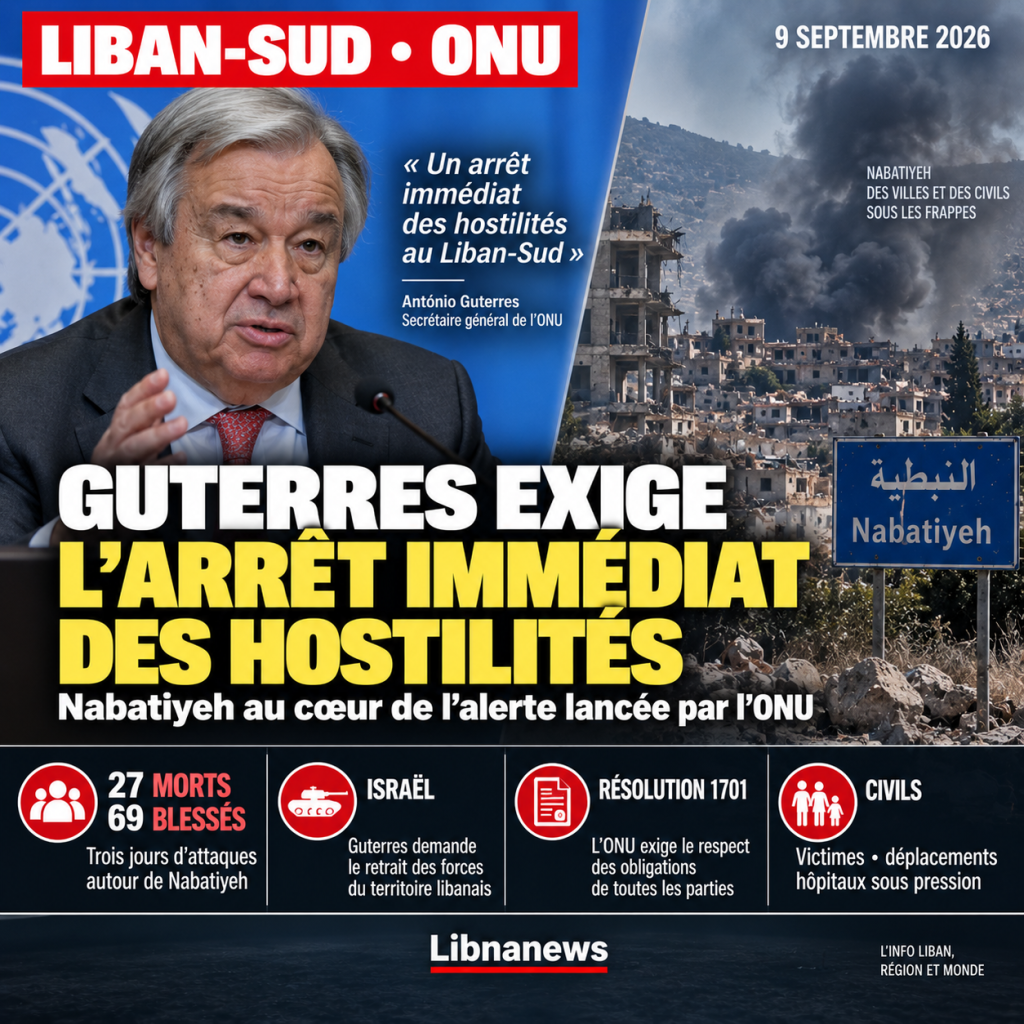
UN Secretary-General António Guterres called for an « immediate cessation of hostilities » in southern Lebanon on Wednesday, 9 September, expressing deep concern over the intensification of Israeli military operations in and around Nabatiyah. He denounced the increase in civilian casualties, displacement caused by evacuation orders and the extent of destruction. The United Nations leader also called on Israel to withdraw its forces from Lebanese territory and called on all parties to respect the sovereignty of Lebanon and Security Council resolution 1701.
Guterres alarmed by climbing in Nabatiyah
UN raises tone after several days of violence in southern Lebanon. António Guterres expressed « a deep concern » about the escalation of Israeli military operations, with particular emphasis on the situation in the Middle EastNabatiyeh and surrounding localities.
His spokesman, Stéphane Dujarric, conveyed this position in a statement. The Secretary-General expressed concern about the increase in civilian casualties caused by the attacks and their direct consequences for the population.
Guterres pointed out that women and children were among those killed or injured. He also denounced the suffering and displacement caused by evacuation orders addressed to the inhabitants of several sectors.
The proliferation of these orders leads to the departure of families who had sometimes already been displaced in previous phases of the conflict. To this pressure is added the destruction observed in the bombed areas, especially around Nabatiyah.
The Secretary-General’s intervention takes place in a particularly tense context. Three days of Israeli attacks in the Nabatiyah area resulted in 27 deaths and 69 injuries, according to reports in Lebanon.
Civilian victims at the UN call centre
António Guterres places the protection of civilians at the heart of his intervention. It condemns the increase in the number of victims among the inhabitants of the South and recalls that the parties to the conflict remain subject to the obligations of international law.
For the Secretary-General, the military nature of the clashes does not exempt any party from taking the necessary precautions to protect the population. International humanitarian law requires, inter alia, a distinction between military objectives and civilian persons or infrastructures.
This requirement applies to housing, schools, health facilities and public services. Guterres believes that attacks directly targeting civilians or civilian property cannot be accepted.
The United Nations official does not limit his concern to the victims immediately caused by the bombings. He also mentioned the consequences of evacuations, which forced entire populations to leave their homes under often difficult conditions.
These movements occur while several southern localities have already experienced significant destruction. Some families find themselves forced to seek accommodation away from their village again.
UN concerned about attacks on hospitals
The press release places great emphasis on the health situation. António Guterres expressed « deep concern » about reports of Israeli strikes against hospitals and health workers.
He also mentioned attacks on public institutions. These incidents raise particular concerns as military operations move closer to the infrastructure necessary for the daily operation of cities and villages.
The protection of medical institutions is a central obligation of international humanitarian law. Hospitals and health workers are given special protection, even in areas where military operations are ongoing.
Guterres also denounced restrictions on access to humanitarian aid. When roads become dangerous or impassable, medical and humanitarian teams find it more difficult to reach the injured or displaced.
In a region where population movements are increasing, access to care, water, food and shelter is rapidly becoming a major issue. The United Nations is concerned that the continuation of attacks further exacerbates these needs.
» Attacks on civilians cannot be accepted »
The Secretary-General called on all parties to respect their international obligations. He specifically recalled the rules of international humanitarian law relating to the protection of civilians and civilian property.
This formulation is aimed at all actors involved in hostilities. The United Nations insists that the protection of populations must be guaranteed at all times, regardless of military circumstances.
Guterres was adamant about attacks directly directed against civilians. According to the position expressed by his spokesman, such operations cannot be considered acceptable.
This appeal comes as the Lebanese authorities themselves seek to stabilize the Nabatiyah area. President Joseph Aoun, Speaker Nabih Berri and Prime Minister Nawaf Salam have conducted several contacts to curb the escalation.
These efforts have been accompanied by Arab and international efforts. A relative lull has been reported, but the continued presence of military operations maintains a high risk of renewed fighting.
Guterres calls for an immediate cessation of hostilities
The Secretary-General’s main political message is not just to call for a reduction in the intensity of operations. António Guterres explicitly demandsan immediate cessation of hostilities in southern Lebanon.
This demand comes as the situation in Nabatiyah remains fragile. The Lebanese authorities are trying to transform the lull achieved by diplomatic contacts into more lasting stabilization on the ground.
In particular, the Lebanese Army has intensified its patrols in the city. The purpose of this presence is to reassure the population and strengthen State control in an area that has just experienced several days of strikes.
The Guterres appeal provides additional international support to Beirut’s efforts to bring an end to the attacks. However, the Secretary-General did not limit himself to calling for the end of ongoing operations.
He also raised the issue of the Israeli military presence on Lebanese territory. This request places the events in Nabatiyeh within the broader framework of the obligations under the international instruments applicable to Lebanon.
Israel called to withdraw its forces from Lebanon
António Guterres asked Israel towithdraw its forces from lebanese territory. The appeal is made in parallel with his request for cessation of hostilities.
The Secretary-General thus insists on respect for the sovereignty and territorial integrity of Lebanon. For the United Nations, these principles remain at the heart of any lasting settlement of the conflict along the border.
Beirut regularly calls for Israeli withdrawal from Lebanese areas where Israeli forces remain. The Lebanese authorities consider this presence a violation of national sovereignty.
The issue complicates efforts to stabilize the South sustainably. It also maintains a political and military confrontation with Israel, while the Lebanese Government is also seeking to strengthen the role of the army in the region.
Guterres therefore asks that the return to calm is not only based on a temporary cessation of strikes. He called for the application of an international framework to reduce the causes of confrontation in a sustainable manner.
Resolution 1701 moves to the centre of requirements
The Secretary-General asked all parties to fulfil their obligations under thesecurity Council resolution 1701adopted in 2006 at the end of the war between Israel and Hezbollah.
This resolution remains the main international framework for security in southern Lebanon. It includes respect for Lebanese sovereignty and the deployment of the Lebanese army in the South alongside the United Nations Interim Force in Lebanon.
It also provides for an area between the Litani and the Blue Line where no armed forces other than those of the Lebanese State and UNIFIL are to be present. However, its full implementation remains at the centre of persistent differences between the various actors.
By explicitly recalling resolution 1701, Guterres seeks to place de-escalation within a framework already approved by the Security Council. The aim is to avoid temporary arrangements replacing a more lasting institutional solution.
The current strengthening of the Lebanese army’s presence in Nabatiyah takes on additional importance in this context. Beirut seeks to demonstrate its ability to intervene directly in the stabilization of the South.
UN promises to maintain its commitment in South Lebanon
António Guterres finally assured that the United Nations would remain engaged in efforts to end the violence. The organization also wants to continue its efforts to protect civilians.
The United Nations intends to support efforts towards a lasting solution to the conflict. This involvement includes political action by the Secretary-General and the presence of UNIFIL in southern Lebanon.
The immediate priority, however, remains the cessation of the military sequence that hit Nabatiyah and its surroundings hard. Events of the past few days have shown that a sudden resumption of operations could quickly lead to a heavy civilian record.
The appeal made by Guterres on Wednesday comes as the Lebanese authorities seek to consolidate the lull obtained after their diplomatic contacts. The ability of the various parties to respect this de-escalation and the evolution of Israeli operations around Nabatiyah will now determine whether the cessation of hostilities called for by the United Nations can take shape.




