

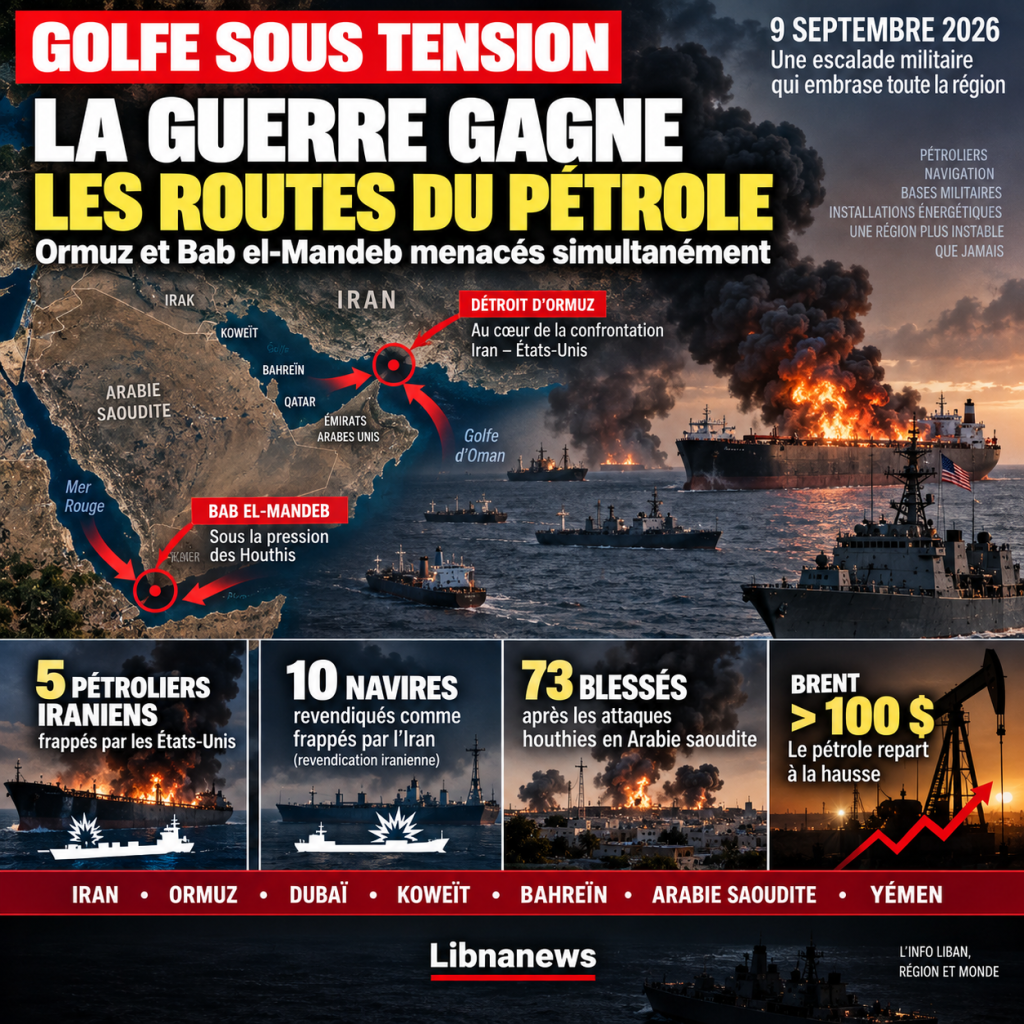
Since 8 September, the Gulf has experienced a sharp rise in tensions that combines direct clashes between the United States and Iran, attacks on oil tankers, incidents off the United Arab Emirates and a Huthie offensive against several cities in Saudi Arabia. During the night of Tuesday to Wednesday, merchant ships were hit in the northern Gulf and the Gulf of Oman, while Tehran claimed to have hit American vessels and several tankers. Washington had a few hours earlier destroyed five Iranian tankers. This sequence, the most important on the sea in several months, now threatens simultaneously the Strait of Ormuz, Saudi energy installations and navigation around Bab al-Mandeb.
Five Iranian oil tankers hit by the United States
The main change in recent hours is the scale of US operations against the Iranian oil fleet. On Tuesday, 8 September, the United States Central Command announced that it had destroyed five Iranian oil tankers in the Gulf of Oman and near Kharg Island, Iran’s main oil export centre.
The vessels concerned were identified as theKivik, Charminar, Horizon 1, Riesco and Derya. According to Washington, their crews were ordered to abandon the vessels before the strikes. The US authorities have not announced any casualties among the sailors.
One tanker was hit near Jask on the Iranian coast of the Gulf of Oman. Another was struck about four nautical miles from Kharg Island. Images broadcast by the US Army show at least one ship on fire and heavily damaged.
Washington presents these attacks as a response to two Iranian attempts against an American war building in the previous two days. The Revolutionary Guards reportedly used ballistic missiles. The U.S. ship reportedly avoided the projectiles and no U.S. military was reportedly injured.
This strategy marks a significant extension of retaliation. The United States is no longer hitting only Iranian military infrastructure. They now directly target ships carrying oil, a resource essential to the financing of the Iranian state.
Iran claims to have attacked ten ships
The Iranian response came quickly. On Wednesday 9 September, the Revolutionary Guards claimed to have strucktwo american buildings and eight tankersin the Gulf and around the Strait of Ormuz.
Tehran asserts that these vessels had attempted to enter an area which it considers « prohibited and dangerous ». Iran claims to maintain close monitoring of the Strait and believes that it can decide the conditions for passage in certain areas.
However, the exact reality of the damage remains difficult to establish. The United States has challenged certain Iranian claims concerning American warships. Several information on attacks on oil tankers has not yet been independently verified.
A British maritime safety agency confirmed on Wednesday thatseveral merchant ships had been hit by heavy enough fire to immobilize themin the northern Gulf and the Gulf of Oman. No human or environmental assessment was still available at the time of writing.
This is an important element, as it confirms that exchanges of fire no longer concern only conflicting military announcements. Commercial ships have indeed suffered damage in the middle of military activity.
A ship hit near Dubai
Another incident was reported on Wednesday off the United Arab Emirates. A mooring building was seen with a strong inclination about24 nautical miles northwest of Port RashidDubai.
According to the initial information provided to the UK maritime authorities, the vessel may have been hit by a projectile. The observed inclination suggests an inlet of water on board.
The identity of the building had not yet been made public in the first available information. Nor was it possible to immediately determine the origin of the projectile or to formally link the attack to the operations claimed by Iran.
However, the incident is particularly sensitive by its location. Port Rashid is in the immediate vicinity of Dubai, one of the main port and commercial centers of the Gulf. A multiplication of attacks in the area would pose a direct risk on maritime routes serving the United Arab Emirates.
For Abu Dhabi, therefore, the danger no longer lies solely in the partial closure of Ormuz. It now concerns military incidents that may occur much closer to the Emirati ports.
Kuwait and Bahrain under direct threat
The confrontation also drew closer to Kuwait and Bahrain. On Wednesday, the Revolutionary Guards sent an explicit threat to oil tanker crews near the ports of these two countries.
Tehran asked them to leave their ships immediately, whether at anchor or dock. Iran warned that these buildings could be targeted.
The justification put forward by Iranian officials is the American military presence in the Gulf. Bahrain hosts the headquarters of the Fifth United States Fleet, while Kuwait hosts forces and facilities used by Washington.
No major attacks on Kuwaiti or Bahraini ports had yet been confirmed on Wednesday at the time of writing. However, the threat affects the level of risk to vessels in these waters.
It also poses an immediate economic problem. A crew abandoning an oil tanker at anchor makes it impossible to load or leave. Even without a strike, a credible threat can disrupt exports.
Ormuz becomes again the main point of tension
The Strait of Ormuz is at the centre of this new phase of the conflict. Prior to the war, about a fifth of the world’s oil and liquefied natural gas was consumed by this passage of a few tens of kilometres between Iran and Oman.
Traffic has been greatly reduced since the beginning of the confrontation. Tuesday, onlysix vessels carrying raw materialscrossed the strait, against nine the day before. The average of the previous 10 days was around 12 passes per day for this category of buildings.
Prior to the crisis, approximately 125 commercial vessels of various types could travel through the area on a daily basis. The comparison shows the extent of the change, although some current statistics are difficult to interpret due to vessels cutting off their location systems.
Data on oil volumes have also become very uncertain. Some estimates now place daily flows between about 4 and 9 million barrels, while they could exceed 20 million barrels before the war.
This decline leads to a profound change in energy trade. Gulf producers are trying to make more use of the oil pipelines to bypass Ormuz, but their capacity is still limited in comparison to the volumes normally exported by sea.
Iran captures US submarine drone
The maritime arm has also taken on a technological dimension. On Tuesday, September 8, Iran announced that it had recovered an American submarine drone at the entrance to the Strait of Ormuz.
The equipment was identified as a stand-alone device of typeDive-LD. This unmanned underwater vehicle can be used for seabed mapping, monitoring or mine-related operations.
Tehran presented the recovery of the drone as an intelligence operation. Washington admitted to having lost the aircraft, but claims that it was an old, failed model.
US officials ensure that the drone did not carry secret data or sensitive classified equipment. The aircraft was, according to them, out of service for more than a day when it was recovered.
The incident nevertheless shows the intensity of the current underwater operations around Ormuz. Naval mines are one of the main concerns for U.S. forces and shipowners who continue to use the Strait.
Saudi Arabia hit in four cities
As tension rises east of the Arabian Peninsula, Saudi Arabia faces a major offensive from Yemen. On Tuesday 8 September, the Houthis launched a wave of drones and missiles againstAbha, Khamis Mushait, Jazan and Najranin the south of the kingdom.
The report of the coalition led by Riyadh states that73 injured, including women and children. The attacks affected civilian, military and energy infrastructure.
The Houthis claim to have targeted an air base in Khamis Mushait as well as several facilities related to the Saudi Aramco oil group. Infrastructures in Abha, Najran and Jazan were among the claimed objectives.
Fires broke out at several sites. The Saudi authorities acknowledged that some energy facilities had had to temporarily discontinue their activities during the firefighting and damage assessment operations.
This is one of the largest attacks on Saudi territory since the outbreak of the regional war in February.
Jazan refinery particularly exposed
Jazan is a particularly sensitive objective. The city houses an important Saudi Aramco refinery as well as strategic port and electrical facilities on the Red Sea.
The refinery is designed to process up to400,000 barrels of oil per day. Significant fires were reported after the Huthi attacks, and some operations were reportedly interrupted.
This infrastructure enables Saudi Arabia to produce gasoline, very low-sulphur diesel and other refined products. It also plays a role in supplying the internal market.
The importance of Jazan has increased further since the disturbances of Ormuz. The kingdom uses its western infrastructure and the Red Sea to reduce its dependence on exports through the Gulf.
By striking Jazan, the Houthis are therefore aiming precisely at one of the routes used by Riyadh to circumvent the difficulties in the Strait of Ormuz.
Khamis Mushait placed on alert
Khamis Mushait was also placed on alert after the attacks. The city hosts an important Saudi air base used by Kingdom forces.
The civil defence lifted the alarm on Wednesday, one day after the strikes. The authorities did not specify whether this measure met a new specific threat or merely constituted a precautionary measure.
The Houthis claim to have targeted Khamis Mushait air base with missiles and drones. The extent of any damage has not been made public.
The Saudi coalition called the attacks « dangerous escalation ». She announced that she would take the necessary measures to prevent further operations against the territory of the kingdom.
The conflict in Yemen also goes away
The attacks against Saudi Arabia are part of a much wider resumption of fighting in Yemen. After several years of relative calm since the truce negotiated in 2022, clashes have intensified in recent weeks.
Yemeni forces supported by Riyadh launched several offensives against Houthis-held areas. They have also tried to make progress in some areas.
The Arab coalition has resumed airstrikes in Huthi positions. The rebels said on Wednesday that32 strikestargeted four Yemeni provinces.
Jawf Province has been bombed several times. The Houthis-controlled authorities claim that more than 20 people have been killed there in the last two days, but this has not been confirmed independently.
A prison in the al-Hazm area was also hit. The balance sheet announced on Wednesday reported that23 deadwith several persons still missing.
This resumption of ground and air operations increases the risk of a return to an open war between Saudi Arabia and the Houthis.
Bab el-Mandeb becomes the second maritime lock
The crisis thus affects both ends of the Arabian peninsula. In the east, Ormuz is subjected to confrontation between Iran and the United States. To the west, the Houthis threatened navigation in the Red Sea and around Bab al-Mandeb.
The Yemeni movement announced in July a maritime blockade against Saudi Arabia. Since then, several ships associated with the kingdom have been targeted in the Red Sea.
Tuesday, about25 vesselscrossed Bab al-Mandeb, compared to an average of about 27 in the previous 10 days. As a result, traffic remains less disturbed than in Ormuz, but the level of risk increases rapidly.
Bab al-Mandeb is the southern access to the Red Sea and the Suez Canal. A lasting disruption of this route would force more ships to bypass Africa through the Cape of Good Hope, extending the routes between Asia and Europe.
The simultaneous threat to Ormuz and Bab al-Mandeb is the most worrying scenario for world trade. Both passages provide a considerable share of oil and freight flows between Asia, the Middle East and Europe.
Oil goes over $100
Markets reacted immediately. On Wednesday, Brent’s barrel crossed the bar$100, a level he had not reached since july.
The increase comes after several weeks during which markets began to integrate a relative lull between Washington and Tehran. The new attacks have suddenly put the risk of a prolonged disruption of supplies to the market.
The Brent has grown by more than 60% since the beginning of the year. Several international banks have revised their forecasts upwards, believing that risks remain oriented towards higher prices.
The problem is not just the amount of oil currently available. Insurers apply higher risk premiums to vessels wishing to enter exposed areas.
The cost of freight is also increasing. Companies must pay more crews, change roads or immobilize some vessels when the level of threat becomes too high.
The United Arab Emirates, Qatar and Gulf markets under pressure
The regional financial centres reflect this uncertainty without, however, experiencing widespread panic. On Wednesday, the main Gulf indices were changing in contrast.
Dubai’s stock exchange fell by around 0.5%, while Abu Dhabi’s stock exchange grew slightly. The Qatari market fell slightly and the Saudi index remained close to balance.
This relative resistance must not mask the magnitude of the risks. The economies of the Emirates, Qatar, Saudi Arabia, Kuwait and Bahrain are highly dependent on the security of regional sea routes.
Qatar is particularly exposed to Ormuz for its liquefied natural gas exports. The Emirates has an oil pipeline to transport part of its oil to Foujeirah, in the Gulf of Oman, but this does not protect all of its shipping.
Saudi Arabia owns an East-West pipeline linking the oil fields of the eastern part of the kingdom to the Red Sea. However, the Huthies attacks on Jazan show that this alternative is also vulnerable.
An escalation now spread over several fronts
The peculiarity of the events of 8 and 9 September lies in their simultaneous nature. This is no longer an isolated incident in the Strait of Ormuz or a one-time attack on a Saudi facility.
The United States hit Iranian oil tankers. Iran claims attacks on American vessels and commercial vessels. Merchant vessels were indeed damaged in the Gulf and Gulf of Oman.
Another building was reportedly hit near Dubai. Kuwait and Bahrain face explicit threats against ships in their ports.
At the same time, the Houthis hit Saudi Arabia with drones and missiles. Riyadh responds to Yemen, where ground fighting and air strikes resume.
The region therefore faces two main lines of confrontation:Iran–United States around Ormuz, andHouthis – Saudi Arabia around Yemen and the Red Sea. Both fronts are politically and militarily linked, but they have their own dynamics.
The immediate challenge will be whether Iran’s threats against oil tankers in Kuwait and Bahrain result in further attacks. Maritime authorities are also monitoring the affected vessel off Dubai and vessels detained in the Gulf, while traffic in Ormuz remains significantly below pre-conflict levels.




