

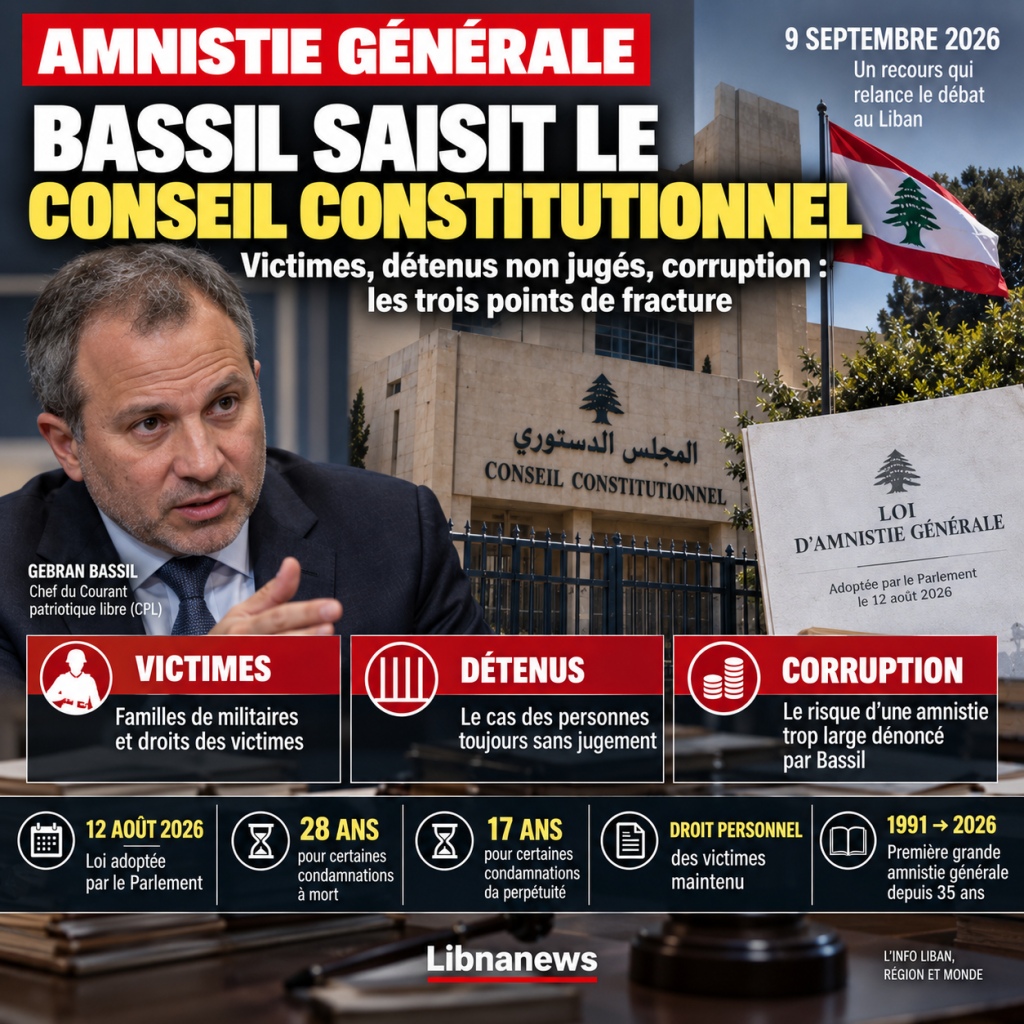
The Free Patriotic Movement (CPL) appealed to the Constitutional Council on Wednesday 9 September against the general amnesty law adopted by Parliament on 12 August. His leader, MP Gebran Bassil, said that the remedy was based on three concerns: justice due to victims, especially the military and families of killed persons, the fate of Islamist detainees who had not yet been tried, and the risk that a mechanism presented as a humanitarian response would ultimately serve to erase responsibility in corruption cases. This challenge gives the centre a text that has for months divided the families of military personnel, Sunni elected officials, defenders of the rights of detainees and several political blocs.
Bassil contests the perimeter of the general amnesty
The appeal was filed directly with the Constitutional Council. Gebran Bassil explained that his block did not in principle reject the idea of an amnesty, but that he challenged the way in which Parliament had transformed a targeted demand into a much wider one.
The president of the CPL argues that the initial objective should be to resolve the situation of a limited number of detainees, including Islamists, who remained in prison for years without final trial. According to him, this issue does not justify extending the erasure or reduction of sentences to categories of crimes that are unrelated to the problem of prolonged detention.
Basil states that his appeal is based on three « concerns »: justice, victims and untried Islamist detainees. It ensures that a solution can be found to correct judicial injustices without turning amnesty into an instrument of impunity.
Military families at the heart of the first controversy
The first point of friction concerns victims of armed violence and their families. The case is particularly sensitive for the relatives of soldiers and members of the security forces killed in clashes with Islamist groups, especially during the years of confrontation with jihadist organizations.
These families have repeatedly protested against successive versions of the project. They fear that persons convicted of attacks on the army, murder or participation in armed groups may benefit from reductions in sentences that they consider incompatible with the seriousness of the incident.
This concern has affected parliamentary debates in the spring. Joint commissions had sought to exclude crimes of murder and terrorist attacks against civilians or military personnel from amnesty. They had also stressed the maintenance of « personal law », i.e. the right of victims or their families to pursue their civil claims and compensation.
But the controversy does not disappear with this guarantee. A reduction in the criminal penalty can be experienced by families as a partial erasure of the sanction, even if their personal rights remain legally intact.
Basil stressed this point by stating that the defence of the army was a national and non-community duty. He rejected the accusations that the opposition to the text was aimed at a specific community, stressing that many soldiers who fell into the fighting were themselves Sunni.
This remark refers to one of the most explosive dimensions of the file. The debate has sometimes been presented as a confrontation between the defenders of the army and representatives of the Sunni community, several of whom have long held the issue of Islamist detainees.
On the contrary, the CPL seeks to separate the two subjects. For Basil, defending the rights of killed or injured soldiers should not be interpreted as hostility towards Sunni detainees who have not been tried.
Who are the « Islamic detainees » concerned?
The second core of the controversy concerns precisely « Islamic detainees », an expression that covers very different judicial situations. Some have been convicted of serious acts related to armed groups, jihadist organizations or attacks on security forces.
Others have spent long periods in pretrial detention without a final judgement. This category has for years been one of the main arguments put forward by families and Members in favour of amnesty.
This is the second category Bassil claims to want to deal with. He said that he was looking for a correction of the text so that the measure would really benefit those who had suffered abnormally long detention without trial, rather than those convicted of crimes unrelated to this procedural injustice.
The Sunni elected officials who submitted the case also present the amnesty as a response to a failure of the judicial system. In discussions with the Speaker of Parliament, Nabih Berri, several MPs denounced the slow pace of proceedings and the existence of thousands of unconvicted prisoners in Lebanese prisons.
They also stressed that Islamist detainees represent only part of this problem. The issue of excessive pre-trial detention has a wider impact on the functioning of criminal justice and prison overcrowding.
This is one of the few areas in agreement between the opposing camps. The CPL acknowledges that a person cannot remain indefinitely imprisoned because the justice system has failed to judge him within a reasonable time.
The promoters of the amnesty, on the other hand, argue that the delays in the courts and the state of the prisons impose an exceptional measure. They consider that waiting for a comprehensive reform of the judicial system would be a further extension of the detention of persons who have never obtained a final judgement.
The same law for very different situations
Disagreement therefore focuses on the remedy. Basil believes that a judicial malfunction must be corrected by the courts and by targeted provisions, not by a law sufficiently broad to change the situation of persons already convicted of serious crimes.
This criticism helps to understand why the law has been so difficult to develop. Parliamentarians tried to bring together in the same text a number of problems that were not legally identical: untried prisoners, long-term prisoners, prison overcrowding and some historical political issues.
The risk is then to give one category of measure thought to another. This is precisely what the CPL claims to want to prevent by its appeal to the Constitutional Council.
Basil also blamed politicians who had held government office or led the Ministry of Justice for not having resolved the issue of untried prisoners earlier. According to him, a failure accumulated for years cannot justify an uncontrolled extension of the amnesty.
The debate on sentences of 28 and 17 years
The law passed on 12 August is not limited to a simple amnesty. It also provides for an exceptional reduction of certain sentences, which explains some of the controversy over its beneficiaries.
During the work of the joint committees in May, Parliament’s Vice-President Elias Bou Saab indicated that parliamentarians had retained a period of28 years of detentionfor those sentenced to death. For persons sentenced to life imprisonment, the duration referred to was17 years of detention.
These figures were obtained after several negotiating sessions. The commissions had consulted, inter alia, the Ministries of Justice, Defence and the Interior, as well as representatives of the army and prison services.
The scheme had also led to a debate on the confusion or merger of sentences when several convictions were imposed on the same person. According to the explanations given at the conclusion of the work of the commissions, this mechanism should be limited to cases involving three or less crimes.
These provisions show why the debate cannot be summed up by the expression « liberation of Islamist detainees ». Depending on the judicial record of each detainee, the law may have different effects on the length of detention or the execution of sentences.
The « personal right » of victims remains preserved
The advocates of the text emphasize another element: the maintenance of the personal rights of victims. An amnesty or reduction of the criminal penalty does not automatically erase civil claims made by injured persons or their families.
This guarantee was one of the main compromises in Parliament. In particular, it had to address the concerns of the families of killed soldiers, as well as victims of murder, assault or other serious crimes.
For the families concerned, however, this distinction remains insufficient. The right to financial or civil compensation does not, in their view, replace the execution of the criminal sentence imposed on the perpetrator.
The debate therefore contrasts two conceptions of justice. The legislator may consider that an exceptionally reduced penalty remains compatible with the maintenance of the victim’s rights, while families may consider that this reduction infringes the penalty itself.
Corruption, third angle of Basil’s remedy
The third point raised by Gebran Bassil is politically different: corruption. The head of the CPL accuses the text of having slid from an answer to the question of detainees and overcrowding to an amnesty which, according to him, could benefit perpetrators of financial crimes or corruption.
He claims that his block accepted the principle of a limited measure. According to his version, the problem arose when this « determined situation » was used to broaden the categories that could benefit from the scheme.
Basil accuses some officials of using the sensitive issue of Islamist detainees to pass provisions that would allow others to escape their responsibility. He presents his appeal as a defence to the Lebanese who refuse to create a new form of impunity through amnesty.
However, this aspect must be distinguished from a judicial decision already acquired. The CPL’s appeal is, at this stage, a political and constitutional argument presented to the Constitutional Council.
Constitutional judges will have to examine the contested provisions and their exact scope. Consequently, filing the appeal does not mean that the Council has already established that the law effectively protects all financial offences reported by Basil.
Why the issue of corruption is particularly sensitive
The controversy takes on a particular dimension in a country marked by financial collapse since 2019. A large part of the population has been calling for the identification of political, banking and administrative responsibilities that have contributed to the crisis for several years.
In this context, any measure that may extinguish prosecution for corruption, embezzlement of public funds, illicit enrichment or financial crimes becomes highly sensitive. Opponents of an overly broad amnesty fear that a prison provision will produce effects far beyond the prison population.
This concern is a historical precedent. Lebanon has already used amnesty as an instrument for political settlement after the civil war, with lasting consequences on the issue of accountability.
First major amnesty since 1991
The text adopted in August is the first general amnesty law since 1991. The latter had erased much of the political and military crimes committed during the civil war from 1975 to 1990.
The 1991 Act remains controversial more than three decades after its adoption. Its critics consider that it has prevented the establishment of responsibilities for many crimes and helped to establish a culture of impunity.
However, defenders of the 2026 amnesty claim that the comparison has its limits. The current text focuses on a prison and judicial crisis, while the 1991 one sought to legally end fifteen years of civil war.
This difference does not eliminate political risk. Each enlargement of the amnesties raises the question of how far Parliament can go to resolve a crisis without prejudice to the rights of victims.
A parliamentary adoption already very conflictual
Parliament finally passed the law on 11 and 12 August. The meeting had been particularly tense, particularly around the position of the army and the Minister of Defence, Michel Menassa.
The CPL and Hezbollah had left the meeting after a controversy related to the fact that the Minister of Defence had not been able to present the intervention he wished to devote to the project. Among other things, he wanted to raise concerns about the military institution and the victims of armed groups.
The episode immediately took on a community dimension. Some officials were concerned that an intervention by the army might be interpreted as a position taken by the institution against a demand made largely by Sunni politicians.
Bassil repeats this argument precisely today to refute it. He claims that defending the military and their families is not a hostile position to Sunnis, especially since many soldiers who were victims of armed groups themselves belonged to that community.
Constitutional Council now at the centre of the file
The appeal now moves Parliament’s debate to the Constitutional Council. The latter will have to examine the arguments presented by the « strong Lebanon » bloc and check whether the contested provisions comply with the Constitution.
One of the issues will be how the categories of beneficiaries have been defined. In particular, judges will have to assess whether the differences in treatment provided for in the law are based on criteria sufficiently objective and compatible with the principle of equality.
The Council may also consider arguments concerning Parliament’s powers. Basil argues that a lack of judicial power does not allow the legislator to circumvent constitutional rules by adopting an overly general system.
The case thus presents several difficult requirements to reconcile. Lebanon must respond to excessive pre-trial detention and judicial delays, while protecting the rights of victims and avoiding that an exceptional measure does not benefit from crimes that are outside its original objective.
The concrete fate of the law now depends on the review of the Constitutional Council. Its decision will determine whether the text voted on 12 August can be fully implemented in its current form or whether it will be affected by certain contested provisions.




