

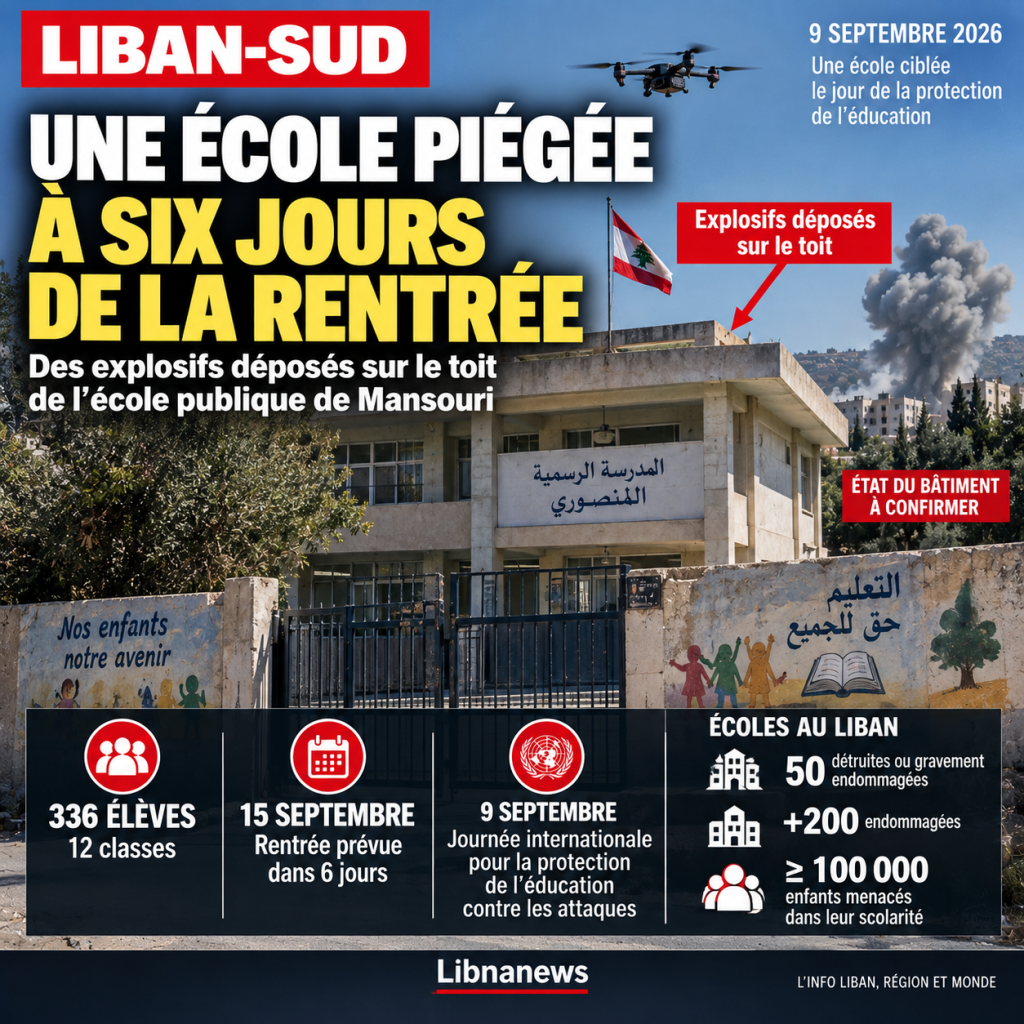
The Mansouri public school in the South Lebanon district of Tyre is directly threatened after a new Israeli operation on Wednesday 9 September. A small Israeli telepilot aircraft dropped explosive materials on the building’s roof, according to several Lebanese media, before a large explosion was reported nearby. The incident occurred a few days from the school year scheduled for 15 September and in a town that had been subject to evacuations, strikes and destruction for several weeks. This mixed school had 336 students according to data from the Centre for Educational Research and Development (CRDP).
Explosives at Mansouri Public School
The alert occurred in the morning of Wednesday. A number of Lebanese media reported that a small Israeli remotely piloted aircraft had deposited explosive materials directly on the roof of Mansuri’s intermediate public school. Images of the operation also circulated.
The initial reports presented this operation as a preparation for the destruction of the establishment. However, this intention was not formally confirmed by the Israeli army in the information available at the time of writing. It is therefore appropriate to distinguish the observed fact — the deposit of explosive materials on the building — from the interpretation that the building would announce its demolition.
Shortly thereafter, a major explosion was reported near the school. The initial information available did not yet allow for a precise determination of the extent of damage to the building or confirmation of its destruction.
No students were reported at the time of the incident. The public school year must begin on 15 September, as the security situation continues to profoundly disrupt education in the south of the country.
A school of 336 students at the heart of the threat
The institution concerned is not a marginal structure. The official directory of the CRDP identifies the Mansouri School as a mixed public intermediate school within the educational district of Tyre.
The data available in this directory show that336 pupils in 12 classes. The school consists of three kindergarten classes, six undergraduate and graduate classes and three postgraduate classes.
The same data include 87 children in kindergarten, 160 in the first two cycles and 89 in the third. The school works in the morning and uses English as the first foreign language.
According to this sheet, its staff comprises 11 teachers or administrative staff and 16 contractors. Twenty-one members of the education team have a university degree.
The threat to the building therefore directly concerns an essential infrastructure for the families of Mansouri. In a locality where population movements have increased, the school’s disappearance would further complicate the possibility of a sustainable return of residents.
Mansouri had already received an evacuation order
Wednesday’s incident is not an isolated event for Mansouri. This coastal area south of Tyre has been under particularly strong Israeli military pressure for several weeks.
On 5 August, the Israeli army ordered the inhabitants to immediately evacuate the village. She asked them to move north and move at least one kilometre away towards open areas.
Israel then justified this warning by violations of the ceasefire it attributed to Hezbollah. The order had been followed by bombardments and had led to a further displacement of the population, while some inhabitants had returned to their homes after a period of disqualification.
Mansouri had already been targeted before that order. On 26 June, a few days after the announcement of the ceasefire, an Israeli drone dropped leaflets over the locality warning the residents that the area was threatened.
The operations then continued during the summer. Strikes, artillery fire and destruction were reported on several occasions in and around the town.
This succession of events gives a particular dimension to the threat now facing the school. A school is not only essential for education: in the villages of the South, its ability to function also depends on the return of families.
A school already bereaved in November 2025
The Mansouri public school had already been directly affected by the consequences of the conflict. On 17 November 2025, the Lebanese Ministry of Education announced the death of its director, Mohammad Shueikh.
According to the ministry, his vehicle had been targeted by a gunshot fired from an Israeli drone. The Minister of Education, Rima Karami, then called for the protection of schools, teachers and students from military operations.
This episode had placed the institution at the centre of concerns about the security of South Lebanon’s educational structures. Less than ten months later, the school building itself is now threatened.
The school had been publicly invested before this new phase of destruction. The registers of the Lebanese Public Procurement Authority show renovations specifically for the mixed public intermediate school in Mansouri.
Two amounts are included in this data for 2025. A first market reached aboutlebanese pound6.19 billion, while a second amount amounted to aboutpound1.54 billion.
In total, the amounts recorded represent close tolebanese pounds 7.73 billion. These expenses illustrate the additional cost of destroying the building: to the educational damage would be added the loss of recent public investment in its rehabilitation.
The incident occurs on the day dedicated to the protection of education
The date of the incident reinforces its scope. 9 September corresponds to theInternational Day for the Protection of Education against Attacks, established by the United Nations to draw attention to the consequences of armed conflict for students, teachers and schools.
On Wednesday morning, the Lebanese Minister of Education, Rima Karami, issued a message on that occasion. She recalled that education should not become a war target and called for the protection of schools, teachers and students.
The Minister also stressed the need to ensure safe access to education. She stressed that this responsibility was not only the responsibility of her ministry, but also of the Lebanese State and the international community.
His message comes in a particularly difficult situation for the public school in South Lebanon. The destruction, displacement and transformation of settlements into shelters complicate the preparation of the school year 2026-2027.
According to data provided by the Ministry of Education and international organizations in early September,50 public schools were destroyed or severely damagedsince the outbreak of war. More200 other establishments suffered moderate or minor damage.
At least 100,000 children at risk in school
The situation goes far beyond Mansouri, although the Wednesday incident directly illustrates the vulnerability of the educational infrastructure in the South. The United Nations believes that the consequences of the conflict could disrupt the return of at least100,000 children.
Approximately 80 public schools were still recently used as shelters for displaced families. One party should be able to return to school, while others still face the presence of displaced persons or the damage caused by the fighting.
More340,000 peopleremained displaced in early September in southern Lebanon and other conflict-affected areas. Some cannot return to their villages because their homes are destroyed or because their communities remain exposed to military operations.
For the children concerned, interruptions accumulate. Many have already experienced prolonged periods without normal education since the border clashes began in 2023, and then during the subsequent war phases.
Minister Rima Karami seeks to maintain face-to-face education wherever security conditions permit. In areas where schools cannot operate, the Ministry plans to use distance education or temporary solutions.
A week before the Mansouri incident, the minister had toured the South to assess the condition of the establishments. In particular, it had announced that the Ministry was working on the installation of prefabricated classes in communities where school buildings had been destroyed.
A fast-moving September 15
The Mansouri incident occurred only six days before the expected date of re-entry. This proximity turns the threat to the building into an immediate problem for students, teachers and their families.
If the institution were to be severely damaged or destroyed, the ministry should find an alternative for several hundred students. Transfer to another school, installation of temporary classes or distance learning are among the solutions already used in the affected areas.
However, the security situation makes these arrangements difficult to organize. A substitute school must itself be accessible and located in a safe area to accommodate children on a daily basis.
The problem also concerns teachers. Population displacements have moved part of the education staff away from their workplace and sometimes make travel to southern institutions difficult or dangerous.
Mansouri now has several obstacles: repeated displacement of its inhabitants, military operations, damage to property and direct threat to its public school. These factors compromise the resumption of normal daily life, even when fighting temporarily decreases.
The destruction of schools, a precedent already observed in the South
The fear of Mansouri is reinforced by recent precedents. On 12 August, the Lebanese army announced the destruction by Israeli forces of several civilian infrastructure in Zawtar al-Sharqiyah, Nabatiyah governorate.
According to the command of the army, destruction had affectedpublic school, clinic, crèche and several houses. The military institution had denounced a policy preventing the restoration of stability and the return of the inhabitants.
This precedent explains why the deposit of explosive materials on the roof of the Mansouri school immediately raises the fear of demolition. It does not, however, alone make it possible to say that the building will have the same fate.
The exact state of the school is therefore the central element to be monitored in the next few hours. After the explosion reported on Wednesday near the school, the authorities will have to determine the damage suffered and, above all, whether the building can still accommodate its students at the beginning of September 15.




