

The November 2026 list of the Lebanese Energy Conservation Centre announces a new training criterion for recommended solar suppliers and installers. It shall apply from 2 January 2027. For a household, the list can help choose who to ask for a quote, but it does not guarantee the autonomy of the housing or the proper execution of a specific project.
In version 25, dated November 2026, the Lebanese Centre for Energy Conservation (LCEC) states that, as of 2 January 2027, companies already registered or wishing to join the list will be required to obtain at least 70 per cent of the points allocated by the Lebanese Committee of the World Energy Council for participation in its technical seminars. The threshold corresponds to certificates of presence. This is neither a score obtained on an examination nor a measure of the quality of work performed by a client. As of 20 November, this is an announced condition, not yet applicable.
What the Centre verifies at company level
The criteria published for the current list relate first to the supplier or installer. The Centre requires, among other things, a commercial and tax registration, an electrical engineer registered with the Order who has at least five years of photovoltaic experience, and a valid contract with a civil engineer or mechanic meeting the specified conditions. A full-time employee technician must also hold the qualifications and training certificates specified in the document.
The Centre asks companies to provide a signed declaration that the products used comply with Libnor standards, as well as site references. The document establishes a cumulation of more than 1,200 kWc installed and at least two systems of more than 150 kWc, one of which is put into operation and fully operational. Experience at this scale is a criterion for selecting the enterprise; it is not an expert roofing of an individual. Nor does the installer’s declaration of conformity replace the specific equipment sheet proposed in the estimate.
Check that the quote commits the right installer
The first reflex is to bring the name on the estimate closer to that of the most recent list. If the sale, installation and after-sales service are provided by different companies, it is necessary to identify in writing who is responsible for the installation, who is responsible for the guarantees of the devices and to whom to make a complaint. Registration in the register does not exempt the procedures and controls that apply to the site.
Before comparing promises of autonomy, ask which devices will be able to remain powered during a shutdown and on what assumption of consumption the calculation is based. Include in the estimate the exact equipment references, the usable capacity of the battery and the operating conditions in case of failure. These elements relate to the accommodation and equipment purchased; The list of the Centre, however, provides information on the company.
A technical remedy, not a money back guarantee
The Centre reports that it reviews its list every two months and monitors companies on the basis of customer returns. In case of a negative return, his teams say they are ready to control a facility free of charge. This possibility of technical inspection does not constitute a commitment to reimbursement or a promise to delay. For a complaint to be considered, keep the signed estimate, invoice and facility references, with a description of what does not work as expected.
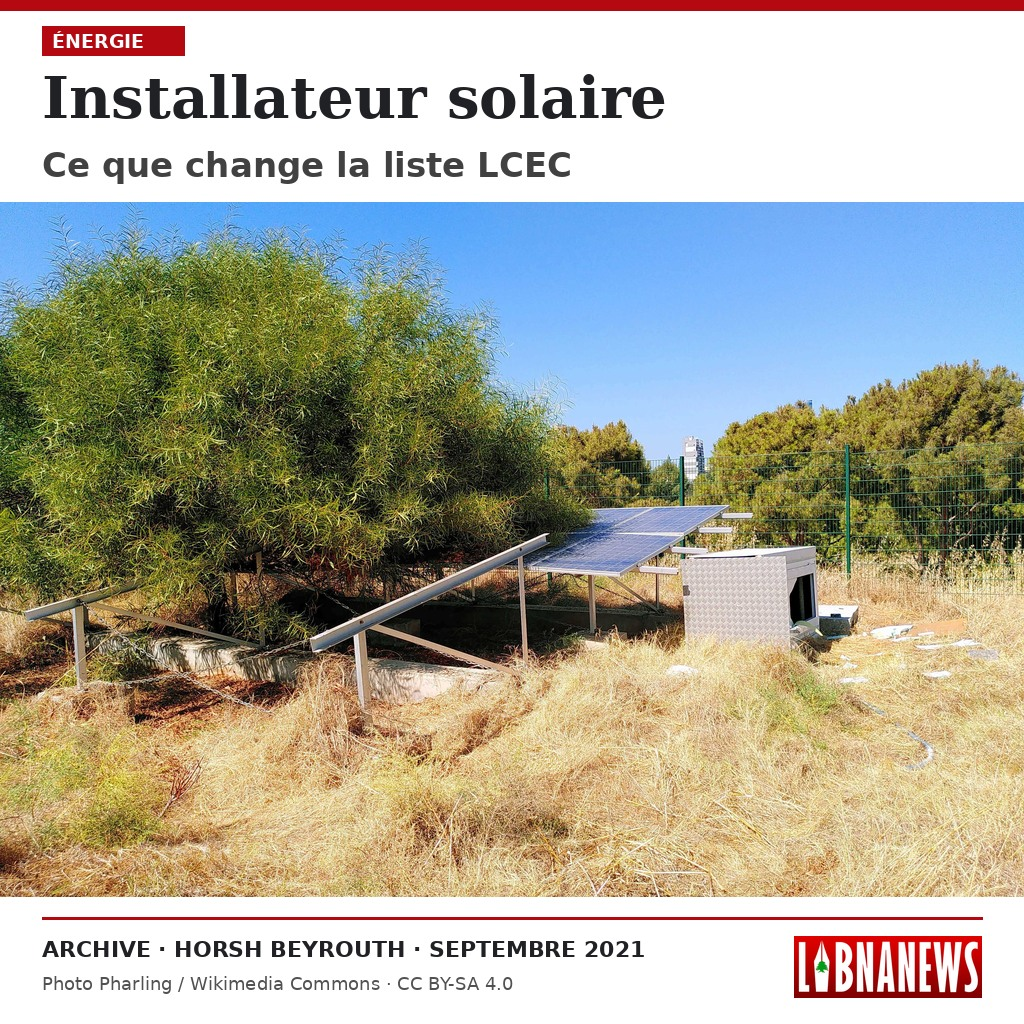
Archive photo: panels of the Air Quality Measurement Station in Horsh Beirut, September 2021. This facility is not residential. Pharling, Wikimedia Commons, CC BY-SA 4.0; Framed photo.





Comments