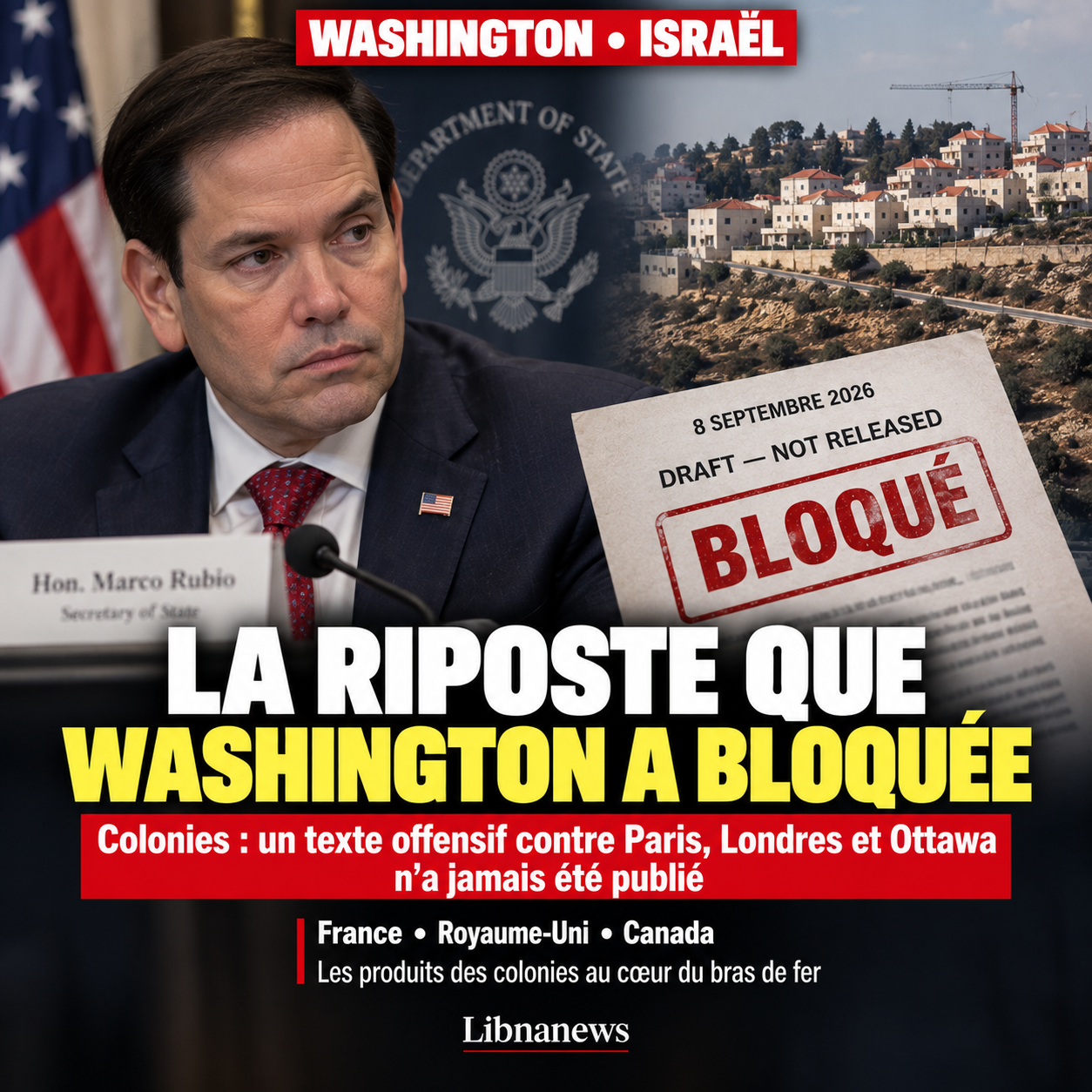
A statement attributed to Marco Rubio prepared and then left in the drawers
A discreet diplomatic battle took place in Washington in early September around the Israeli settlements in the West Bank. American officials working in Jerusalem and the federal capital have prepared a draft declaration attributed to Secretary of State Marco Rubio. The text was to condemn British, French and Canadian plans for imports from Israeli settlements into the occupied Palestinian territories.
The prepared version was particularly offensive. It proposed that the initiatives of the three Western allies be described as a series of measures hostile to Israel and that they be associated with a contribution to anti-Semitism. The document was dated September 8, 2026. It was therefore not an improvised reaction to a public statement. A text had been prepared within the American apparatus with the potential aim of engaging the Secretary of State politically.
But this declaration was not finally published. Three familiar sources of the file indicate that she was not supported by either the White House or senior officials of the State Department. The episode is important precisely because the final decision was to say nothing. Part of the administration wanted to transform the commercial and legal dispute over the colonies into a diplomatic confrontation with London, Paris and Ottawa. Another party prevented this escalation.
The file thus reveals more than a disagreement over products made in colonies. It shows that even within the US administration there is a discussion on how to defend Israel when some Western allies now increasingly distinguish Israel from its settlements in occupied territory. It also shows the limits that the White House seems to have intended, at least in this specific episode, to a confrontation with three major partners.
David Milstein, Mike Huckabee’s advisor, who initiated the initiative
Two sources attribute the project’s initiative to David Milstein, who was presented as one of the influential advisers to the American ambassador to Israel, Mike Huckabee. This origin gives the document a particular meaning. It was not a mere bureaucratic procedure of the State Department. It is said to have been pushed from the United States diplomatic mechanism directly responsible for relations with Israel.
Mike Huckabee himself occupies a special place in this architecture. His approach to the Israeli-Palestinian conflict and Israeli settlements is significantly different from that which has long dominated part of American diplomacy. The preparation of a very hard text against three Western allies is therefore part of a broader battle over the language Washington should use when it comes to colonies.
The vocabulary issue is far from secondary. Qualifying trade measures targeting the products of settlements « hostile to Israel » means reducing the distinction between Israeli territory and settlements built in the occupied West Bank. Adding a reference to anti-Semitism would still have raised the level of confrontation. The debate would no longer have focused solely on the legality of colonies or the commercial treatment of their products, but on the political and moral intentions of the British, French and Canadian governments.
Such a charge to London, Paris and Ottawa would have been a particularly strong signal. These three capitals are not opponents of the United States. They belong to the core of Western Washington partners. The project would therefore have transformed a divergence on Israeli policy in the occupied territories into an open conflict between allies.
The fact that the text was prepared shows that part of the American apparatus was ready to take this step. The fact that it was blocked shows that another party considered the political cost too high or the formulation inappropriate.
London, Paris and Ottawa seek to distinguish Israel from settlements
The dispute arose from a concrete question: imports from Israeli settlements in the West Bank. The Governments concerned are considering restrictions on these products. The logic of these measures is to distinguish between trade with Israel and economic activities related to settlements in a territory that the international community does not recognize as part of the Israeli State.
This distinction is fundamental. A measure targeting settlements does not legally or politically amount to a general embargo against Israel. On the contrary, it seeks to differentiate two spaces that the Israeli government and some of its political supporters tend to treat as a whole.
It was precisely this separation that the American project seemed to want to challenge. By qualifying the hostile measures in Israel, the prepared text would have equated a settlement-based restriction with an action against the Israeli State itself.
The choice of the three countries concerned is also significant. France, the United Kingdom and Canada have all reinforced their criticism of certain Israeli policies. The settlements, the war in Gaza and the prospect of a Palestinian state occupy an increasing place in their relations with the government of Benjamin Netanyahu.
The trade debate thus becomes an instrument of foreign policy. By acting on settlement products, Western governments seek to translate their diplomatic positions economically. They are no longer content with statements on the two-State solution. They envisage measures with a potential cost to economic activities in the occupied territories.
Why the reference to anti-Semitism would have changed the nature of the conflict
The most sensitive part of the project concerned anti-Semitism. Linking restrictions on settlement products to a contribution to anti-Semitism would have moved the debate on international law to the moral and identity field.
Such a formulation would have had several consequences. First, it would have made a technical discussion between allies much more difficult. A government accused of contributing to anti-Semitism cannot respond as if it were merely a tariff dispute.
Secondly, it would have reinforced the argument that the measures against the settlements constituted an attack against Israel as such. This assimilation is politically important because it reduces the space available to States that want to maintain normal relations with Israel while sanctioning or discouraging economic activities in the occupied territories.
Thirdly, it would probably have provoked a political response in the three countries concerned. Paris, London and Ottawa should have publicly defended their distinction between colonial criticism, Israeli government criticism and hostility to Jews. The result would have been a much broader controversy than the original trade file.
The blocking of the text can therefore be interpreted as the refusal within the US administration to bring the conflict to that level. However, the available evidence does not provide a clear indication of why the White House and senior officials of the State Department did not support the declaration. It would be excessive to see evidence of a general change in American policy on colonies.
What is established is more limited, but significant: a hard statement has been prepared, it has been proposed and it has not reached the political level necessary for its publication.
A less homogeneous US administration than it looks
The episode reveals a difference in sensitivity within the American apparatus. On the one hand, there are officials close to the diplomatic representation in Israel who want a particularly strong defence of the Israeli government against European initiatives. On the other hand, the White House and the senior levels of the State Department have not validated the text in the proposed form.
This difference does not necessarily mean the existence of two contradictory American policies. An administration can share a general objective while at the same time diverging on the means, language and acceptable diplomatic cost. Washington can support Israel while considering it unnecessary to simultaneously open a confrontation with three major allies.
The timing also counts. The United States is engaged in several regional crises. Iran remains at the centre of a complex negotiation. The war and discussions around Gaza continue. Lebanon is seeking new Israeli withdrawals under American mediation. Yemen and the attacks on Saudi Arabia add another source of instability.
In this context, triggering a crisis with London, Paris and Ottawa over settlement products would have added an additional fracture to a Western front already under many tensions.
The decision to block the declaration can therefore respond to a logic of managing alliances without constituting a disapproval of Israeli policy. That is precisely what makes this case interesting: Washington chose not to turn every divergence with Europeans into a public confrontation.
At the same time, the West Bank is experiencing accelerated developments
This diplomatic battle comes at a time when the situation on the ground is getting worse. In the West Bank, the Israeli authorities have initiated new procedures related to settlement expansion. A bid was announced for 400 additional housing units in the Karnei Shomron settlement, built on land east of Qalqilya.
The draft is 196/2026 and sets 23 November 2026 as the closing date. Its importance lies not only in the number of dwellings. The move to tender means that the project is leaving the planning phase alone to enter a much closer stage to the actual construction.
The expansion is aimed at a colonial complex which the Israeli authorities seek to strengthen and link more closely to the surrounding settlements. Each such project therefore has a territorial dimension that goes beyond the housing itself. The roads, infrastructure and continuity between settlements are gradually changing the geography of the West Bank.
The same movement is found around Ramallah. More than 400 olive trees were torn off in Beit Rima after operations involving approximately 31 dunums of land. Two days earlier, a military order had targeted these areas and planned the removal of vegetation and trees.
In Deir Nizam, another military order, numbered 104/26, concerns 94.79 dunums in the Wadi al-Hammata area. It also provides for the removal of vegetation and the grubbing up of olive trees, with an extremely short period of time granted to the owners.
These operations give a very concrete dimension to the European debate. The proposed trade measures are not discussed in a context where settlement is frozen. They intervene as new housing is being prepared and measures affecting Palestinian land are increasing.
53 military orders in 2026 compared to 47 the previous year
The figures measure this acceleration. Since the beginning of 2026, 53 military orders for the removal of trees or vegetation cover have reportedly affected approximately 2,287.58 dunums in the West Bank.
By 2025, 47 such orders had targeted approximately 1,613 dunums. The comparison therefore shows an increase in both the number of orders and in particular the area concerned.
The increase in the area reached about 674.6 dunums in one year, an increase of nearly 42%. The number of orders increases less rapidly, by about 13%. This means that the average area affected by each measure is also larger.
These figures are particularly sensitive to the approach to the olive harvest season. The olive tree is not only a political symbol. It is a source of income for many families. The removal of trees therefore produces economic damage which can be prolonged for several years, since a new tree takes time to reach comparable production.
The debate on colonial imports thus takes place in a context where territorial transformations have direct economic consequences for the Palestinians. European governments who want to differentiate products from colonies also seek to avoid their markets participating economically in an expansion that they politically challenge.
E1 makes a much larger threat
To these developments add folder E1. The project is considered by Palestinians to be particularly dangerous because it could help cut the territorial continuity between the north and south of the West Bank and further isolate East Jerusalem from its Palestinian environment.
Mahmoud Abbas placed this issue at the centre of his speech before the UN General Assembly. He called for action by the Security Council and recalled the need to implement resolution 2334 concerning settlement activities.
The Palestinian President has also linked the progress of settlements to a more general threat against the two-State solution. Its argument is geographical: an international recognition of the Palestinian State gradually loses its substance if the territory on which that State is to exist is fragmented by settlements, reserved roads and areas under different control regimes.
It is precisely this contradiction that drives some Western governments to seek measures other than declarations. Political recognition of a future Palestinian State and continued economic exchanges without distinction with the settlements can become increasingly difficult to reconcile.
The battle over imports is therefore an attempt to match trade policy and diplomatic position.
Washington had already prepared other instruments of pressure against allies
Marco Rubio’s project must also be seen in a broader evolution of American diplomacy. The Trump administration gladly uses economic instruments, sanctions and trade threats to change the behaviour of partners as adversaries.
In the Israeli-Palestinian case, however, this method faces a particular difficulty. The United States must reconcile its support for Israel with Western alliances whose Governments were adopting increasingly critical positions on the settlements and Gaza.
Sentencing or publicly accusing several of these allies could have an opposite effect to that sought. The Governments concerned could harden their positions so as not to appear to be a ceding to US pressure. European public opinion also plays an increasing role in the debate.
The non-publication of the text can therefore translate into a cost-benefit calculation. Defending the colonies against targeted trade restrictions was it worth a crisis with three allies simultaneously? The answer given in this particular case appears to have been negative.
But this decision does not guarantee that the same choice will be made in a future European initiative. The battle remains open.
Washington’s silence is not valid for European measures
It would be wrong to conclude that blocking the text means that the White House supports British, French and Canadian projects. The information available does not make it possible to go that far.
The decision may have several explanations: disagreement over the wording, opposition to the reference to anti-Semitism, willingness not to provoke allies, difference in timing or preference for discreet diplomatic intervention.
None of these assumptions can be transformed into certainty without further information. The solid fact remains the difference between the existence of the project and the absence of publication.
This nuance is important because it prevents presenting the case as an American break with Israel. Nothing in the available elements allows such a conclusion. Washington continues to play a central role in the diplomatic and security protection of Israel.
The episode shows rather the existence of a one-off limit: some officials were ready to use very harsh rhetoric against three allies, but this proposal was not validated at the top.
Netanyahu arrives in New York in an unusual isolation climate
This case takes place in parallel with a particularly difficult sequence for Benjamin Netanyahu at the United Nations. His address to the General Assembly was marked by the departure of many delegations from the Chamber. This scene provided a visual representation of the isolation that the Israeli government is facing on several issues.
Netanyahu defended the strikes against Iran and its nuclear program. He also assumed operations against Hezbollah and recalled the attack on the communications apparatus in Lebanon. On the Palestinian question, he continued to reject the establishment of a Palestinian State.
At the same time, his efforts to get an appointment with Donald Trump faced difficulties. This situation does not mean a break between Washington and Israel. However, it states that Netanyahu can no longer regard every US support demonstration as automatic in its form and schedule.
The non-publication of the draft declaration against London, Paris and Ottawa is part of this atmosphere. It shows that at a time when the Israeli government is calling on its partners to combat settlement initiatives, Washington does not necessarily respond to all these demands in the most maximalist way.
A battle that could determine the economic cost of colonization
Perhaps the real challenge of European initiatives is in the medium term. For decades, international condemnation of colonization has rarely resulted in a significant economic cost to activities in the occupied territories.
Import restrictions would partially change this situation. They would establish a principle: a product manufactured in a colony does not necessarily enjoy the same treatment as a product manufactured inside Israel.
If several major Western markets adopt this distinction, the consequences could exceed the trade volumes directly concerned. Companies should strengthen the traceability of their supply chains. Investors would face a higher legal and political risk. Distributors may choose to avoid certain suppliers in order not to have to distinguish the exact origin of the goods.
The Israeli government therefore has an interest in preventing the installation of this precedent. The reaction envisaged in Washington can be understood from this perspective. It is not just about defending a few exports. The aim is to prevent the economic distinction between Israel and settlements from becoming a common Western practice.
That is also why the words of the American project were so important. By presenting European measures as hostile to Israel, the text would have erased precisely the distinction that London, Paris and Ottawa sought to establish between Israeli territory and settlements. The addition of a charge related to anti-Semitism would have made this assimilation even stronger. The battle would then have focused not only on trade, but on the very legitimacy of a Western government to treat products from the occupied territories differently.
The fact that the project has been blocked prevents this doctrine from becoming an official American position. However, it does not delete the debate. Some influential officials wanted Marco Rubio to carry this line publicly. There is no reason to exclude it from reappearing if France, the United Kingdom or Canada actually move from advertising to applying trade restrictions.
A precedent that could exceed the goods only
The risk identified by Israel is not limited to the amount of exports concerned. An official trade distinction may set a precedent for other sectors. Whenever a government demands to determine whether a commodity comes from Israel or a colony, the same question may be asked for investment, financial services, public procurement, insurance or business activities in the occupied territories.
It is this potential dynamic that gives the file a strategic reach. A first targeted measure can remain economically modest while changing the rules applied by companies. Banks, insurers and distributors then begin to examine their exposure. They do not necessarily do so to take a political position, but to reduce legal or commercial risk.
Traceability then becomes central. In order to apply a restriction only to colonies, the customs authorities must be able to identify precisely the origin of the products. Importers must obtain this information from their suppliers. A distinction that existed essentially in international law and in diplomatic declarations thus forms part of the daily business procedures.
This development is precisely what the Israeli government has an interest in preventing. The more the distinction between Israel and settlements becomes customary in Western economic practices, the more difficult it becomes to present it as an exceptional or hostile measure.
A growing contradiction between diplomacy and trade
European governments are faced with a contradiction that they have long been able to deal with through diplomatic language. They formally defended the two-State solution, considered settlements to be an obstacle to that solution and challenged their legality. At the same time, their economies can continue to import goods produced in the same settlements.
Draft restrictions seek to narrow this gap between diplomatic and commercial practice. Their logic is that the condemnation of colonization loses part of its scope if no economic distinction is made between Israeli territory and settlements built in the West Bank.
This issue becomes more pressing as geography changes. The 400 additional housing units planned in Karnei Shomron are not only 400 housing units. They reinforce a colonial whole and increase the population, infrastructure and need to connect with the surrounding settlements. The 53 military orders recorded in 2026, covering 2,287.58 dunums, also affect the ability of Palestinians to use their land.
The E1 dossier gives this dynamic an even greater dimension. The danger denounced by the Palestinians is that of a break in territorial continuity between different parts of the West Bank and increased isolation from East Jerusalem. If this development continues, the two-State solution advocated by several Western governments may become increasingly difficult to translate geographically.
Trade measures are therefore seen by their promoters as a means of introducing a cost where political condemnation has not prevented settlement expansion.
The Battle Moves to Business
Another possible consequence relates directly to the private sector. An international company does not necessarily expect a general embargo to change its behaviour. It is sometimes enough to identify an increasing risk.
If several States begin to impose restrictions on settlement products, companies will have to consider whether their suppliers, subsidiaries or partners operate in the occupied territories. Legal advice will have to verify the rules applicable in each country. Banks may re-evaluate certain transactions. Distributors may prefer to avoid products whose origin may lead to litigation.
This mechanics can produce greater economic effects than the initial measurement. A limited ban creates uncertainty. Uncertainty increases compliance costs. Companies can then choose to withdraw from an activity even when they are not legally obliged to do so.
For Israel, preventing the first precedent therefore becomes particularly important. The problem is not just what London, Paris and Ottawa will do today. This is what other governments could do tomorrow, and then the companies themselves.
This also explains the interest of a strong American reaction. If Washington officially described settlement restrictions as hostile to Israel, it would in turn increase the political cost to governments and businesses wishing to make this distinction.
The blocking of the statement leaves this battle open.
White House avoids further fracture with Europe
The decision not to publish the text also makes sense when it is placed in the state of transatlantic relations. The United States needs its European allies on several issues simultaneously. A public confrontation with France and the United Kingdom over the colonies would necessarily have overflowed on other subjects.
France plays a role in the Lebanese dossier and in the search for an architecture to succeed the Finul. The United Kingdom also maintains a security and diplomatic commitment to the Middle East. Canada belongs to the same Western group and participates in major international coordinations.
At the same time accusing these three States of adopting measures hostile to Israel and contributing to anti-Semitism would have caused a crisis whose effects would have exceeded the West Bank.
The choice not to publish the declaration therefore appears to be a decision to control diplomatic escalation. This does not mean that Washington approves the proposed measures. This means that in this episode the defence of Israeli positions was not considered sufficient to justify the proposed wording against three allies.
This distinction is important. American policy remains very favourable to Israel. But support for Israel does not necessarily lead the White House to take up all the demands made from Jerusalem or by the American officials closest to the Israeli position.
Next test will come with effective application of restrictions
For the moment, the episode remains that of a statement prepared and then blocked. The real test will begin if the Governments concerned effectively apply their measures on imports from the colonies.
Washington will then have to choose between several options. He will be able to maintain a discreet opposition and try to convince his allies through diplomatic channels. It may adopt a public statement that is less aggressive than that prepared in September. It may also return to a much harder line if the White House considers that the restrictions create a threatening precedent for Israel.
The Israeli response will be equally important. The Netanyahu government can try to convince European capitals directly to give up the measures. He can ask Washington to intervene. It may also consider diplomatic or economic countermeasures.
The behaviour of other Western states will be a third indicator. If French, British and Canadian initiatives remain isolated, their scope will be limited. If they are imitated, the commercial distinction between Israel and settlements will begin to institutionalize.
It is precisely this scenario that explains the intensity of the battle behind the scenes before the measures are fully implemented.
A more revealing American silence than a statement
The most interesting element of this case is ultimately what was not published. A text existed. He had a date, wording and political leader to whom he was to be assigned. He proposed a very severe condemnation of three Western allies. He did not obtain the necessary approval.
This silence makes it possible to see the limits of a policy that might otherwise appear entirely homogeneous. A part of the American apparatus wants to defend Israel by implicating settlement restrictions with measures directed against Israel itself. Another party did not agree that this position should be transformed into the official word of the Secretary of State.
The difference is considerable. It currently preserves the possibility for Washington to challenge European measures without resuming the accusation of anti-Semitism. It also leaves, at least implicitly, the diplomatic space in which Western allies distinguish Israel from settlements.
However, this margin can close quickly. Colonization continues. Tenders are moving forward. Military orders for land and trees are increasing. European governments are looking for instruments that can go beyond verbal condemnation. Israel is trying to prevent these instruments from becoming a norm.
The draft declaration attributed to Marco Rubio was therefore much more than an abandoned diplomatic note. It revealed the next line of confrontation: not only whether the colonies were politically condemned, but whether that condemnation should have economic consequences.
For Washington, the question remains. Does defending Israel also mean defending the commercial treatment of settlement products as if they came from Israeli territory? By blocking the text of September 8, the White House avoided giving such a categorical answer. The next European initiative will say whether this silence can last.