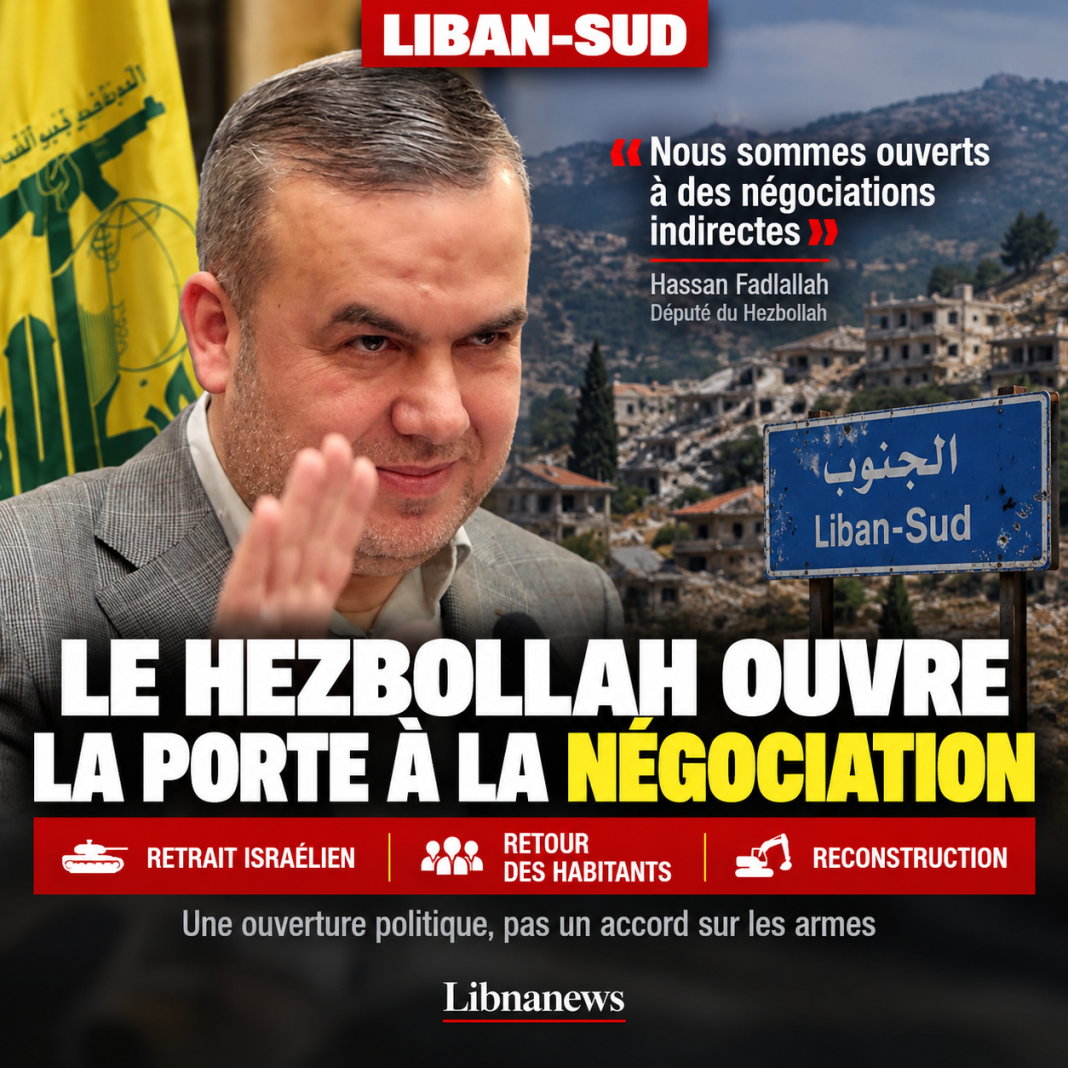






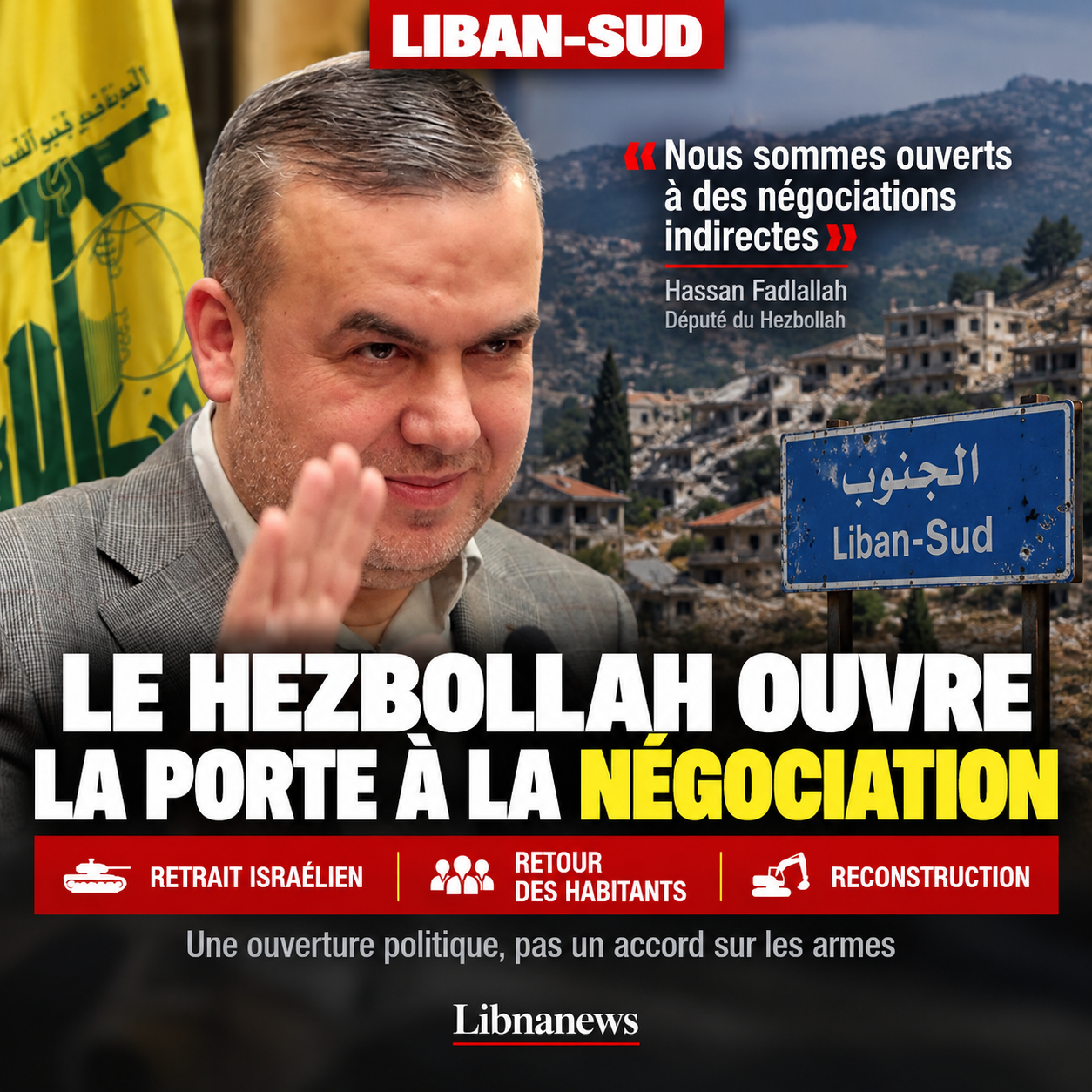
Hezbollah MP Hassan Fadllallah said on Friday that his party and the Amal movement were not opposed to a « political solution » for the South and declared themselves open to indirect negotiations if they allowed for Israeli withdrawal, the return of the inhabitants and reconstruction. However, the parliamentarian rejected any approach which he regarded as capitulation and strongly criticized the framework agreement concluded by the Lebanese authorities. This statement comes at a time when the debate is now as much about the diplomatic means of ending the situation in the South as about Hezbollah’s weapons and the role of the State.
On Friday, Hassan Fadallah formulated a position that clarifies the conditions under which Hezbollah envisages a diplomatic route in South Lebanon. The Member did not reject the principle of negotiation. It has even explicitly accepted the hypothesis of indirect discussions with Israel, provided that they achieve objectives that it presents as non-negotiable: the liberation of the territory, the return of displaced inhabitants and the reconstruction of the affected areas.
» We are not supporters of war, » said Hassan Fadllallah. According to him, the successive conflicts were imposed on the inhabitants of the South by the proximity of Israel and by a history marked by invasions, occupations and confrontations.
The MP then defined Hezbollah’s current priority. After the destruction caused by the Israeli war and operations, he said it was « to liberate the South, to return and to rebuild it ».
It was in this context that he introduced the possibility of a diplomatic approach.
» We support diplomacy based on our rights and are open to indirect negotiations if they lead us to this goal, » he said.
Hezbollah accepts the principle of indirect negotiations
The reference to indirect negotiations is the central point of Hassan Fadllallah’s statement.
The MP does not propose direct negotiations between Hezbollah and Israel. Nor is it in favour of normalising relations. On the other hand, it explicitly opens the door to an indirect diplomatic process that can resolve the remaining issues in the South.
This distinction corresponds to a practice already used in relations between Lebanon and Israel. Both countries do not have diplomatic relations, but several cases have been dealt with through international mediators.
The maritime border negotiations, concluded in October 2022, had been conducted with American mediation. Beirut and Tel Aviv had accepted an arrangement without establishing direct diplomatic relations.
The mechanism resulting from the ceasefire of 27 November 2024 was also based on international mediation and separate commitments made by the parties.
By saying that he was open to indirect negotiations, Fadallah therefore did not break with the principle of the absence of direct relations with Israel. He agreed, however, that the political path could be used to achieve results in the South.
Three objectives: withdrawal, return and reconstruction
Hassan Fadllallah associated this openness with three priorities.
The first concerns the Israeli withdrawal. Despite the ceasefire of 27 November 2024, the issue of the Israeli presence and positions in South Lebanon remained at the centre of tensions between Beirut and Israel.
The second concerns the return of the inhabitants. The fighting and destruction have led to large population displacements in border villages. While part of the population has returned since the cessation of hostilities, the situation remains difficult in several locations directly affected by military operations.
The third priority is reconstruction. Villages, homes, infrastructure and agricultural land suffered significant damage during the clashes. Reconstruction is therefore an economic and social issue as well as a political one.
Fadallah links these three questions. In his speech, a political solution cannot be judged on its formal existence. It must produce concrete results on the ground.
It is on this condition that it presents indirect negotiations as acceptable.
Fadllallah rejects « submission » solution
This diplomatic openness is accompanied by a clearly formulated limit.
Hezbollah MP says that the goals he lists cannot be achieved by « capitulation », « subordination » or « subordination ». He believes that a policy based on these principles would lead to continued occupation rather than its disappearance.
Fadallah directs this criticism directly against the Lebanese authorities.
He accuses the power of consolidating the Israeli presence through the framework agreement concluded under American mediation. This accusation is part of the political conflict between Hezbollah and the government of Nawaf Salam over the strategy followed against Israel and the weapons issue.
On the contrary, the government defends an approach based on the strengthening of the state, the deployment of the army and the negotiation of an Israeli withdrawal. It also considers that weapons should gradually be placed under the exclusive authority of State institutions.
The divergence therefore no longer concerns only the existence of a political path. Fadllallah’s statements show that it also covers its content, its conditions and the balance of power in which it is to be conducted.
Since November 2024, Hezbollah considers the proposals insufficient
Hassan Fadllallah also chose 27 November 2024 as the starting point for his political assessment.
This date corresponds to the entry into force of the ceasefire which ended more than a year of confrontation between Israel and Hezbollah, including two months of particularly intense war in autumn 2024.
According to the MP, no « reasonable » political proposal has since been presented to Hezbollah and Amal to resolve the situation in a sustainable manner.
He defined the criteria that should be met by such a proposal: to protect Lebanon, to put an end to assassinations and to allow the inhabitants to return to their homes.
« Hezbollah and the Amal movement have not closed doors and are not against a political solution, » he insisted.
This formulation allows the MP to respond to the accusation that both Shia formations would necessarily favour the military option. Fadallah, on the contrary, asserts that they are willing to consider a negotiated solution, but considers that the conditions proposed so far do not guarantee the objectives they defend.
A statement in the midst of the debate on arms
Fadllallah’s comments were made while the issue of security in South Lebanon was now directly linked to the national debate on Hezbollah’s weapons.
President Joseph Aoun and Prime Minister Nawaf Salam have repeatedly reaffirmed the principle of state arms monopoly. The Lebanese army is expected to play a central role in the control of the territory and in the arrangements to stabilize the border.
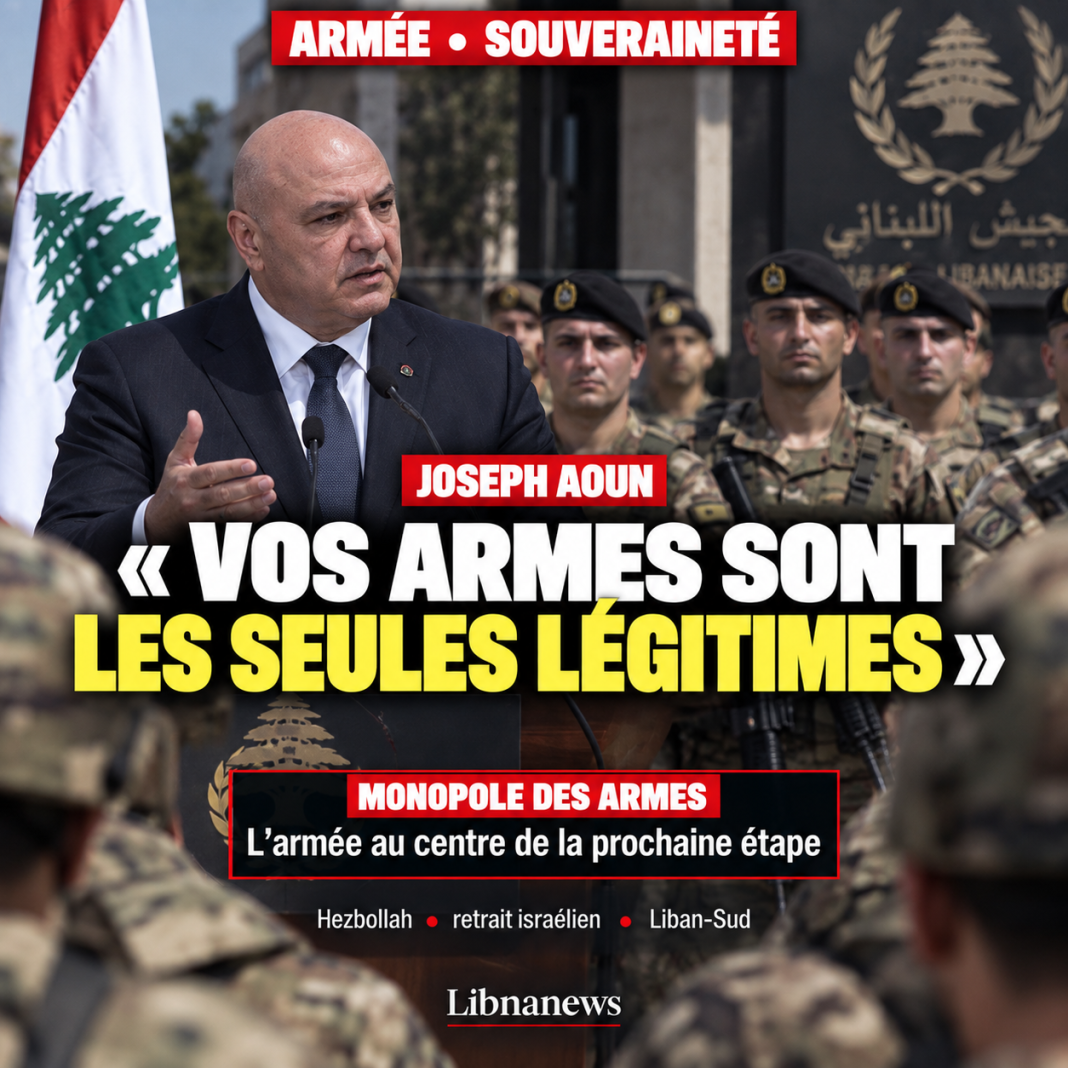
Joseph Aoun once again declared this week before military personnel that the weapons of the army were « the only legitimate weapons ». At the same time, he stressed the need for the institution to protect all Lebanese, including those who oppose decisions or State authority.
Hezbollah, for its part, disputes a disarmament that would take place as Israel maintains positions in Lebanon and continues operations in the territory.
This divergence remains complete.
Fadllallah’s statement does not contain Hizbullah’s commitment to surrender its weapons in the context of a possible political settlement. It deals with the possibility of using diplomacy and indirect negotiations to resolve the situation in the South.
However, the two issues are closely linked in the ongoing discussions. The Lebanese authorities want Israeli withdrawal while extending State and army control. Hezbollah calls for the end of the Israeli presence and operations to precede any final questioning of its arsenal.
The maritime border precedent
Fadllallah’s opening to indirect negotiations has an important precedent: the maritime boundary agreement concluded in 2022.
At the time, Hizbullah had accepted the principle of negotiations conducted by the Lebanese State with American mediation, without participating directly in discussions with Israel.
The agreement established the maritime boundary between the two countries and defined their rights to offshore energy zones.
However, the precedent is limited. The maritime delimitation involved a specific file. The current discussions deal with much broader issues: the Israeli military presence, border security, return of populations, reconstruction, deployment of the army and the future of the Hezbollah military apparatus.
A possible negotiation on South Lebanon would therefore be much more complex politically and safely.
However, the Fadllallah statement states that Hizbullah does not in principle reject a mechanism in which the Lebanese State negotiates through a third party.
Hezbollah maintains ministers in the Salam government
Hassan Fadllallah also discussed Hizbullah’s relations with the government of Nawaf Salam on Friday.
Despite its criticism of executive policy, the party is not considering withdrawing its ministers at this stage.
The MP explained their retention in government with « national and political needs related to partnership. » He also mentioned an agreement with the Amal movement to stay in the firm during the current period.
However, in his view, this decision does not constitute support for government policy.
Fadllallah explicitly stated that Hizbullah’s presence in the government did not mean that Hizbullah considered the cabinet’s policy to be successful, nor did it mean that the participation of Hizbullah’s ministers would significantly change its direction.
This distinction reflects the party’s current position: to remain in institutions while challenging several central government decisions.
Hezbollah and Amal thus retain their participation in the cabinet while they disagree with Nawaf Salam on major issues, in particular the treatment of weapons and the strategy followed against Israel.
Between negotiation and disagreement with the government
Hassan Fadllallah’s statements therefore clarify the contours of Hezbollah’s current position on the South Lebanon.
The party does not close the door to a political solution. It accepts the principle of diplomacy based on the rights claimed by Lebanon and declares itself open to indirect negotiations. However, it sets the expected results of Israeli withdrawal, the return of the inhabitants and reconstruction.
At the same time, Hezbollah refuses to associate this diplomatic route with what it considers a capitulation in the face of Israeli demands. It rejects the Government’s approach to the US-mediated agreement and maintains its opposition to disarmament under current conditions.
The declaration therefore does not resolve the disagreement between the party and the executive. Rather, it clarifies the terrain on which he is moving: Hezbollah does not reject the negotiation itself, but challenges the political and security conditions in which it is currently conducted.
The next step will therefore depend on the content of the proposals submitted in Beirut, the evolution of the Israeli withdrawal and the guarantees that could accompany a possible settlement. For Fadllallah, the criterion announced on Friday remains concrete: a solution must put an end to Israeli operations and allow the inhabitants of the South to return to their villages in a sustainable manner.