





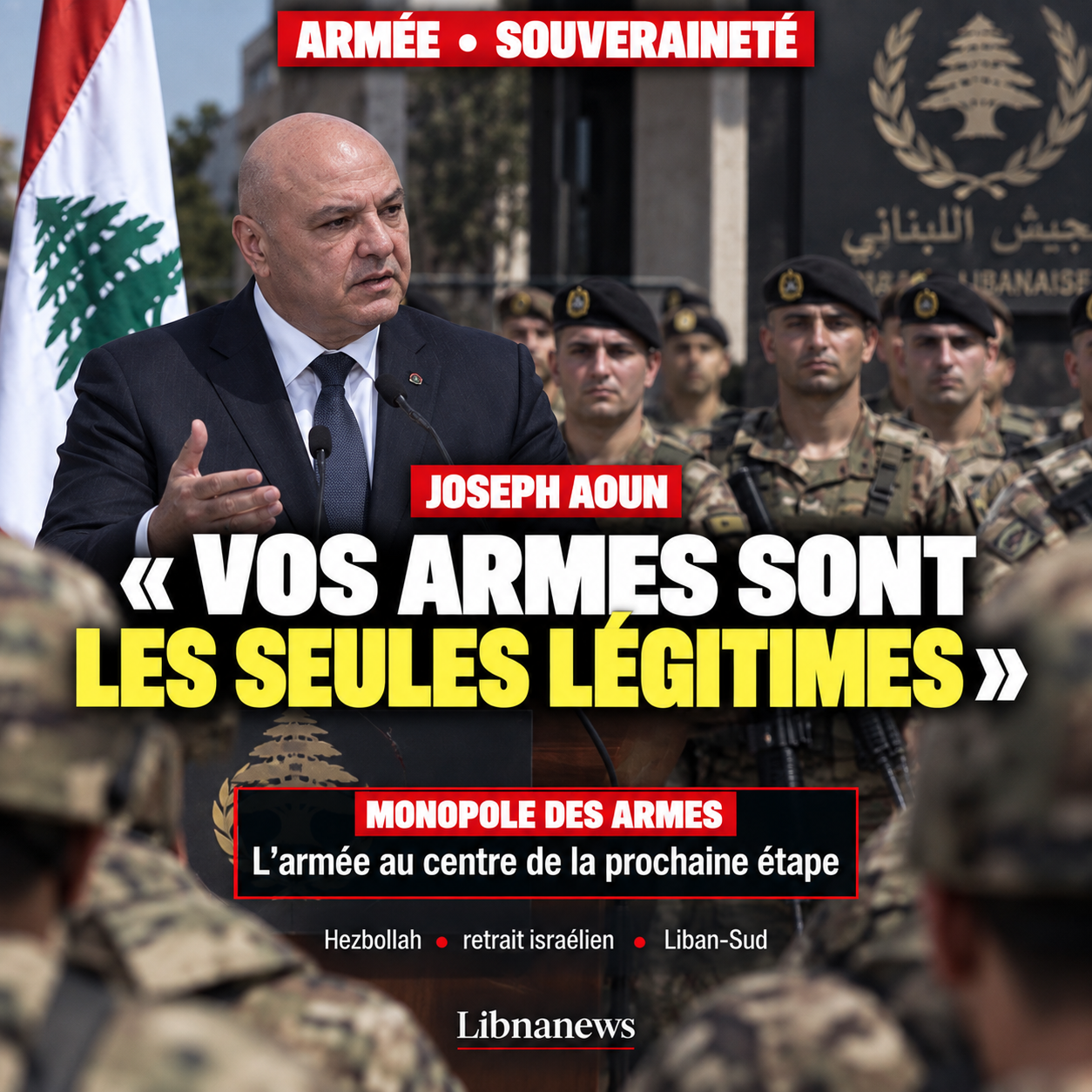
Lebanese President Joseph Aoun reaffirmed on Monday the state’s arms monopoly by addressing directly the military. « Your weapons are the only legitimate weapons, » said the head of state, who asked the army to continue to protect all Lebanese, including the « very small minority » who oppose the state. These statements come at a time when the military institution is at the centre of the mechanism for extending State authority, accompanying the Israeli withdrawal from South Lebanon and addressing the issue of Hezbollah’s weapons.
Joseph Aoun chose to place Lebanese confidence in their army at the centre of his message. In front of the military, the President of the Republic stressed both the exclusive legitimacy of the military institution and its obligation to protect the entire population, regardless of the political divisions that cross the country.
« You protect all our people, even the very small minority that stands against our homeland and our state, » he said. Aoun then formulated more directly the principle defended since his arrival in the presidency: « Your weapons are the only legitimate weapons. »
However, the Head of State immediately clarified the meaning he gave to this legitimacy. It rests, according to him, « not on the strength, nor on the tutelage of anyone, » but on the confidence placed in the army by the Lebanese. This confidence is, he added, « the most important and powerful weapon. ».
The point comes at a time when the question of the military authority of the State is no longer solely a matter of a principle enshrined in official declarations. It is at the heart of the decisions taken by the Lebanese authorities and the negotiations aimed at stabilizing the South Lebanon.
Aoun places Lebanese confidence at the heart of the army’s mission
Joseph Aoun, who led the Lebanese army prior to his election as President of the Republic, devoted an important part of his intervention to the relationship between the military and the population. He asked the institution to preserve that confidence as it assumed increasingly sensitive missions in the territory.
« No army with which the people stood by it has ever been defeated, and no army against which its people stood has ever succeeded, » said the president.
This idea is not new in his speech. When he commanded the army, Joseph Aoun already insisted on popular support as one of the main elements of the military institution’s ability to carry out its missions. Since his assumption of the presidency, he has taken up this concept in a context much more directly linked to the debate on arms.
The President thus associated two elements: the army must be the only legitimate armed force in the country, but this legitimacy must be based on the accession of the population rather than on a logic of internal confrontation.
This clarification comes as Hezbollah’s weapons file remains one of the most sensitive subjects of Lebanese policy.
« The only legitimate weapons »
Monday’s sentence is the central political passage of the presidential intervention.
By affirming before the military that their weapons are « the only legitimate weapons », Joseph Aoun reiterates the principle ofstate monopolization of weaponsalready defended on several occasions by the presidency and government of Nawaf Salam.
In particular, at the end of August, the President reaffirmed Lebanon’s commitment to limit legitimate weapons to State institutions and extend the authority of the army throughout the country. It then linked this objective to the implementation of UN Security Council Resolution 1701 and the restoration of full Lebanese sovereignty.
At the 81st anniversary of the army on 1 August, Aoun also declared that there was no legitimacy for weapons outside the state. He had presented the army as the guarantee of the unity, sovereignty and independence of Lebanon.
Monday’s message therefore follows an established line. Its particularity lies in the way it is formulated: Aoun speaks directly to the military and opposes the legitimacy of their weapons not only to the existence of other arsenals, but also to any idea of coercion or external guardianship.
Hezbollah directly affected by the arms monopoly
Joseph Aoun did not need to systematically name Hezbollah when he referred to the need to reserve arms to state institutions. The Shiite movement remains the main Lebanese organization with an autonomous military apparatus and an arsenal beyond the direct control of the army.
The issue of this arsenal has taken on a new dimension since the war with Israel and the military weakening suffered by Hezbollah. It now occupies a central place in the relations between the presidency, the government, the army and the movement led by Naïm Qassem.
Joseph Aoun and Prime Minister Nawaf Salam both defended the principle of a State with the right to hold arms and decide war and peace alone. The government has engaged the army in the implementation of this orientation, while seeking to prevent it from leading to a confrontation between Lebanese.
This last dimension explains the importance of the rest of the presidential speech. In asking the military to protect even those who stand up against the state, Aoun recalls that the army must retain its role as a national institution at the same time as it is called upon to implement decisions likely to encounter political and popular opposition.
The President had already insisted that the matter should be dealt with in a manner that respected civil peace. This line remains particularly sensitive in areas where Hizbullah maintains a strong political and social presence.
An army to protect opponents of the State
The wording used on Monday goes beyond the issue of weapons alone.
« You protect all of us, » Aoun told the military, before saying that this protection extended even to those who stand against « our homeland and our state ».
The President therefore does not exclude them from the scope of protection of the military institution. The army remains responsible for their safety and that of all other citizens.
This principle takes on a particular dimension in the Lebanese context. The military institution must carry out the government’s decisions while avoiding becoming an actor in an internal political confrontation. It intervenes in a country where the divisions around Hezbollah, relations with Israel and regional policy remain deep.
Aoun had already claimed that the decision on the arms monopoly was a Lebanese decision taken by the Council of Ministers and not an externally imposed measure. He also explained that its application depended on military capabilities and conditions on the ground.
His Monday message echoes this articulation. The state claims the exclusivity of weapons, but the president presents national confidence as the basis of the army’s authority.
Israeli withdrawal continues to be associated with the weapons file
However, this issue cannot be separated from the Israeli presence and the situation in South Lebanon.
In June, the Lebanese and Israeli Governments concluded, under United States mediation, a framework agreement providing for an Israeli gradual withdrawal and the deployment of the Lebanese army in the sectors concerned. The arrangement combines Israeli withdrawal with the strengthening of Lebanese State control and the treatment of Hezbollah weapons.
Since then, its implementation has remained difficult. The Lebanese authorities regularly accuse Israel of compromising the process by its military operations and by maintaining positions on Lebanese territory.
The army itself has already warned that Israeli actions are hampering its deployment and the execution of its missions in the South.
Joseph Aoun, for his part, has on several occasions linked the processing of the Hezbollah weapons file to three elements: the end of the Israeli occupation, the complete takeover of the territory by the army and a reconstruction programme under the responsibility of the State.
This position allows the Presidency to defend the principle of arms monopoly without presenting disarmament as an independent process of obligations imposed on Israel.
Hezbollah refuses to disarm under current conditions
Hezbollah continues to reject disarmament under current conditions. In particular, the Israeli presence and operations against Lebanese territory prevent the unilateral closure of the issue of its weapons.
He also opposed the framework agreement with Israel and direct negotiations with the Hebrew State.
This divergence places the Lebanese state in the face of a concrete difficulty. The Government has set a goal of arms monopoly, but its implementation must be carried out by an army whose authorities want to preserve cohesion and national status.
The file is therefore not limited to collecting weapons. It also covers territorial control, military positions, supply routes, the capacity of the State to ensure the security of the population and the reconstruction of war-affected areas.
The role of the army becomes all the more important as the authorities want to avoid parallel military structures without opening up armed confrontation within the country.
A line already defended from Baabda
Since his election, Joseph Aoun has progressively tightened his position on weapons without abandoning his call for an internal solution.
In early 2026, he had explained that the decision to reserve arms to the State had been taken by the Council of Ministers and should be implemented by the army in accordance with available possibilities and the situation on the ground. It had also considered that weapons outside the State had lost their deterrent function and had become a weight for their own environment as for Lebanon as a whole.
In his subsequent statements, the President reiterated that the protection of the territory should be the responsibility of the State and its armed forces.
In July, however, during a visit to the United States, he had clarified the conditions he considered necessary to move forward on the Hezbollah issue: ending the Israeli occupation, allowing the army to exercise complete control and launching state-run reconstruction.
This approach continues to structure the presidential position in September. Aoun does not separate the arms monopoly from the restoration of Lebanese sovereignty over areas still occupied or subject to Israeli operations.
Army at the centre of next stage
Monday’s speech places the army above all at the centre of this equation.
The institution must strengthen its deployment, control the areas under state authority, enforce government decisions and, at the same time, maintain the confidence of the various components of the population.
It was precisely on this last point that Joseph Aoun insisted before the military. The legitimacy of the army is not only a matter of the Constitution or government decision. The President also attached her to the trust that the Lebanese gave to an institution that was supposed to protect them without distinction.
This confidence becomes all the more important as the tasks entrusted to the army now directly affect the most conflicting issue of Lebanese security policy.
The presidential statement also comes in while the implementation of the June agreement still depends on developments on the ground. Discussions on Israeli withdrawal, the deployment of the army and the fate of Hezbollah weapons remain closely linked.
In affirming that the military must protect even those who oppose the State, Joseph Aoun thus sets two limits to the action he demands: no weapon must have the same legitimacy as the State, but the application of this principle must not transform the army into a force directed against a part of the Lebanese population.
The timing and modalities for translating this principle on the ground now remain at the heart of the discussions between Baabda, the government, the army command and the various Lebanese political forces.