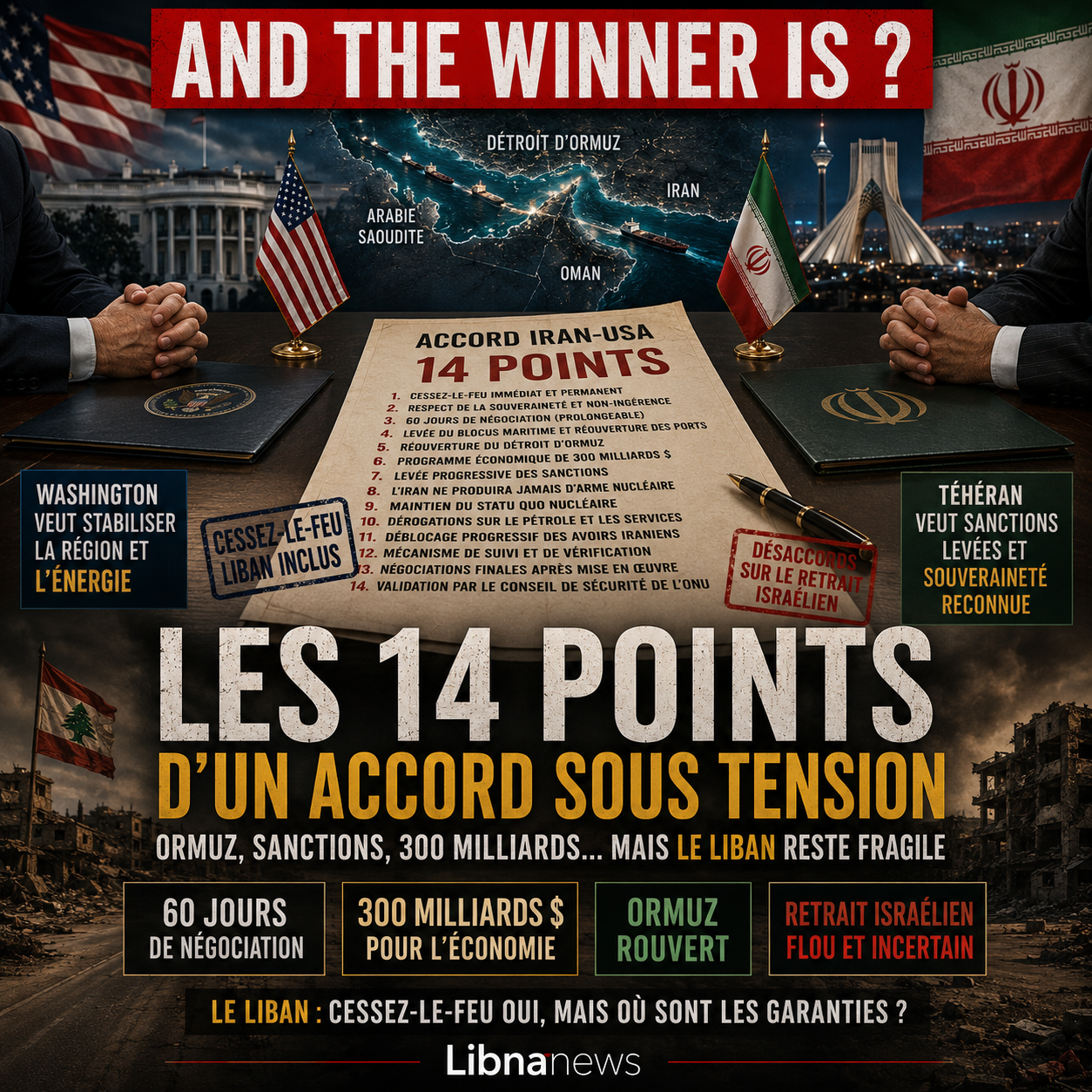







Bezalel Smotrich claims that Israel will not withdraw from southern Lebanon after the expected signing of the US-Iran agreement. Itamar Ben Gvir defends the continued destruction and control of the area, even against Donald Trump’s opinion. For Lebanon, these statements reveal an Israeli will to transform the military occupation into reality.
The statements of Bezalel Smotrich and Itamar Ben Gvir brutally close the parenthesis opened by the announced agreement between the United States and Iran. While Washington presents Friday’s signature as a stage of regional de-escalation, two prominent Israeli ministers claim, on the contrary, that the Israeli army must remain in southern Lebanon and prevent the return of the inhabitants. For Lebanon, the message is clear: the diplomatic agreement does not guarantee Israeli withdrawal, the end of destruction or the return of displaced persons.
In an interview on Wednesday with Israel’s Channel 14 channel, Finance Minister Bezalel Smotrich said that Israel would not withdraw from South Lebanon on Friday, after the announced signing of the Washington-Theran agreement, nor in the foreseeable future. He added that the Israeli army should remain in place « in the long term », until Hezbollah was disarmed. This statement extends the line already defended by defence minister Israel Katz, who had claimed that Israeli forces would remain in a « security zone » in southern Lebanon, without the return of the local population.
Itamar Ben Gvir also expressed an even more brutal position. According to statements relayed by media and accounts close to the Israeli right, the Minister of National Security said that Israel could not stop destroying the houses in southern Lebanon, nor allow the return of the inhabitants, and that it was necessary to continue the control of the area, even if Donald Trump opposed it. Although the exact wording must be handled with caution, it corresponds to a political line already publicly assumed by Ben Gvir, who called Netanyahu to say « no » to Trump and to continue the strikes against Hezbollah.
These positions are taking place in a decisive diplomatic moment. The American-Iranian agreement, expected Friday in Switzerland according to several media, must extend the ceasefire and open a 60-day negotiating period. The G7 welcomed this sequence while calling for an immediate ceasefire in Lebanon and the disarmament of Hezbollah. But the statements of Smotrich and Ben Gvir show that a central part of the Israeli coalition does not want to translate this de-escalation into military withdrawal. On the contrary, it wants to transform the Israeli presence in southern Lebanon into reality.
Smotrich assumes a sustainable occupation
Smotrich’s statement is important because it is not a mere verbal overflow. It gives a doctrine. Israel would remain in southern Lebanon as long as Hezbollah was not disarmed. This condition postpones any withdrawal to an indefinite period. It turns a military presence presented as temporary into a potentially sustainable occupation. It also places the decision to withdraw out of any diplomatic timetable, since the disarmament of Hezbollah is not an objective that can be achieved within a few days.
This position amounts to a maximum requirement. Hezbollah will not disarm under pressure from an Israeli occupation. On the contrary, he will use this occupation to justify the maintenance of his weapons. The already weakened Lebanese State cannot impose disarmament alone in a context where foreign forces occupy sectors of the country. The logic defended by Smotrich therefore creates a closed circle: Israel remains because Hezbollah is armed; Hezbollah remains armed because Israel remains.
Given Lebanon, this reasoning is not a guarantee of security. It is an extension of the conflict. Villages in the South cannot become habitable again if the Israeli army controls access, destroys houses or prohibits the return of inhabitants. Internally displaced persons cannot return if their presence is considered a threat. Lebanese institutions cannot restore their authority if the area remains subject to Israeli military decisions.
Smotrich also expresses an Israeli political reality. The Netanyahu coalition depends on ministers who refuse any concessions. These officials want to prevent the agreement with Iran from being perceived as a Hezbollah victory. They want to reassure the electorate in northern Israel. They also want to preserve an image of firmness as election deadlines approach. But this internal calculation has an external cost: it places Israel in direct opposition to the American goal of de-escalation.
Ben Gvir radicalizes Israeli line
Itamar Ben Gvir pushes this logic further. Where Smotrich speaks of a sustainable presence, Ben Gvir assumes the idea of continuous pressure on the houses and inhabitants of South Lebanon. His remarks are part of a series of already known statements. He called on Netanyahu to refuse Trump’s requests and to « do what is necessary » against Hezbollah. Israeli officials of the same movement also demanded electricity cuts in Lebanon and destruction of buildings.
This line is politically clear. It not only targets Hezbollah as a military organization. It targets the civilian environment in which the movement evolves. Preventing the return of the inhabitants amounts to transforming a inhabited area into an empty military space. Destroying houses is about making it impossible to return, or delaying it for years. For Lebanon, this logic resembles a policy of prolonged displacement under cover of security.
It also collides with Donald Trump’s criticisms. The U.S. President publicly blamed Israel for destroying residential buildings to target Hezbollah members, noting that not all inhabitants of these buildings belonged to the movement. He called on Netanyahu to act more responsibly in Lebanon. Ben Gvir says, in essence, that destruction must continue even if Trump opposes it.
This frontal opposition is new in its intensity. It shows that the Israeli radical right no longer regards the White House as an automatic limit. She thinks she can challenge Trump in the name of Israeli security and internal electoral pressure. It’s a risky bet. Trump wants the deal with Iran. He wants to present it as a success. If Israel sabotages the sequence in Lebanon, tension with Washington can become more open.
Return of internally displaced persons becomes a strategic issue
The most serious point for Lebanon is the return of the inhabitants. Hundreds of thousands of Lebanese were displaced by the war. Whole villages in the South have been emptied. Houses, roads, schools, electricity grids and agricultural land have been destroyed or damaged. Return depends not only on a ceasefire on paper. It depends on real security, access to villages and the possibility of rebuilding.
When Israeli ministers say that this return should not be allowed, they no longer speak only of fighting against Hezbollah. They talk about sustainable territorial control. The displacement of civilians becomes a military instrument. The destruction of the building becomes a means of changing the human geography of southern Lebanon. This logic reminds the Lebanese of ancient episodes of occupation, buffer zones and forbidden villages.
The Lebanese authorities have already called for caution, as some areas remain dangerous. But this caution does not have the same meaning as an Israeli ban. A State asks its citizens to wait when the land is mined, bombed or unstable. A foreign army prevents their return when they want to control an area. The difference is political and legal.
Hezbollah will benefit from this situation. The more Israel prevents people from returning, the more the movement can present itself as the only force capable of challenging the occupation. The more houses are destroyed, the stronger the discourse of resistance in the affected environments. Israel claims to want to weaken Hezbollah. But by transforming civilians into a prevented population, it reinforces the central argument of its opponent.
Washington between Iranian and Israeli allies
Smotrich and Ben Gvir’s statements come at the worst time for Washington. The US wants to make the deal with Iran a turning point. The expected memorandum should prolong a truce, reduce the risks around the Strait of Ormuz, open a nuclear negotiation phase and limit escalation in Lebanon. The G7 supported this approach, while recalling that the Lebanese issue remains central.
But Israel does not intend to be confined by a text to which it is not a direct party. According to the British press, US officials said that Israel would not be forced to withdraw from southern Lebanon, even if Washington’s press did not fail the ceasefire. This ambiguity gives a margin to Netanyahu and its ministers. They can say that they respect the American alliance while refusing immediate withdrawal.
The difficulty for Trump is obvious. He needs an agreement with Iran to emerge from a costly and politically fragile war. He also needed to preserve his relationship with Israel. But its two objectives diverge. If the Israeli army remains in southern Lebanon and continues to destroy, Iran can denounce a violation of the spirit of the agreement. Hezbollah may refuse to remain silent. Lebanon will remain an open front.
Trump has already shown his annoyance. He criticized Israeli methods in Lebanon. He recalled that the United States was indispensable to Israel. He also suggested that the agreement with Iran remained reversible if conditions were not met. But these statements are not enough to force the Israeli coalition. The test will be concrete: will Washington require the cessation of destruction and a withdrawal schedule, or will it be content with calls for restraint?
Lebanon faces a fait accompli
For Beirut, the Smotrich-Ben Gvir line looks like an attempt to create a fait accompli before Friday’s signature. If Israel states right now that it will not leave, it reduces the scope of the American-Iranian agreement on the Lebanese issue. It puts Iran before a dilemma: signing despite the occupation, or tightening its position at the risk of delaying the whole process. He also puts the Lebanese state before a political humiliation: the future of the South is debated without it.
The Lebanese Government can invoke international law, national sovereignty and ceasefire mechanisms. He may request the support of Washington, Paris, the UN and Arab countries. But on the ground, the Israeli army controls the areas it occupies. The inhabitants cannot impose their return. Municipalities cannot rebuild under drones. The Lebanese army cannot deploy freely if Israeli forces remain in position.
This asymmetry feeds Lebanese anger. The country is required to discuss the disarmament of Hezbollah, but it sees a foreign army maintaining a presence on its territory. He is called upon to restore his authority, but this authority is circumvented by Israeli military decisions. He is invited to support the de-escalation, but his villages remain subject to strikes and destruction.
The Lebanese perception of the Iran-USA agreement will therefore depend on the South. If the agreement leads to an Israeli withdrawal, even progressive, it can be presented as an early exit from war. If he lets Israel control a band of Lebanese territory, it will be seen as an incomplete arrangement or even as diplomatic cover of the occupation. Smotrich and Ben Gvir seem to want to impose this second reading.
Israel encounters the logic of the agreement
The American agreement with Iran is based on a simple idea: all fronts must calm down to allow for a lasting negotiation. Lebanon is not a secondary theatre. It is one of the places where the credibility of de-escalation will be tested. If the strikes continue, if the inhabitants do not return and if the Israeli troops remain, the agreement will have little value in the eyes of the Lebanese and Tehran allies.
The Israeli position therefore creates a contradiction. On the one hand, Israel claims to want to neutralize Hezbollah’s threat. On the other hand, it adopts measures that make the disarmament of Hezbollah even more unlikely. A sustainable occupation reinforces the arguments of the movement. House destructions fuel anger. The ban on return radicalizes affected populations. The security sought by Israel can thus produce prolonged insecurity.
This paradox is not new. The security zones imposed by force have often created local resistance. They give the occupant tactical depth, but they produce a political cost. In the case of South Lebanon, this cost is known. The memory of the Israeli occupation remains alive. Any attempt to resettle a controlled area immediately revives this story.
Smotrich’s statement shows that this memory does not restrain the Israeli right. She assumes it. It considers that control of the ground is worth more than political risk. This approach can satisfy some of Israel’s short-term opinion. It can also lock Israel in a long confrontation with Hezbollah weakened but legitimized by the Israeli presence.
An Israeli coalition against de-escalation
The words of Smotrich and Ben Gvir are not only two individual statements. They reveal the structure of the Netanyahu coalition. The Israeli Prime Minister must deal with allies who see the continuation of the war as a condition of political survival. These allies can threaten the coalition if they believe Netanyahu is ceding to Trump or Iran. They therefore weigh on every military decision.
This constraint explains why Netanyahu cannot simply accept the American agreement. He must avoid appearing as the leader who waged an expensive war and eventually withdraw under pressure. It must show that the army retains the initiative. He must prove that Hezbollah does not return to the border. Smotrich and Ben Gvir provide him with a hard line, but they also reduce his diplomatic margin.
The problem is that this policy conflicts with immediate American interests. Trump wants to reduce the risk of a regional war. He wants to stabilize energy prices. He wants to sign with Iran. It also wants to avoid Lebanon becoming the main obstacle to its agreement. The Israeli coalition, on the other hand, wants to maintain pressure until Hezbollah’s disarmament. The two agendas hardly cross.
This divergence can worsen if Israeli strikes cause further civilian casualties. Trump has already criticized the destruction of residential buildings. It will be more difficult for him to defend the agreement with Iran if, at the same time, Israeli ministers claim that these destructions will continue. Israel’s international image, already very degraded in Lebanon, is likely to deteriorate further.
Hezbollah finds a central argument
From the Hezbollah perspective, Israeli statements are a political resource. The movement can say that its weapons remain necessary because Israel does not want to leave. He can say that calls for disarmament are unrealistic as long as the occupation continues. It can portray the return of the inhabitants as a national battle, not as a mere humanitarian issue.
This dynamic complicates the internal Lebanese debate. Many Lebanese want the state to take over the monopoly of military decision-making. Many refuse that Hezbollah alone decides whether to enter or leave the war. But when Israeli ministers talk about staying in southern Lebanon and destroying houses, the debate changes in nature. The issue of occupation takes precedence over disarmament.
Hezbollah therefore does not need to convince the entire country. It is enough to show that the State cannot obtain Israeli withdrawal by diplomacy alone. Each Smotrich or Ben Gvir statement reinforces this demonstration. Every village prevented from returning becomes an argument. Each razed house becomes political evidence in its narrative.
This is one of the most counterproductive effects of the Israeli line. She wants to reduce Hezbollah. It risks reconstructing its political usefulness. She wants to separate the movement from her environment. On the contrary, it pushes this environment to see in it a protection or revenge. She wants to impose security by force. It extends the conditions of war.
On the Friday of the signature will not settle the South
The signature expected on Friday will not be enough to settle the Lebanese case. It may open a new phase, but it will not resolve the decisive issues. Will Israel withdraw? Can the inhabitants come back? Will Hezbollah accept a lasting suspension of its operations? Will the Lebanese army be able to deploy? Will the United States put real pressure on Netanyahu? Will Iran test the agreement from South Lebanon?
The statements of Smotrich and Ben Gvir indicate that the Israeli response, for the time being, is negative on the essential points. No withdrawal Friday. No predictable withdrawal. No full return of the inhabitants. No stopping assumed destruction on the most radical line. This position transforms the signature into a simple diplomatic step, without immediate effect for the occupied or destroyed Lebanese villages.
For Washington, the danger is that this contradiction will become visible within the first few hours of the agreement. If the images of South Lebanon show razed houses, blocked residents and Israeli soldiers in position, Tehran can denounce the lack of American sincerity. Hezbollah may refuse any demobilization. The Lebanese Government can hardly defend a de-escalation without withdrawal.
The Lebanese case thus becomes the truth test of the Iran-USA agreement. Smotrich and Ben Gvir have chosen to say it straight away: the Israeli right does not want American diplomacy to impose a retreat in South Lebanon. It remains to be seen whether Trump will accept this limit, or whether he will consider that the Netanyahu coalition is now threatening its own success. On the southern roads, internally displaced persons expect Friday’s signature less than the practical possibility of returning home.