





Hat —The draft 14-point agreement between Iran and the United States provides for a ceasefire, the reopening of the Strait of Ormuz, the gradual lifting of sanctions, the release of Iranian assets and a fund of $300 billion. But the Lebanese side remains fragile: Lebanon is mentioned in the ceasefire, without sufficient public guarantees on the Israeli withdrawal from the South.
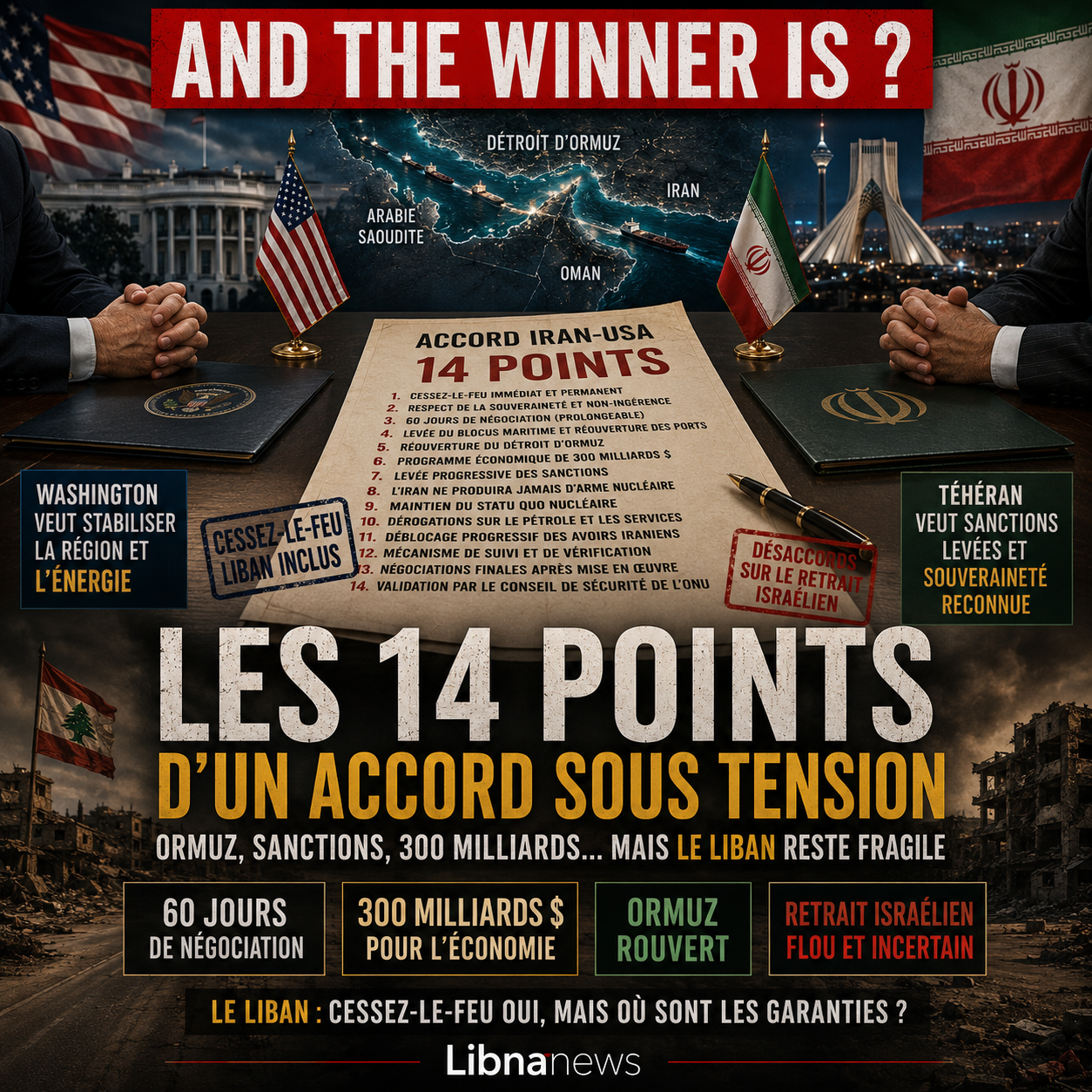
The draft fourteen-point agreement between Iran and the United States, attributed to urgent discussions after several months of war, outlines an ambitious architecture. It promises a ceasefire, a 60-day negotiating period, the reopening of the Strait of Ormuz, the gradual lifting of sanctions, the release of Iranian assets and an economic programme of $300 billion. But it also reveals a series of grey areas, particularly in Lebanon, where the cessation of hostilities does not automatically mean Israeli withdrawal from the South.
The text was not published in an official full version by Washington and Tehran. The 14 known points come from media reports, with differences between American, Iranian and regional readings. This caution is essential. The project exists as a political framework, but each party is already trying to impose its interpretation. Iran insists on lifting the blockade, releasing its funds and including Lebanon. The United States stresses the conditionality of economic benefits and the need for control of the nuclear programme. Israel refuses to allow the agreement to limit its freedom of action in southern Lebanon.
The stakes therefore go beyond the mere diplomatic list. These fourteen points constitute an unstable compromise between three objectives. Washington wants to stop a war that has become costly, prevent Iran from gaining access to nuclear weapons and stabilize energy markets. Tehran wants to secure economic guarantees, preserve its sovereignty and show that its regional allies are not sacrificed. The neighbouring countries want to reopen maritime routes and avoid an extension of the conflict. Lebanon, for its part, appears in the text, but without obtaining all the guarantees it would need.
A general ceasefire, the cornerstone of the text
The first point reported provides for an immediate and permanent ceasefire between Iran, the United States and its allies on all fronts. The formula includes Lebanon. This is one of the most important references of the project, because it recognizes that the war is not limited to the face-to-face between Washington and Tehran. It also includes the fronts opened by Iran’s allies, including Hezbollah, as well as Israeli operations that strike Lebanese territory.
This clause is central. It aims to prevent a resumption of hostilities during the negotiation phase. It also seeks to transform a fragile truce into a more sustainable framework. In the reported version, the parties would undertake not to initiate hostile actions and not to use the threat or use of force. The text therefore seeks a broad break, which would give diplomats time to negotiate a final agreement.
But this formulation is already difficult. A ceasefire can stop firing without resolving the causes of the conflict. In Lebanon, the issue is not just one of bombing. It also covers the presence of Israeli forces in southern Lebanon, the return of displaced persons, the reconstruction of villages and the ability of the Lebanese State to regain control of the area. The first point includes Lebanon, but it is not enough alone to protect Lebanon.
Sovereignty and non-interference: a general principle
The second point concerns respect for sovereignty and territorial integrity. Iran and the United States would commit themselves not to ingest in their respective internal affairs. This clause responds to an old Iranian request. Tehran wants to prevent the agreement from being presented as a prelude to regime change or imposed limitation of its political system.
For Iran, this principle is essential. The war reinforced the story of an assaulted sovereignty. The Iranian regime therefore wants the text to explicitly recognize that the negotiation is not intended to redraw the country’s map, nor to promote sustained opposition from outside. This guarantee would allow Tehran to sell the deal as a victory of resistance, not as a capitulation.
For the United States, this clause has a limited political cost if it remains general. Washington can accept while maintaining demands on nuclear, missiles, sanctions and armed groups allied to Iran. The difficulty arises when this principle is applied to regional fronts. If sovereignty is a principle, Lebanon may request that it also apply to its territory. This is where Lebanese reading becomes sensitive.
Sixty days to negotiate the final agreement
The third point provides for a negotiating period of 60 days, which can be extended by mutual agreement. This period is intended to transform the interim memorandum into a final agreement. It avoids immediate resolution of all the details, but obliges the parties to maintain dialogue. It also allows Washington to present a quick result without waiting for the technical conclusion of each file.
This period of 60 days is a political necessity. The United States wants to show that they’ve got a de-escalation. Iran wants concrete action before negotiating the heavier concessions. Markets, shipping companies and Gulf countries want visibility. The delay therefore creates an airlock. He suspended the war without pretending to solve all the disputes at once.
However, there is a risk associated with this mechanism. If the most difficult subjects are referred to later, they may explode during the transition period. Nuclear, inspections, frozen assets, secondary sanctions and the situation in South Lebanon are not technical details. These are dossiers capable of defeating the whole process. The 60 days can therefore be an exit window, or a test period.
Maritime blockades and Iranian ports
One of the most concrete points concerns the lifting of the US maritime blockade against Iran. The United States would undertake to commence this lifting upon signature of the memorandum and restore full-capacity shipping within a maximum of 30 days. This clause is important for the Iranian economy, since it directly affects ports, exports and maritime insurance.
For Tehran, lifting the blockade is an immediate victory. It shows that the agreement produces tangible effects even before the final conclusion. It helps ease the pressure on imports, exports and logistics. It also responds to a symbolic demand: Iran no longer wants to appear as a country locked in its own waters.
For Washington, this concession is presented as reversible and conditional. It must accompany the reopening of Ormuz and the stabilization of energy flows. The United States does not give up its pressure capacity. They move the power ratio to a compliance mechanism. If Iran complies with the commitments, the traffic resumes. If the agreement fails, the restrictions can come back.
Ormuz, the energy core of the compromise
The fifth point concerns the Strait of Ormuz. Iran would take immediate steps to restore the passage of commercial vessels between the Persian Gulf and the Oman Sea, with a return to pre-war levels within 30 days. The text also mentions the removal of technical barriers and the neutralization of mines. This aspect is probably one of the most important for the world economy.
Ormuz is the Iranian strategic lever par excellence. A considerable part of the world’s oil flows through this passage. Its closure or disruption has immediate effects on prices, insurance, shipping and consumer decisions. By gradually reopening the Strait, Iran gives the United States and Gulf countries a major economic guarantee.
But this guarantee implicitly recognizes Iranian nuisance power. Washington wanted to stop Tehran from using Ormuz as a weapon. The agreement shows that this weapon exists and that it must be negotiated. This is a pragmatic but politically heavy compromise. Iran obtains de facto recognition of its role in regional maritime security.
The $300 billion, promise and controversy
The sixth point refers to a reconstruction and economic development programme of at least $300 billion for Iran. According to one news agency, a private fund of this magnitude, distinct from US state aid or war reparations, is presented as a component of the agreement. More than half of this amount would already be committed, according to a source cited by this agency. The sectors covered would include energy, logistics, industry and transport.
This envelope is politically explosive. For Iran, it is proof that the war has forced the United States and its partners to finance reconstruction or, at least, economic recovery. For Washington, it is not a cheque to the Iranian regime. The US officials insist that the mechanism would be private, conditional and linked to verifiable Tehran commitments, including nuclear.
The communication battle is already open. The Iranian media can present these 300 billion as a victory. American officials seek to avoid the image of a reward offered to Iran after the war. Opponents of the agreement report a risk of indirect financing of the regime or its allies. The final text should therefore specify who finances, who controls, who pays out and under what conditions.
Sanctions, oil and assets frozen
The seventh point provides for a gradual lifting of sanctions against Iran. This would concern, according to the reports, primary and secondary US sanctions, as well as certain devices related to the United Nations and the International Atomic Energy Agency. The timetable would remain to be defined in the final agreement. This is the economic core of the negotiations.
The tenth point completes this architecture with American derogations on Iranian oil, petrochemicals and associated services. These services include insurance, banking, logistics and transportation. This clause would allow Tehran to resume exports and gain income more quickly. It also addresses the global need to stabilize energy markets.
The eleventh point concerns frozen Iranian assets. The United States would commit to the gradual release of limited funds and assets, based on progress in negotiations. These assets would be used as directed by the Iranian Central Bank. This is a major distrust in Washington and Israel’s allies. American officials claim that any release would be framed and conditioned.
Nuclear power, but still incomplete
The eighth point states that Iran reaffirms that it will never produce nuclear weapons. This formula is based on a position already expressed by Tehran. However, it gives the memorandum a political basis. The United States can say that the agreement places the ban on nuclear weapons at the centre. Iran can say that it does not renounce its right to a civil program.
The ninth point provides for the maintenance of the nuclear status quo during the negotiating period. Iran would not change the current status of its programme. The United States would not take further sanctions and would not strengthen its forces in the region. The purpose of this clause is to prevent escalation during the 60 days. It does not yet address the fate of enriched stocks, centrifuges, future enrichment and inspections.
This is one of the weaknesses of the interim text. It announces the objective, but not yet the complete mechanism. Washington wants dismantling or strict supervision. Tehran wants to preserve civilian capacity and avoid political humiliation. Between these two lines, the final agreement will have to define inspections, ceilings, relevant sites and penalties for violations.
Monitoring mechanism and UN validation
The twelfth point provides for the creation of a mechanism to monitor the implementation of the final agreement. This clause is indispensable, because the whole text is based on the minimum confidence between two opponents who suspect each other. The mechanism will have to verify nuclear, economic, maritime and military commitments. Its composition will therefore be decisive.
The thirteenth point provides that the final negotiations begin after the beginning of the implementation of the most concrete measures: lifting of the blockade, reopening of Ormuz, oil derogations and release of funds. This logic gives Iran advance guarantees. It also allows Washington to test Iranian cooperation before the final agreement.
The fourteenth point refers to a validation by a binding UN Security Council resolution. This step would give the text an international scope. It would also expose it to power relations between great powers. China and Russia could support recognition of the agreement. The United States should convince its allies and avoid too strong an internal challenge.
The Lebanese side, visible but fragile
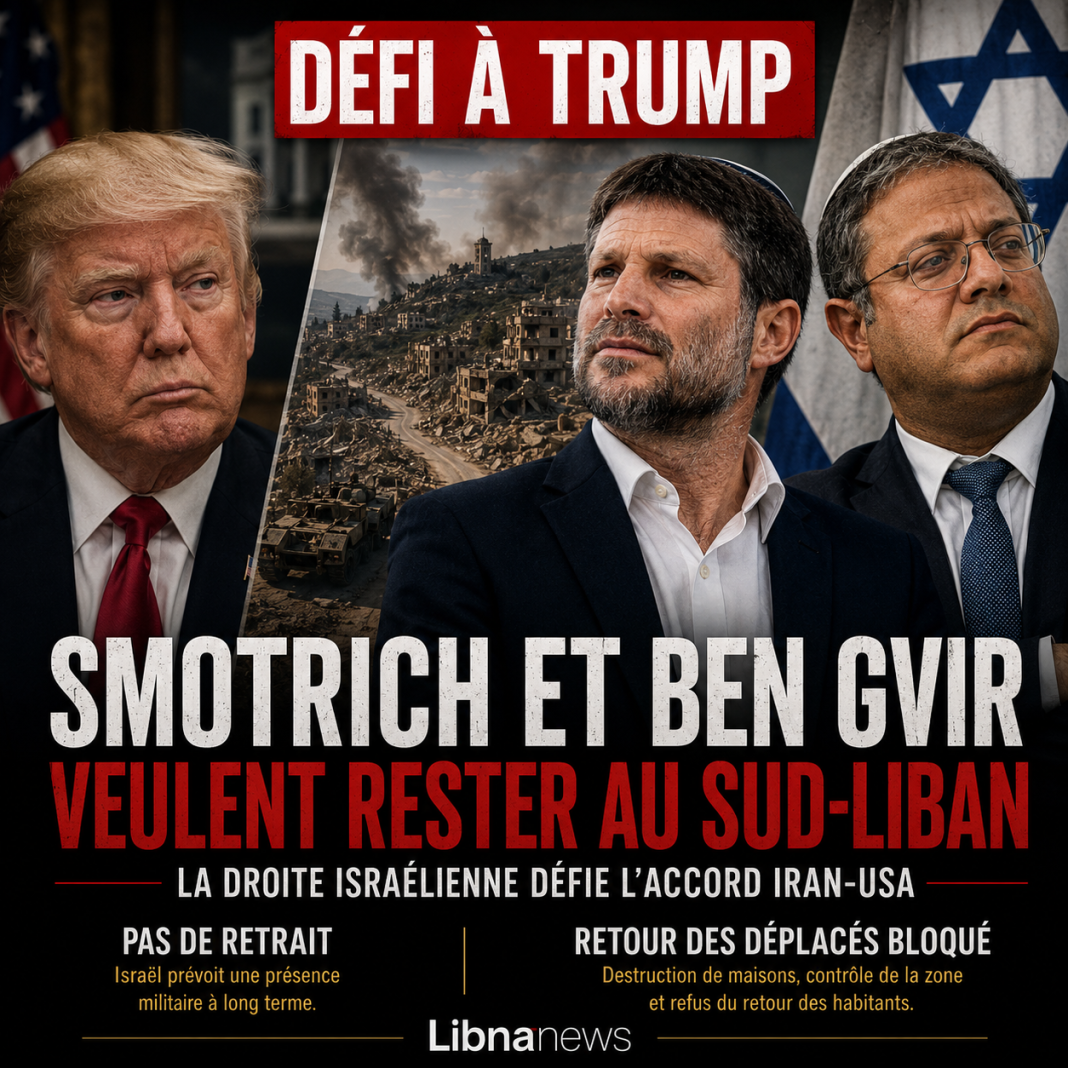
The Lebanese side must be clearly distinguished. Lebanon is not absent from the project. It is mentioned in the general ceasefire clause. According to a news agency, Iran considers Lebanon an integral part of the agreement, and Hezbollah claims that Tehran has obtained that the Israeli withdrawal remains in the discussion. But the fourteen known points do not publicly detail an Israeli withdrawal schedule from southern Lebanon.
This is the central problem for Beirut. A ceasefire in Lebanon is not enough if the Israeli army remains deployed in southern areas. It is not enough if displaced inhabitants cannot return. It is not enough if the destruction of houses continues under the pretext of security. It is not enough if the Lebanese State is not placed at the centre of the scheme. The difference between stopping fire and ending occupation is essential.
The Iranian position is trying to fill this void. Tehran claims that any continued Israeli presence in Lebanon would violate the spirit of the memorandum. Hezbollah relies on this reading to say that resistance has not been sacrificed. But this interpretation is not yet equivalent to a binding public clause. Israel can argue that it is not directly bound by a text signed between Washington and Tehran, especially if the disarmament of Hezbollah is not guaranteed.
Lebanon therefore finds itself in a paradoxical position. It is included in the agreement because the Lebanese front is too important to be ignored. But it is not yet sufficiently protected by known formulations. The guarantees that Beirut needs are concrete: verifiable Israeli withdrawal, return of internally displaced persons, deployment of the Lebanese army, international monitoring of violations and prohibition of turning southern Lebanon into a permanent buffer zone.
A useful agreement, but through contradictions
The 14-point project can open a way out of the war. It responds to real emergencies: stopping the fighting, reopening Ormuz, reviving the maritime trade, regulating Iranian nuclear power, reducing the pressure on the markets and giving diplomats two months to write a final agreement. It is a stabilization text more than a comprehensive peace treaty.
But there are many contradictions. It promises considerable economic benefits without any public conditions. It includes Lebanon without fully clarifying the Israeli withdrawal. He speaks of non-interference while regional fronts depend on armed actors allied in Tehran. It provides for nuclear safeguards without further detailing the final inspections. He wants to calm Israel without imposing all constraints on it publicly.
The follow-up will therefore depend less on the announcement than on the execution. If Ormuz reopens, if Iranian ports resume, if sanctions begin to be relaxed and if nuclear inspections are prepared, the agreement will gain credibility. If the South Lebanon remains occupied, if the Israeli strikes continue and if the displaced do not return, the text will appear incomplete from its first days.
For Beirut, vigilance must be focused on this point. Lebanon must not be merely a line in a regional ceasefire. It must become a specific subject of guarantees. The Iran-USA agreement can reduce regional violence. It can also freeze an injustice if the Lebanese question remains too vaguely formulated. The next few hours will say whether the word « Lebanon » in the fourteen points opens up real protection, or whether it is only used to cover a de-escalation negotiated elsewhere.