





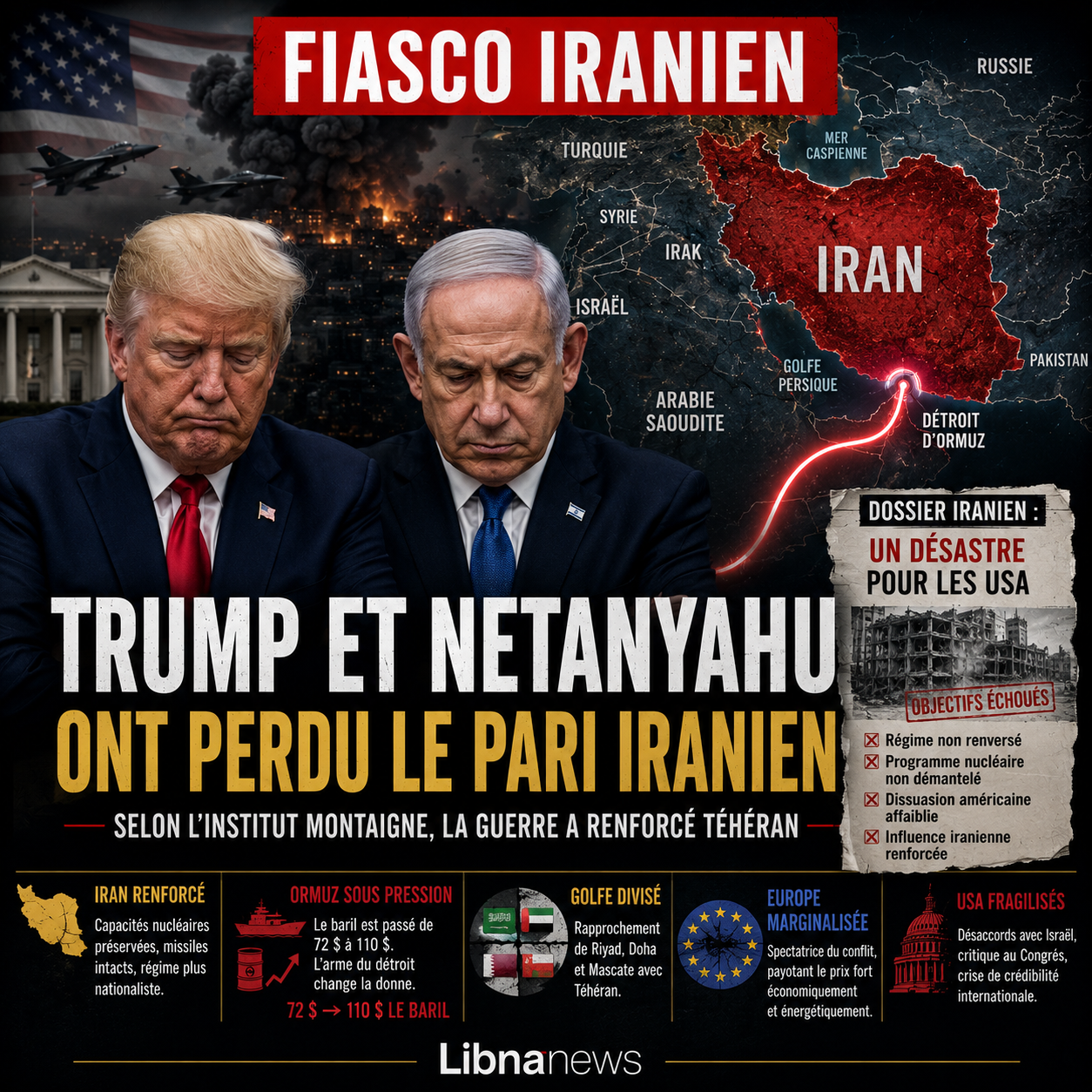
According to the Institut Montaigne, the war waged against Iran produced the opposite of the goal sought by Washington. The Islamic Republic has not been dismantled, its nuclear programme has not been erased and its regional weight has increased. The Iranian case now appears as a lesson on the limits of US crude power.
The analysis of the Montaigne Institute on the war against Iran draws a severe observation for Washington. The Iranian case, long presented to the United States as a problem to be solved by maximum pressure, sanctions and military superiority, has turned into a reverse demonstration. The use of force has not dismantled Iran’s nuclear programme. He didn’t break the regime. He did not restore an undisputed American deterrence in the Middle East. Rather, it revealed a loss of control, reinforced Tehran’s strategic centrality and accelerated regional doubt about the American guarantee.
This reading is not based on an ideological reversal favourable to Iran. It’s from a balance sheet. According to the analysis published by the Institut Montaigne, the sequence opened by the Israeli-American operation of 28 February 2026 produced a major paradox: three months later, the Islamic Republic had a stronger geopolitical position than before the conflict. His nuclear capabilities have not been erased. His ballistic means remain significant. His control over the Strait of Ormuz was affirmed. Its internal power has been reconfigured around a more nationalist, military and security centre of gravity.
This diagnosis is particularly difficult for the United States. It involves not only military execution, but Washington’s intellectual method. The Iranian problem was treated as a matter of power, while it required historical, social and political understanding. The force was confused with the strategy. Technology has been confused with knowledge. The destruction capacity was confused with the transformation capacity. This misconception partly explains why a war to weaken Tehran ended up weakening the Washington-supported regional order.
A war launched despite a diplomatic alternative
The first element highlighted by the Institut Montaigne is the calendar. The war did not break into a diplomatic vacuum. Indirect negotiations existed between Washington and Tehran, under Omani mediation. On the eve of the attack, the Omani Foreign Minister further indicated that the two parties were to meet in Vienna a few days later. Therefore, the use of force did not occur because of lack of option. It was chosen when a discussion channel remained open.
This point is decisive because it weakens the narrative of a war presented as inevitable. The United States and Israel acted as if diplomatic time were exhausted. But Montaigne’s analysis suggests the opposite. The use of force has interrupted a process that could still produce results. This decision gave Tehran a powerful political argument: that of an attacked State while it was still discussing. This story then weighed heavily in the Iranian national mobilization.
The war thus produced an effect contrary to that sought. She had to isolate the regime. It has enabled the Iranian government to put the national issue at the centre. It had to show that Iran was a danger to the region. It allowed Tehran to present itself as the target of external aggression. In a country marked by a long memory of foreign interference, this narrative reversal had immediate effectiveness.
The American error is due to a misreading of Iranian opinion. Washington seemed to believe that social anger against the regime could mechanically turn into support for a foreign operation. Iranian history shows, however, that hostility in power does not mean acceptance of external intervention. Iranian society can challenge its leaders and simultaneously refuse a war perceived as a threat to national sovereignty. This distinction was underestimated.
The ignored intelligence, the policy followed
The analysis of the Institut Montaigne insists on a first failure: that of intelligence. The US agencies felt that Iran had not taken the political decision to acquire nuclear weapons. If this assessment was correct, the urgency of a massive strike would become questionable. The decision to intervene was therefore taken against part of the assessment produced by the American intelligence apparatus itself.
This is a serious matter. A power can be wrong because it lacks information. It can also fail because it refuses the available information. In the Iranian case, the Montaigne Institute describes a decision taken under political influence, notably based on Israeli assessments that have overestimated the regime’s vulnerability and underestimated its military capabilities. This combination created a strategic blindness: officials wanted to believe that Iran was more fragile than it was.
The question is not to deny Iran’s regional ambitions or the risks associated with its nuclear programme. It is to understand how a military intervention can produce realistic effects. If the initial diagnosis is false, the operation cannot achieve its objectives. If the regime is stronger than expected, if its capabilities are more dispersed, if its society joins in the face of aggression, then military superiority is not enough.
This flaw recalls other precedents. In Iraq, the United States had overestimated the ability of the force to rebuild a state. In Afghanistan, they had underestimated the social and territorial depth of the insurgency. In Iran, according to Montaigne’s note, they underestimated the national depth of a country of 90 million inhabitants, heir to a multi-year history and structured by a powerful sense of independence.
A war without a clear objective
The third failure is strategic. What were the war objectives? Regime change, nuclear dismantling, reduction of ballistic capabilities, regional weakening, protection of Israel, restoration of American deterrence: all these objectives coexisted. No one was really prioritized. But a war is not just about the accuracy of the strikes. It considers itself to be consistent between the goals displayed, the means mobilized and the political exit sought.
In the Iranian case, this consistency has failed. A change of regime implies a credible political project for the next day. Nuclear dismantling requires a sustainable capacity for control, inspection and negotiation. A reduction in ballistic capabilities implies a prolonged constraint mechanism. A restoration of deterrence implies an outcome perceived as favourable by the allies. War did not produce any of these results clearly.
The absence of clear objectives has also reinforced Iranian propaganda. Tehran was able to present the operation as an attempt to dismember the country, not as a limited action against sensitive facilities. The statements attributed to Donald Trump on an Iranian map that might be different after the war fueled this perception. Information on support for Iranian Kurdish groups based in Iraq and on regional Israeli positions has been further strengthened.
This perception neutralized part of the Iranian opposition. Movements hostile to the regime were placed before an impossible alternative: criticizing power while refusing to be associated with a foreign war. The external opposition, perceived as aligned with Netanyahu and Trump, has lost some of its credibility. The war has therefore made the internal challenge more difficult, which it claimed to encourage.
Iran has resisted better than expected
It would, however, be too simple to reduce the American failure to the errors of Washington alone. The Institut Montaigne insists on Iranian strategic intelligence. For four decades, Iran has been building a doctrine based on dispersion, redundancy and asymmetry. This doctrine is not intended to compete directly with the United States. It aims to absorb conventional strikes, preserve response capabilities and make any adverse victory too costly.
This strategy worked. Iranian capabilities have not been destroyed. Missiles, drones, command networks and dispersed infrastructure have allowed Tehran to maintain a policy space. The figures cited by the Institut Montaigne, attributed to American sources and the American press, indicate significant losses and damage on regional American bases. Although these data must always be examined with caution, they illustrate the gap between the image of total domination and the reality of American vulnerability.
Iran also succeeded in a strategic concealment operation. For years, he has maintained an ambiguity about the real extent of his ballistic capabilities and his drone fleet. This ambiguity worked like a weapon. It has made it more difficult to assess against. It allowed the regime to reveal certain capabilities at the appropriate time. She pointed out above all that modern war is not only a matter of airspace or cybernetics. It is also played in the perception of what the other knows or ignores.
Finally, Tehran won a narrative battle. In the face of the American-Israeli discourse of a stability operation, Iran imposed that of attacked sovereignty. This story has found an echo beyond its borders, especially in societies already critical of Western double standards. The effectiveness of this communication does not mean that the Iranian regime has become popular everywhere. It means that the Western message did not convince.
National reflex saved the regime
One of the implicit bets of the war was that massive military pressure would cause an internal fracture. This bet failed. Iranian society, which had undergone an uprising in January 2026, did not become a force to supplement a foreign coalition. On the contrary, the feeling that national integrity was threatened produced a reflex of rallying. This mechanism is classic, but it has been underestimated.
The Islamic Republic has benefited from this momentum. She was able to present any radical opposition to war as a form of patriotism, and close to the coalition as a betrayal. The power has thus moved the debate. It was no longer just about freedoms, corruption or repression. It was about state survival. In this register, the regime has a structural advantage, as it controls institutions, security forces and the media.
This rallying does not mean that Iranians have forgotten their aspirations. The Institut Montaigne points out that requests for freedom, the rule of law and economic dignity remain. But the war has pushed them back in time. It offered power a parenthesis of national legitimacy. It weakened those who hoped to transform the social crisis into a political transition. Once again, foreign intervention reinforced the security logic that it claimed to break.
This result represents a political disaster for Washington. The United States spent its military and diplomatic capital to produce a reverse effect. They wanted to reduce the diet margin. They gave him an opportunity to reconfigure. They wanted to implicitly support an opposition. They exposed him to suspicion of collusion with foreign nationals. They wanted to lock up Iran. They made it more central in regional calculations.
An Islamic Republic 2.0
The formula of the Institut Montaigne is central: the war has helped to bring about an « Islamic Republic 2.0 ». This is not a visible institutional change. The structures inherited from 1979 remain formally in place. The Guide, the guardians of the revolution, religious institutions and control mechanisms remain. But the political centre of gravity is moving towards a new generation of commanders, security officials and technocrats.
This generation seems more nationalist than revolutionary. Its main objective would no longer be the export of the Islamic revolution, but the strengthening of the Iranian national power. Islamic ideology remains useful for internal cohesion and institutional legitimacy. It becomes less a mobilising conviction than an instrument of power. The language of the State, sovereignty, territory and regional rank is becoming more important.
This development is strategic. It can make the regime more pragmatic in some negotiations, but also harder on issues of sovereignty. A nationalist, militarized and technocratic power can accept economic compromises. He will more strongly reject injunctions that give the impression of a bid. For Washington, this complicates the case. The Iranian regime has not only remained standing. It has evolved towards a form more adapted to the regional balance of power.
The test will be economical. The legitimacy born of war will not suffice if living conditions do not improve. Iran remains undermined by corruption, mismanagement, sanctions and structural weaknesses in its economy. The Ormuz control gives Tehran a lever. It does not replace reforms. If the new elite transforms geopolitical gains into social improvement, it will consolidate its power. If she fails, the anger will come back.
Gulf doubts US protection
One of the most important effects of the war is the Gulf monarchy. According to the Institut Montaigne, the Gulf Cooperation Council has broken down into two lines. Qatar, Saudi Arabia and Oman would seek a modus vivendi with Tehran. The United Arab Emirates and Bahrain would retain a line more aligned with Israel. This division reflects a deep doubt: does the American guarantee still protect, or does it expose more?
Petromonarchies are stable. Their business models are based on infrastructure security, open sea routes, financial attractiveness and investor anticipation. The Iranian strikes and the tension around Ormuz revealed a structural vulnerability. Even the richest States cannot prosper sustainably if their territory becomes a target in a war decided elsewhere.
Regional doubt is therefore rational. If the American presence deters Iran, it has value. If it attracts Iranian strikes, it becomes a risk. This question concerns US bases, defence agreements, arms purchases and strategic partnerships. It also opens a space for China, which presents itself as a power of stability, trade and dialogue. Beijing doesn’t need to replace Washington immediately. All he has to do is appear as an option.
For the United States, this shift is serious. Their influence in the Middle East depends as much on the perception of their reliability as on their military capabilities. If their allies think they can be dragged into poorly prepared wars, they will diversify their partnerships. Iran, for its part, gains implicit recognition: it becomes an actor with whom to deal, not only a threat to contain.
Israel and the United States, Different Interests
The war also brought to light the differences between Washington and Tel Aviv. For a long time these differences were concealed by the language of the strategic alliance. But the Iranian file makes them more visible. Israel seeks to prevent any Iranian consolidation and reconstruction of its regional allies. The United States is now seeking to limit its exposure, reach agreement and avoid protracted war.
The Montaigne Institute evokes a gradual challenge, in some American circles, to the unconditional nature of support for Israel. This evolution does not mean a break. It translates fatigue. Part of the establishment believes that Washington was trained in an unprepared adventure, serving agendas that do not always correspond to American interests. This perception is politically explosive.
The tensions surrounding the negotiations with Tehran reinforce this fracture. If Israel seeks to influence, circumvent or neutralize the American position, the relationship of trust is damaged. Donald Trump’s brutal statements towards Benjamin Netanyahu show that a language threshold has already been crossed. The US President remains in favour of Israel. But he also wants to be able to conclude with Iran without constantly being caught up with the Israeli military agenda.
This conflict of interest is in Lebanon. Israeli strikes in southern Lebanon complicate the agreement with Iran. Trump’s criticism of the destruction of residential buildings is a symptom. Washington wants to contain climbing. Netanyahu must hold a coalition and an opinion that requires the continuation of the war. The Iranian case is thus mixed with the Lebanese case, and the United States discovers that its ally can become an obstacle to their own exit from the crisis.
Congress reports US domestic crisis
The Iranian disaster is not limited to the Middle East. It’s in Washington. The Montaigne Institute highlights the vote by the House of Representatives on a resolution to limit Donald Trump’s ability to continue the war against Iran without explicit permission from Congress. Although the legal scope of this type of text can be discussed, its political scope is strong.
It reveals fractures in the Republican camp and an institutional concern about the conduct of the war. Trump started the confrontation to weaken the Iranian power. According to the formula of the note, it is his own power that comes out weakened. The paradox is clear. A war supposed to demonstrate its presidential strength opened a debate on the constitutional limits of its authority.
This sequence recalls an American constant. Far-away wars often start under the sign of unity, and then face costs, ambiguities and lack of results. When the goals become blurred, Congress returns to the game. Opinion is getting tired. The allies doubt. Opponents are patient. Iran, by surviving the initial shock, left time to work against Washington.
The US internal crisis also strengthens Tehran’s negotiating position. A president challenged in his ability to continue the war needs more agreement. This need reduces its margin. Iran can delay, demand guarantees and demand economic action. The United States maintains immense military superiority, but its political constraint is increasing. This is one of the most visible signs of a war lost strategically.
China and Russia reap the gains
The analysis of the Institut Montaigne insists on the acceleration of the Beijing-Moscow-Tehran axis. China appears to be the major strategic beneficiary of the war, without directly participating in it. It has kept itself away from the conflict, while cultivating an image of stability power. This contrast allows him to gain credibility among actors tired of American interventions.
Sino-Iranian rapprochement is growing in energy, finance and security. The expansion of the yuan trade is part of a broader dynamics of petrodollar fragmentation. This movement remains progressive. It does not mean the immediate end of American financial domination. But it indicates a direction. Every crisis that weakens confidence in Washington accelerates diversification strategies.
Russia, too, benefits from the sequence. It consolidates an anti-hegemonic Eurasian axis with Beijing and Tehran. Moscow can present the war against Iran as further proof of the instability produced by the United States. This story joins positions already disseminated in Africa, Asia and the Middle East. He does not convince everyone, but he meets favorable terrain in many capitals.
The result is a wider shift. A war designed to reduce Iran helps strengthen coalitions that challenge the American order. It gives Beijing a narrative advantage, Moscow a strategic opportunity and Tehran a new centrality. The American disaster is precisely that: the short-term gains of the strike are overtaken by long-term losses of credibility.
Ormuz, oil and economic shock
The Strait of Ormuz has become the symbol of this reversal of the power ratio. By this way a major part of the world’s oil flows through. The Institut Montaigne recalls that the blockade of Ormuz has increased the barrel from 72 dollars to over 110 dollars. An operation that is supposed to reduce strategic risk has therefore caused a global economic shock. It has revived inflationary pressures and exposed importing economies.
This shock particularly affects Europe. Already weakened by previous energy crises, it suffers the consequences of a war that it has neither initiated nor controlled. It pays for inflation, supply chain tensions and financial volatility. Once again, she discovers that her strategic alignment does not necessarily give her an ability to influence.
For Iran, Ormuz is becoming a political lever. Control or threat over the Strait does not replace a strong economy. But it forces opponents to negotiate. It turns an apparent weakness into a pressure instrument. Iran can suffer from sanctions and mismanagement, while having a systemic nuisance capacity. That is precisely what makes the file difficult to deal with by force alone.
So Washington created a contradiction. He tried to secure the area through a military demonstration. It has made Iran’s ability to disrupt the global economy more visible. He wanted to reassure his allies. He reminded them of their vulnerability. He wanted to show that American order remained dominant. He showed that this order could be destabilized by a less powerful but better prepared opponent.
Europe in the face of its erasure
The Institut Montaigne devotes an important part of its analysis to Europe. It appears as the great absence of the sequence. Spectator of a war close to her interests, she bears the costs without weighing decisions. Its impotence is not only cyclical. It reveals a structural inability to defend a clean line in its strategic neighbourhood.
This absence is all the more costly as Europe is perceived in the region as practicing double standards. Its support for Israel, coupled with a selective application of the human rights discourse, weakens its credibility. She cannot pretend to be the mediators if she seems to mechanically take back American positions. It cannot defend international law with variable geometry without losing authority.
The note calls for a Gaullist path. It is not French nostalgia, but a tradition of independence, balance and dialogue with all actors. Such a course would require Europe to speak to Iran without giving up its demands, speak to Israel without automatic alignment, speak to Gulf countries without blind energy dependence, and speak to the United States without follow-up.
The challenge is existential. If Europe does not catch the moment, it will remain a spectator of a world increasingly structured by the rivalry between Washington and Beijing. It will suffer energy, migration, security and financial shocks without being able to direct them. The Iranian war thus offers a European as much as American lesson: the absence of a strategy always ends up costing more than autonomy.
The American disaster is first intellectual
Perhaps the strongest conclusion of the Montaigne Institute’s analysis is this: the lesson is not only geopolitical, it is epistemological. The United States has satellites, drones, algorithms, bombers, aircraft carriers and exceptional intelligence capabilities. But they regularly fail to understand the societies they face. They see regimes, targets and networks. They underestimate civilizations, memories and national jurisdictions.
This lack of knowledge produces ill-thought wars. It leads to confounding hostility to the regime and the availability of interference. It leads us to believe that destroyed infrastructure amounts to weakened power. It leads us to imagine that a complex country can be reconfigured by external pressure. Iran has a history, an identity, a society traversed by contradictions and a deep memory of foreign interventions. Ignoring these dimensions amounts to fighting an imaginary opponent.
That is why the war seems lost for the United States, even if its military superiority remains intact. Losing here does not mean surrendering. This means not achieving its central objectives. The nuclear programme has not been dismantled. The regime was not reversed. The American deterrence has not been restored. The allies doubt. The rivals benefit. Iran is negotiating from a stronger position than expected.
The Iranian issue has become a disaster because it concentrates all the limits of contemporary American power. The strength remains immense. The ability to produce a sustainable political order weakens. The power to strike remains. The power to convince back. The war had to close the Iranian problem. It has expanded to include the Gulf, Lebanon, Israel, the US Congress, Europe, China and the very future of the international order.
Open lesson for Washington
The follow-up will depend on the American ability to draw the consequences of this failure. An agreement with Iran can still limit the damage. It can reopen control channels, reduce nuclear risks, stabilize Ormuz and offer a political exit. But it will not be enough to erase the lesson. Washington discovered that Iran cannot be treated as an isolated target. It is a state, a society, an energy node, a military actor and a symbol of sovereignty for a part of the non-Western world.
The compromise, if it happens, will not be a triumph. It will be a partial repair. He must implicitly recognize what the war has shown: Tehran cannot simply be crushed. We must deal with him, without naivety, but without illusion about the virtues of brute force. For the United States, this is a difficult lesson. For Israel, this is a warning. For the Gulf, it is an incentive to diversify its balance. For Europe, this is an invitation to get out of passivity.
The Iranian case has become a disaster because it has revealed a wider collapse: that of an international order where American power can still destroy, but can no longer always organize. The paradox is cruel. In trying to prevent Iran from becoming a must, Washington helped make it even more inescapable.