





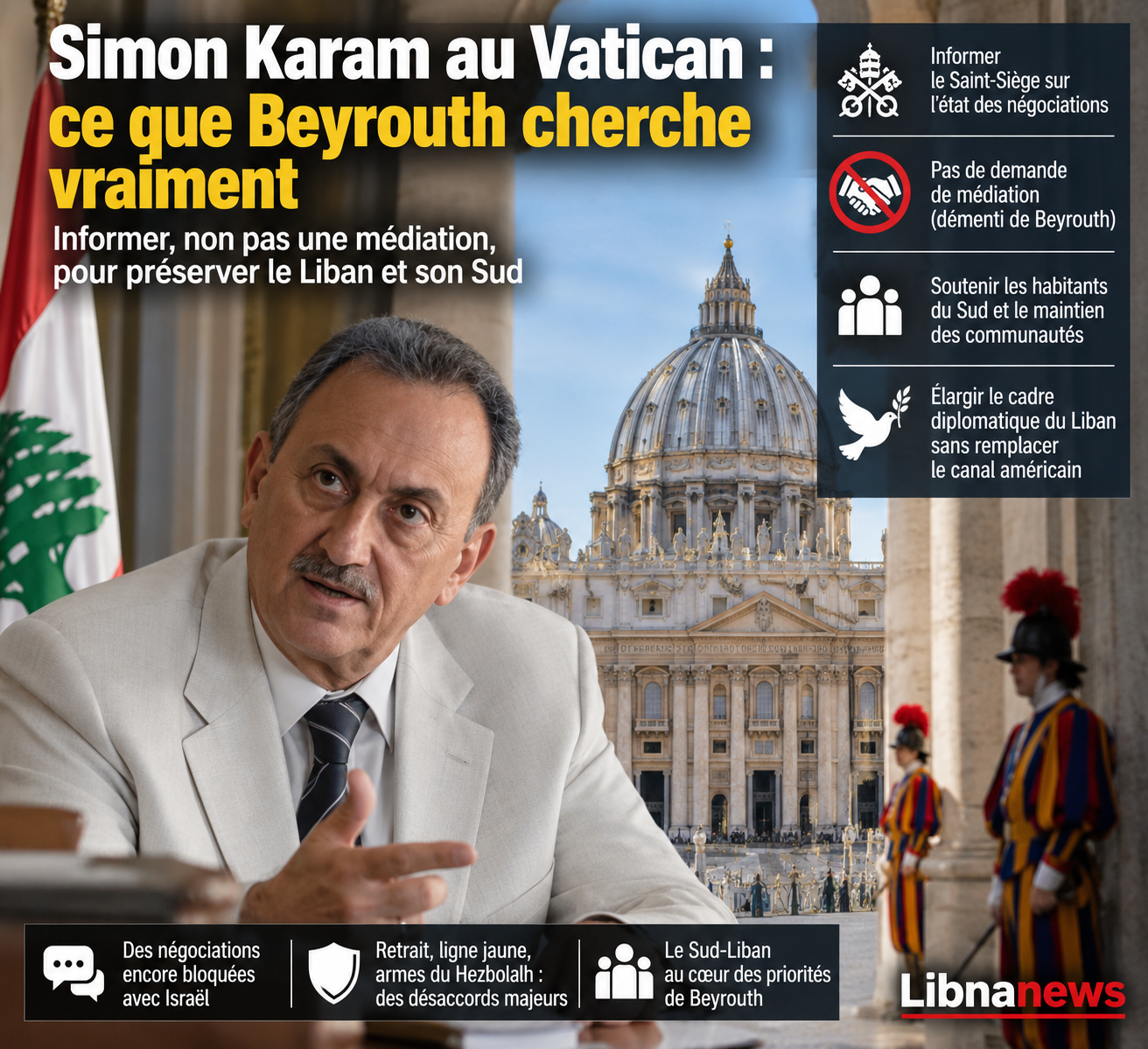
Simon Karam’s displacement to the Vatican may seem secondary to the negotiations with Israel, the bombings in the South and the direct discussions with Washington. Yet it takes on a different dimension when we look at precisely the function of its visitor. Simon Karam was not sent to Rome as a mere diplomat: he led the Lebanese delegation to negotiate with Israel. His mission also came after Joseph Aoun’s visit to the Vatican and the negotiating process was going through a difficult phase. The most significant information, however, is the clarification provided by Beirut: the Holy See must be informed of the state of the discussions, but it is not asked to become its mediator.
This denial deserves more attention than the spectacular hypothesis of pontifical mediation. It provides an understanding of the Lebanese strategy. Beirut does not seek to replace the American channel. Rather, it seeks to broaden the diplomatic environment around negotiations whose results directly affect the sovereignty of the country, the maintenance of the inhabitants in the South and the future of the international presence. The Vatican is thus asked for what it can really bring: a political accompaniment capacity, a constant interest in Lebanon and a concrete presence with the people of the South. However, it does not have the role or leverage assigned to the United States in the negotiations.
Why send the negotiator himself?
Simon Karam’s choice is the first consideration. While the only purpose of displacement was to maintain normal relations with the Holy See, Lebanon had other diplomatic channels. The fact that the head of the delegation negotiating with Israel was responsible for that mission indicated that the content of the discussions was the core of the displacement.
The sequence is also important. Joseph Aoun went to Rome and met the pope the previous month. Simon Karam’s visit is presented as the continuation of this contact. So it’s not about suddenly opening a new channel. Beirut seeks to follow up between the presidential and negotiating levels.
Karam must above all inform his interlocutors of their real state. This formula becomes clear when the information available on the next step is contradictory. An eighth session in Rome was still envisaged, but the chances of holding it in October seemed more fragile. The seventh session did not resolve substantive disagreements. The Israeli file of the « yellow line », the withdrawal of forces in the South and the issue of Hezbollah weapons remain intertwined.
The mission to the Vatican therefore comes at a time when there is a gap between the existence of a diplomatic process and its ability to produce a result.
That’s probably what Simon Karam has to explain. Not only does it say that a negotiation exists, but it also explains what prevents it from moving forward.
The denial of mediation is not a detail
Beirut takes care to clarify that there is no request for mediation addressed to the Vatican. This clarification makes it possible to exclude an immediate interpretation: that of a Lebanon seeking a new mediator because the existing channel would have failed.
Such an approach would have had considerable political significance. Asking the Holy See to relaunch the discussions would have meant that the current architecture was no longer enough. This would also have raised the question of the American reaction, since Washington is directly sponsoring the process.
There is nothing in the documents provided to suggest such a change.
On the contrary, the simultaneous steps taken by Nawaf Salam in Washington show that the government continues to regard the United States as the main external lever capable of acting on Israel. The Prime Minister calls on the Americans to help enforce the tripartite framework, to secure the Israeli withdrawal and to continue their support for the Lebanese army.
Karam’s displacement must therefore be understood in addition to this approach, not in competition with it.
The denial also protects the diplomat’s mission. If he was presented as a mediator, each of his meetings would be interpreted as an attempt to create a parallel channel. By formally limiting the purpose of the visit to information and coordination, Beirut maintains a diplomatic margin without changing the structure of the negotiations.
This difference is substantial.
The Vatican already has special access to the South
The second concrete element concerns the presence of the Holy See in Lebanon. The role mentioned is not at the negotiating table but on the ground, through the apostolic nuncio.
The Vatican directly monitors the situation in the southern regions and, through this presence, helps to support Lebanese who seek to stay in their localities. This point allows us to understand why the negotiation issue is of interest to the Holy See beyond international politics alone.
The problem of the South is also demographic.
Bombardments destroy homes. Military operations make certain areas difficult to live in. Displaced inhabitants can remain permanently remote from their villages. As this situation continues, the issue of return becomes more complex.
Reconstruction is therefore not only a consequence of the future agreement. It conditions the maintenance of the human fabric of the region.
The role of the Vatican here takes on a particular dimension. It is not a question of negotiating a military line with Israel, but of following the human consequences of negotiations that are slow to produce withdrawal and stabilization.
Christian presence in the South is naturally part of this concern. However, it cannot be isolated from the rest of the population. The villages of the region form a mixed social space, and the maintenance of the various communities contributes to the territorial continuity of Lebanon.
Helping people stay there is thus becoming a matter of sovereignty as much as a humanitarian issue.
What Karam can explain to the Vatican about blocking
The potential content of Simon Karam’s presentation can be reconstructed from the files that block negotiations, without giving him any comments that the sources do not report.
The first problem is territorial. Israel maintains a presence in the South. The « yellow line » described in the available information works as an advanced line of defense. Its depth varies by sector. It aims to remove certain threats from Israeli localities close to the border.
But this line does not address the issue of weapons capable of operating from a higher depth. Israel therefore also seeks to maintain a capacity for action beyond its land positions.
For Beirut, this logic poses an obvious problem. A military withdrawal would lose some of its scope if Israel continued to regard a large part of Lebanese territory as an area in which it could intervene freely.
The second problem concerns the sequence of commitments. Lebanon wants the Israeli withdrawal and the restoration of state authority to move forward together. He refuses that one part should remain indefinitely suspended pending completion of the other.
The third problem concerns Hezbollah. Washington believes, according to the information reported in the files, that Lebanese measures on weapons are not moving fast enough. Hezbollah, on the other hand, refuses to treat disarmament as a detached precondition for Israeli withdrawal, the return of inhabitants and the release of prisoners.
The Lebanese negotiator therefore finds himself between several incompatible timetables.
It is this complexity that the Vatican must understand if it wants to usefully accompany Lebanon.
The real node: simultaneity
Perhaps the most important word in the Lebanese official position is reciprocity.
Nawaf Salam is not just asking for the tripartite framework to be applied. He called for the principles of reciprocity and progressivity to become concrete measures. This formulation responds directly to the risk of an unbalanced process.
Beirut does not want to find itself in a situation where the State should fulfil a long series of obligations while the Israeli withdrawal would remain postponed. Conversely, US interlocutors are asking for results on the issue of weapons.
The mechanism sought is therefore to cut commitments into verifiable steps.
Israel is taking a withdrawal action. The Lebanese State is strengthening its control. A check is made. A new stage begins.
In theory, this method reduces mistrust. In practice, it requires a very precise agreement on what constitutes the sufficient execution of a stage.
Who verifies that the State has actually fulfilled its obligation? What are the consequences of an incident? Does an Israeli strike suspend the process? Does an arms discovery allow Israel to delay its withdrawal? When is it considered that an area is effectively under the exclusive authority of the State?
The available files do not give definitive answers to these questions.
That is precisely why Nawaf Salam’s request to establish a verification mechanism is important. The conflict no longer concerns only the final objectives. It deals with the rules for achieving this.
Why the Holy See counts despite its absence from the table
The Vatican cannot technically resolve these disagreements. His interest in Beirut is at another level.
Lebanon seeks to prevent negotiations from being reduced to a military power relationship between Israel and Hezbollah. In this configuration, the Lebanese State may appear as a space on which other actors negotiate rather than as the party whose sovereignty must be restored.
The diplomatic involvement of several actors makes it possible to place the State at the centre.
The Vatican can defend this principle without entering into the operational modalities of disarmament. It can support the maintenance of populations, territorial integrity and institution-building.
This distinction explains why a political role can be useful without becoming a mediation.
It also allows Lebanon to diversify its support. Washington has the main lever on Israel. The United Nations provides the international legal framework. The European Union supports the army. The Holy See can help prevent the disappearance of the human and institutional dimension behind military considerations alone.
It is a complementary diplomacy.
The shadow of the post-UNIFIL era
Simon Karam’s mission also comes as a second pillar of southern security becomes uncertain: UNIFIL.
The end of the mission as it exists today obliges Lebanon to reflect on what will replace it. The available information points to two ways: to maintain a form of international presence or to establish a new mechanism with an appropriate legal framework.
No definitive solution is yet identified.
This uncertainty reinforces the scope of displacement in the Vatican. If the international presence declines while the settlement with Israel remains incomplete, the South could enter a period when several security elements simultaneously weaken.
The Lebanese army would be called upon to assume more responsibility. She would need additional resources. International liaison mechanisms should be reconsidered. The Israeli withdrawal should be linked with this transition.
So the problem is not just whether the negotiations are successful. It is also important to know which architecture will exist to apply their result.
The Vatican does not have an operational answer to this question. But his knowledge of the situation and his diplomatic network can help maintain international mobilization around Lebanon.
In this context, informing the Holy See before decisions are taken becomes more useful than asking for it once the arrangements have already been agreed.
Rome, Washington and the Vatican: three spaces not to be confused
The simultaneity of several approaches may give the impression of a disorderly multiplication of mediations. The roles are different.
Washington is the political centre of gravity of the process. The United States has a relationship with Israel and is directly involved in the architecture of the discussions.
Rome is the envisaged venue for meetings between the parties. Its function lies in the negotiation process itself.
The Vatican is a third space. It does not welcome parallel negotiations in the available elements. He received the head of the Lebanese delegation to understand the status of the process and to maintain his coordination with Beirut.
These three levels meet different needs.
Confounding them would overestimate the scope of Simon Karam’s visit. On the contrary, separating them makes it possible to understand its real usefulness.
Lebanon does not necessarily seek a new negotiator. He is looking for more partners capable of supporting the principles he wants to preserve in the negotiations.
The time of the visit is more revealing than its protocol
The interest of this mission is ultimately less related to its protocol character than at the time of its intervention.
Negotiations are not broken, but they are not progressing sufficiently. A new session is mentioned without certainty. Israel maintains a military presence in the South. Operations continue. Hezbollah rejects several elements of the process. Washington is demanding more results from Beirut. The future of UNIFIL adds an additional deadline.
In this configuration, the Lebanese government needs to avoid two scenarios.
The first would be an unbalanced one-on-one with Israel in which the military power ratio would determine the bulk of the results.
The second would be a broader regional negotiation in which the Lebanese issue would be absorbed by the relationship between Washington and Tehran.
Increasing international contacts reduces, at least politically, these two risks.
Simon Karam’s displacement follows this logic.
The Holy See as a political witness of the sequence
The function that emerges is ultimately that of an active diplomatic witness rather than a mediator.
The Vatican must know the Lebanese demands, the obstacles encountered and the consequences of the blockade on the inhabitants. This knowledge allows him to take a more precise position in his own international contacts.
It’s less spectacular than secret mediation. It is also more credible given the information available.
The Lebanese denial of a request for mediation does not necessarily diminish the importance of the visit. It defines its limits.
Simon Karam does not go to the Vatican to open a second negotiating table. It goes because the existing table alone is not enough to protect all Lebanese interests.
The displacement thus reveals a diplomacy that works on several circles: to negotiate where military decisions can be influenced, to maintain the UN framework, to strengthen the army with foreign partners and to preserve around Lebanon actors capable of defending its stability.
The Vatican belongs to this last circle.
Its weight will not be measured by its ability to draft an agreement between Beirut and Israel. Rather, it will measure its ability to prevent Lebanese sovereignty, the return of inhabitants and the permanence of southern communities from becoming secondary variables in a settlement designed elsewhere.