

In Lebanon, a livestock slaughterhouse must be registered with the Ministry of Agriculture to market its production. The controls then continue during operation. The closure announced by the butchers’ and cattle traders’ union is a separate step from a closure for health non-compliance.
Registration sets the conditions for placing on the market
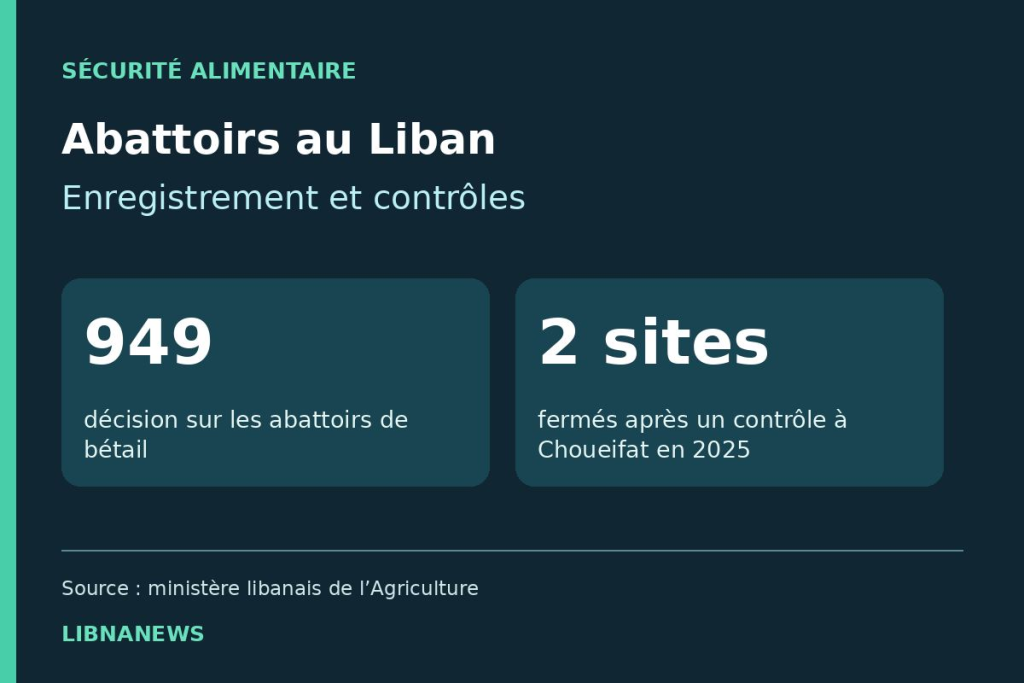
Decision No. 949 of the Ministry defines the technical and health requirements for the registration of livestock slaughterhouses, both public and private. The Animal Resources Directorate publishes a registration application procedure. Poultry facilities are covered by separate legislation: the conditions applicable to livestock cannot be transposed without verification.
The health approach is not valid for the establishment of any establishment on any parcel. The Municipal Decree-Law provides for the intervention of the municipal council in applications for the operation of classified establishments. The text distinguishes between the opinion of the municipality and the decision of the competent authority; In the event of continued disagreement, it provides for the Minister concerned to refer the matter to the Council of Ministers. This local component does not replace the health registration of the site.
In particular, the regulatory framework provides for the examination of animals by the veterinarian responsible for monitoring, keeping records and hygiene rules for premises and equipment. Carcases unfit for consumption and waste shall be insulated and disposed of in accordance with the applicable requirements. The control therefore also concerns the daily operation, beyond the conformity of buildings.
Security forces monitoring, support and closure decision
A previous document in Choueifat illustrates the role of state services: in 2025, the Animal Resources Directorate inspected slaughterhouses with the support of State Security. The department released two closures after identifying significant deficiencies. This precedent does not prove that a municipality or a department can close all files; the competent authority and the measure must be verified in the act of each establishment.
The trade union announcement relayed on 25 November does not, on its own, provide information on the number of sites actually stopped. In order to measure its effects on supply, the list of slaughterhouses concerned, the volumes normally processed and the dates of interruption should be available. No consolidated balance sheet of these three items was found at the time of writing.





Comments