

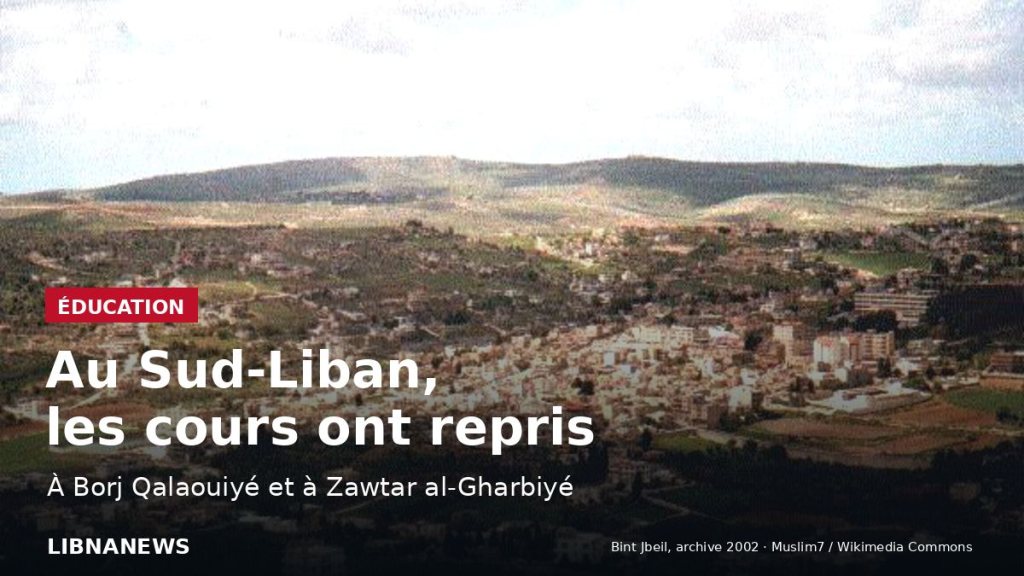
In Borj Qalaouiyah, some 470 students attend classes in an unfinished building after the destruction of their school. In Zawtar al-Gharbiyé, the public school welcomes approximately 74 students, compared with 304 before the crisis.
The Borj Qalaouiyah public school in Bint Jbeil district returned from September to another address. Its three-storey building was completely destroyed in May 2026, according to a survey published on 25 November by UNESCO. The team resumed the courses in a nearby building that was to accommodate a kindergarten and whose work was not completed. Prefabricated rooms are being installed. The organization does not specify their number or the date on which they will all be usable.
In Zawtar, about a quarter of the pre-crisis workforce
At the Imam Moussa al-Sadr public school in Zawtar al-Gharbiyé, also reopened, damage affected laboratories, the library and other workspaces. The school has about 74 pupils, compared with 304 before. The current workforce therefore accounts for about 24% of pre-crisis staff. Both schools accommodate both village children and displaced families. UNESCO’s assessment does not specify how many former Zawtar students are enrolled elsewhere or remain without a school solution.
At school, workshops to talk about war
Students told UNESCO about their sleepless nights, the noise of planes and the fear of a new trip. In accompanied schools, teachers lead discussions and use drawing or other creative activities to give children several ways to talk about what they have experienced. These sessions take place in an educational setting; they do not replace missed courses or, where necessary, specialized follow-up.
A separate national catch-up programme
Across Lebanon, Education Cannot Wait announced on November 20 a $13 million three-year programme led by Ana Aqra and the International Rescue Committee. The scheme targets approximately 59,000 children, including remedial activities, transport assistance and development work in 50 public schools. These figures are targets, not a balance sheet of re-inscriptions or completed projects. The public profile does not name Borj Qalaouiyah or Zawtar al-Gharbiye among the schools to be built.





Comments