

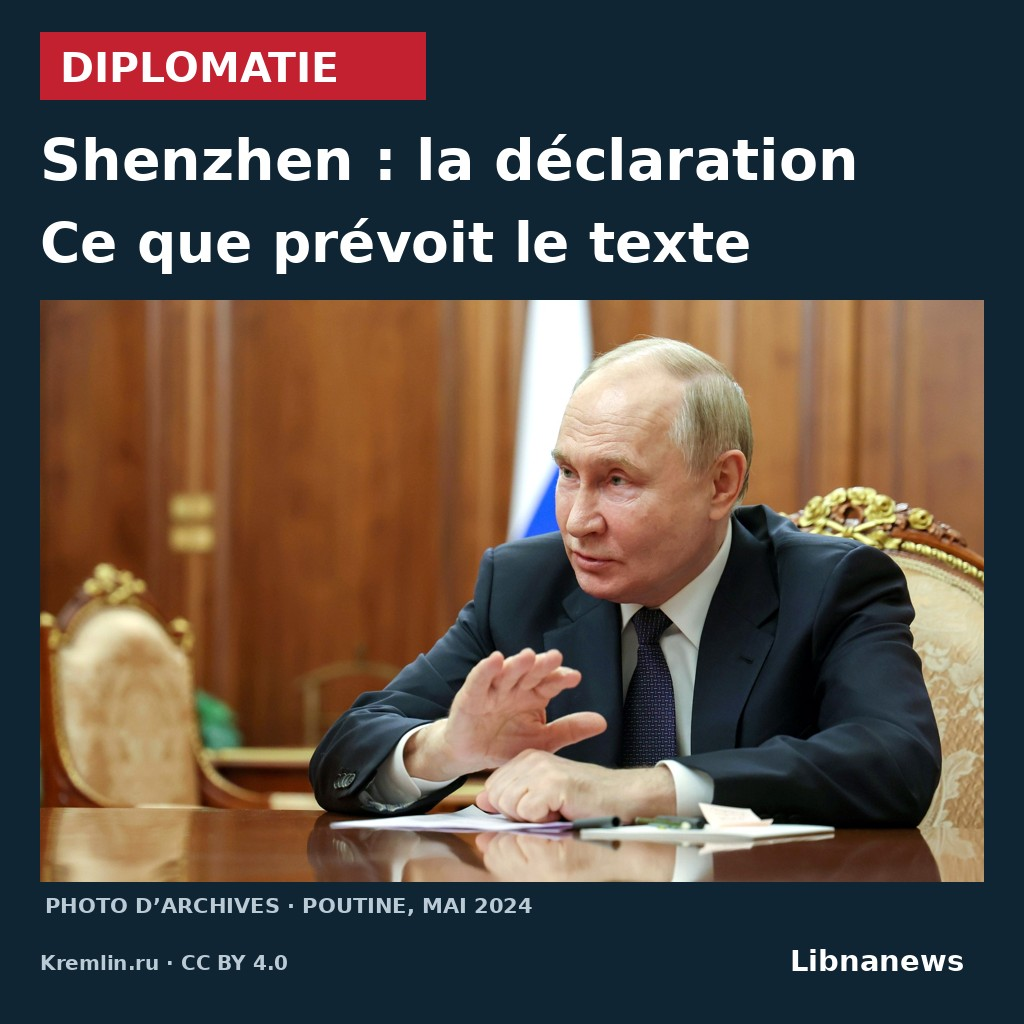
China released on Thursday 19 November the statement of Xi Jinping, Vladimir Putin and Donald Trump after their meeting in Shenzhen. The text covers the UN, refined petroleum products, international justice and nuclear risk. It does not contain any ceasefires concerning Ukraine or Iran. In Berlin, Kyiv’s partners prepare separately the conditions for their support and future security guarantees.
What Shenzhen’s Statement contains
The paper issued by Chinese diplomacy provides for a dialogue on nuclear risk reduction and non-proliferation. There is no ceiling on the arsenal, schedule or inspection device. The three countries are also planning to increase production and supply of refined petroleum products without volumes or deadlines. This is not a costed announcement on crude oil.
They support UN reform. Finally, they defend the consent of States and the immunity of those responsible, and believe that the International Criminal Court and similar bodies should not abuse their jurisdiction. This is their diplomatic position, not a statement of applicable law or a judicial decision.
From national priorities to collective text
The Kremlin announcement preceded the posting of the Chinese document. Dmitri Peskov had indicated that a declaration had been adopted and would soon be published. The meeting lasted about an hour and a half, according to a Russian news agency. The publication now makes it possible to distinguish the commitments formulated together from the topics addressed by each leader.
In his speech to the trilateral, Xi Jinping had proposed regular talks at the summit and communication mechanisms to prevent crises. It also called for better coordination on the stability of energy markets and supply chains. These guidelines provide information on Chinese objectives; Not all should be presented as mechanisms already created.
Vladimir Putin proposed to address economic trade, food and energy security and regional conflicts. He had presented Ukraine as an area of converging interest between the three powers. The Russian President had also said that he had devoted a significant part of his prior meeting with Donald Trump to the Ukrainian issue. This Russian presentation of the discussions makes it impossible to deduce a compromise agreed by Kyiv.
In Berlin, prepare the conditions for a guarantee
The German government describes the meeting of the Coalition of Volunteers as a coordination step to support further direct discussions between Moscow and Kyiv, with American and European participation. He announced representatives from 37 countries, plus EU and NATO officials. This number corresponds to the delegations expected, not to a count of attendance.
The German agenda combines assistance to Ukraine with the preparation of robust and legally binding security guarantees to enter into force after a ceasefire. He mentioned a multinational force and close coordination with the United States. It is therefore not a matter of announcing the actual deployment of a new force or guarantees already in force.
Kyiv had prepared this stage. In his speech on November 16, Volodymyr Zelensky described an exchange between Ukrainian, American and European teams, in which Steve Witkoff and Jared Kushner participated from a distance. He cited France, Germany, the United Kingdom, Italy, Poland, the European institutions and NATO. The Berlin meeting was presented as a concrete follow-up of discussions which he recognized as difficult.
Europe also has a financial instrument
On 16 November, the Council of the European Union authorised a forthcoming payment of just under EUR 8 billion under the Facility for Ukraine. Approximately $5 billion comes from the support loan available in 2026. The authorisation follows the completion of more than 20 stages of reform and must in particular support the financial stability and functioning of the Ukrainian administration. This funding was approved before Shenzhen: it is neither a consequence of the summit nor evidence of an already executed payment. It shows, however, that the European contribution to the process goes beyond diplomatic representation.
French scepticism before publication
On RTL on Thursday morning, Jean-Noël Barrot felt that the leaders gathered in China were too divided to produce results. The French Foreign Minister opposed this meeting the work of preparing peace guarantees in Berlin. His statements, issued before the conclusion of the trilateral, express a French diplomatic position: they do not constitute an assessment of a final text already examined.
The Berlin meeting should specify the next steps in the work between Ukraine and its partners. Its programme distinguishes between immediate support and guarantees that should follow a ceasefire. The details of these guarantees therefore remain a separate file from the exchanges held in Shenzhen.
Archives photograph: Vladimir Putin on May 31, 2024, not Shenzhen. Kremlin.ru / Wikimedia Commons,CC BY 4.0. Whole photo preserved; Libnanews dressing.





Comments