

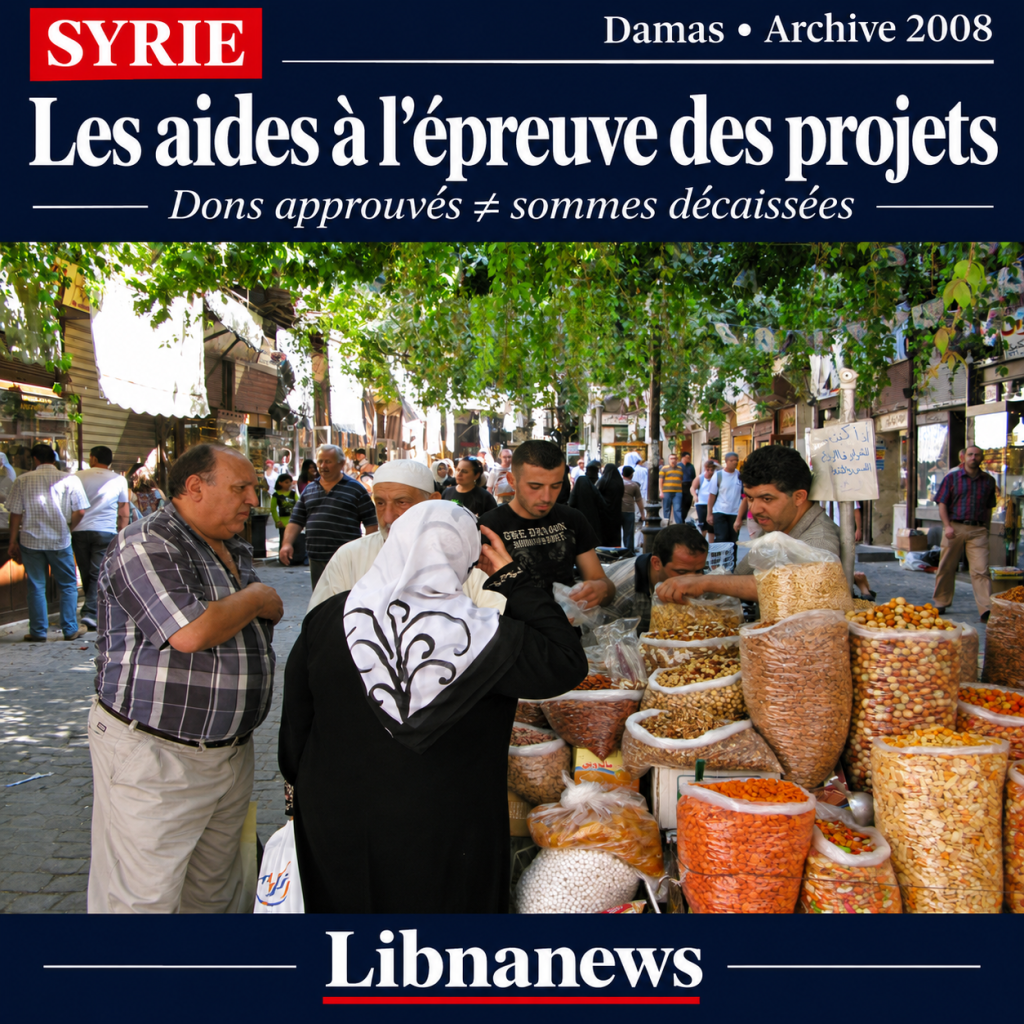
The coordination forum held in Damascus on 17 November 2026 resulted in the launch of a European technical assistance package and new contracts to support the Syrian recovery. The challenge now is to transform financial commitments into services and economic activity. But not all of the amounts recalled on this occasion constitute new aid. Neither should approved donations be confused with amounts already spent on the ground.
In Damascus, contracts rather than a new global envelope
The European Commissioner for the Mediterranean, Dubravka Šuica, has launched a technical assistance centre for the Syrian institutions. EU-funded contracts have also been signed for the rule of law, the business environment and small businesses. The European communiqué does not provide a separate overall amount.
However, it recalls two previous announcements: 175 million euros presented in June 2025 and about 620 million in 2026-2027, announced in January 2026. Adding them as a new addition of November 17 would be misleading. The forum focuses on coordination and implementation, not just financial signage.
Aid to Syria read project by project
The decisions of the World Bank allow for the monitoring of another part of international financing. Five projects identified in its announcements together represent $491 million in donations approved since June 2025. This calculation adds up their initial envelopes. It does not describe a single payment or a balance available in the Syrian caisses.
| Project | Approved donation | Date of approval |
|---|---|---|
| Electrical emergency | $146 million | 24 june 2025 |
| Public finance management | $20 million | 5 march 2026 |
| Water safety | $150 million | 23 april 2026 |
| Restoration of the health system | $75 million | 23 april 2026 |
| Modernisation of the financial sector | $100 million | 6 august 2026 |
These operations are the responsibility of the International Development Association. The news releases present them as gifts, not as commercial loans. Their approval opens up a funding framework. The achievement of the work and the achievement of the objectives require contracts, equipment and operational monitoring.
Electricity, the first link in the restoration of services
The $146 million program marked the return of World Bank project funding to Syria. It targets damaged transport lines and processing stations. Its perimeter includes two 400 kilovolt high voltage interconnections to Jordan and Turkey.
Funding must also provide spare parts and maintenance equipment. It is accompanied by technical support to the institutions of the sector. The objectives therefore concern both the facilities and the capacity to operate them sustainably.
The scheme provides engineering assistance for the management and supervision of works, as well as independent monitoring. This architecture does not allow to deduct the current number of hours of electricity available for each household. It specifies the resources and responsibilities, not a national result already achieved.
Water and health: two programmes for expected beneficiaries
The $225 million approved in April covered two separate projects. The 150 million water component includes treatment and delivery facilities in Idlib, Homs and Hama. It also includes waste water interventions in Damascus.
The 75 million health programme covers primary care, maternal and child health and nutrition. It plans to re-establish services in 150 care centres selected according to needs, capacity and accessibility criteria.
The World Bank estimates that the two projects are expected to benefit approximately 4.5 million Syrians. This figure is a target announced upon approval. It does not mean that 4.5 million people have already received a new benefit. Monitoring will have to determine which facilities are functioning, which populations actually access services and how fast work is progressing.
Twenty million to better monitor public spending
The financial management project responds to a less visible difficulty than a power plant or water system. It must strengthen budget preparation, implementation, public procurement and the production of financial information.
Approved in March, the $20 million grant includes the development of an integrated financial reporting system. It also supports the training of agents and the coordination of reforms. A dedicated structure within the Ministry of Finance should help control external aid.
These instruments should help to track funding coming through multiple channels. They do not replace project-specific controls. Their usefulness will be measured in terms of the quality of accounts, the traceability of expenditure and the ability of administrations to report regularly.
Payments and banks are a separate project
The $100 million donation approved in August relates to the financial sector. It covers payment infrastructure, central bank systems, cybersecurity and banking supervision. It also provides for independent reviews of the quality of assets of public and private banks.
One of the objectives announced is to allow at least 15 million electronic retail payments per year. The programme also targets the active use of these means of payment by at least 500,000 people and businesses. These indicators describe results to be achieved during implementation.
This project is not a direct distribution of $100 million to households. Its financing must improve the channels through which wages, pensions, transfers and commercial transactions flow. In order to assess aid to Syria, financing decisions, disbursements and actual services will have to be monitored separately.





Comments