

The International Court of Justice ruled, Thursday, 19 November 2026 in The Hague, that Myanmar had committed genocide against the Rohingya. The judgment deals with State responsibility in the 2017 violence. It intervenes seven years after the Gambia refers the matter to the Court.
On reading the judgment, the President of the Court, Yuji Iwasawa, held that there was an intention to destroy a substantial part of that population. This makes a distinction between a simple recognition of mass violence and an intentional element of genocide.
Genocide of the Rohingya: what the Court held
The findings presented at the hearing included killings of civilians, large-scale sexual violence and attacks on fugitives. They cover operations conducted by Burmese security forces in Rakhine State, west of the country.
Myanmar challenged the charge of genocide throughout the proceedings. Its representatives presented military operations as a response to insurgent attacks. The Court therefore had to examine not only the acts committed, but also the purpose pursued through those acts.
The distinction is central to the 1948 Convention. Article II requires an intention to destroy, in whole or in part, a national, ethnic, racial or religious group as such. The extent of violence alone is not sufficient to establish this legal qualification.
The Convention covers several categories of acts. It includes murder, serious physical or mental injury and deliberate subjection to destructive living conditions. She also mentioned measures to prevent births and the forced transfer of children. These acts must be accompanied by the specific intention defined by the Treaty.
The Gambia initiated proceedings in 2019
The Gambia filed its application on 11 November 2019. It invoked Myanmar ‘ s obligations under the Genocide Convention. The case did not constitute a criminal complaint filed directly by the victims: it brought two States before the United Nations.
On 23 January 2020, the ICJ ordered provisional measures. Myanmar should prevent acts covered by the Convention, preserve evidence and report on measures taken. This order was not yet a decision on the merits of the prosecution.
In 2022, the Court rejected the Burmese preliminary objections. In particular, it had recognized the right of the Gambia to initiate proceedings on behalf of the common interest of States parties to prevent and punish genocide. The hearings on the merits were then held from 12 to 29 January 2026, prior to the deliberations.
Responsibility of a State, not an individual penalty
The ICJ settles legal disputes between States. His judgement therefore does not impose a prison sentence on a military or political official. This procedure must be distinguished from those of the International Criminal Court, which dealt with the criminal responsibility of individuals.
The Statute of the ICJ states that its judgments are final and without appeal. Their binding force concerns the parties and the case decided. A decision in the Gambian case is therefore not, by itself, a judgment in other conflicts or States.
The finding of genocide here represents the new fact established at the end of the reading. The detailed obligations accompanying the judgment, as well as any provisions relating to reparations, should be examined in the full text. They cannot be deducted from the only applications submitted by the Gambia to the Court.
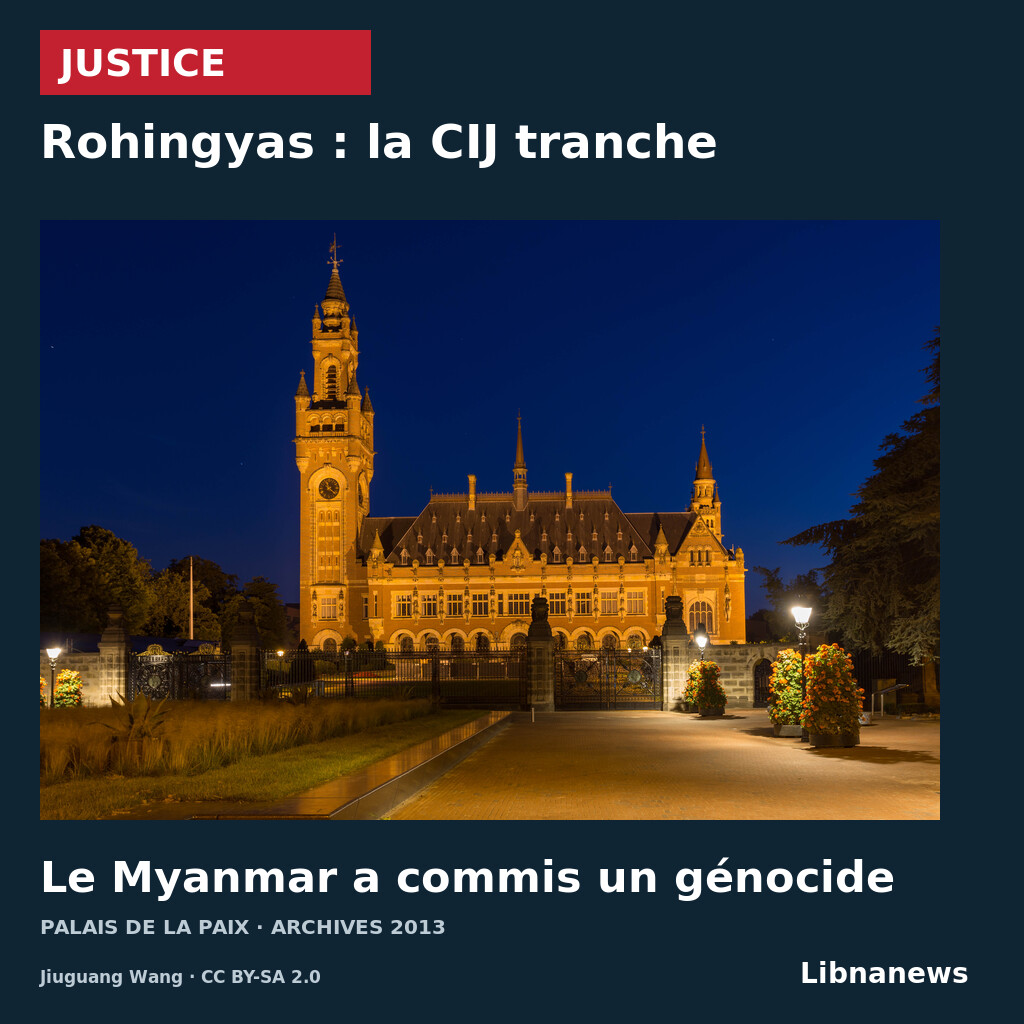
Photograph: Peace Palace in The Hague, 7 July 2013. Jiuguang Wang, via Wikimedia Commons, CC BY-SA 2.0. Resized whole photo; composition Libnanews under the same license. This archive does not represent the hearing of November 19, 2026.





Comments