

Nepal and Bhutan want to give a sustainable place to mountains in climate negotiations. Their proposal for COP31 addresses the effects of warming, including a 1.5°C exceedance, on glaciers, ecosystems and altitude populations. For Lebanon, the stakes are not for Himalayan glaciers: they include seasonal snow and water availability.
A proposal, not yet a programme adopted
Transmitted to the secretariat of the United Nations Climate Convention at the end of October, the text of both countries calls for a regular political dialogue and a work programme on mountains. It links scientific knowledge, adaptation needs and funding. This deposit is neither collective decision nor allocation of funds.
The COP31 Presidency opened consultations on this issue after the adoption of the agendas of 9 November. In a draft covering decision dated 16 November at 12:40 p.m., a passage proposes a programme dedicated to mountains and glaciers, as well as a high-level dialogue at COP32. However, the document expressly mentions unedited projects and still contains elements to be completed. In the documents consulted on the morning of 19 November, this mechanism is not presented as a decision adopted.
In Lebanon, snow is a seasonal reserve
A 2021 research on Mount Lebanon and Anti-Lebanon reconstructed the snow cover for 2010–2017, combining atmospheric models with satellite observations. It highlights its high variability from year to year. In this reconstitution, the maximum storage of water in the form of snow is mainly between 2,200 and 2,500 metres.
The sensitivity to warming is due in particular to the proximity of snow cover temperatures to the zero-degree threshold. This reserve builds up in winter and then releases water during melting. A change in its duration or volume may therefore change the water availability schedule beyond the only white area visible on the peaks. The study does not, however, describe a snow measure of November 2026.
Basins that do not all react in the same way
The link between mountain and supply is not limited to a single formula. A 2020 study of the karst source of Qashqush, north of Beirut, builds on more than three years of continuous monitoring. In the scenarios tested, this system appears to be more sensitive to a decrease in rain than only to warming, due to the limited influence of snow on its flow.
The two results do not contradict each other: one relates to the dynamics of the snow cover of mountain chains, the other to the functioning of a particular aquifer. Rocks, underground reserves and infiltration pathways alter the local response. Translating directly to Lebanon conclusions on the Himalayas glaciers would mask these differences.
The case advocated by Nepal and Bhutan thus opens up a concrete question for the Mediterranean countries: how can they better observe their mountains and translate these data into water policies? The transition from this issue to an international arrangement still depends on the text finally adopted. At this stage, no new Lebanese funding is derived from the documents examined.
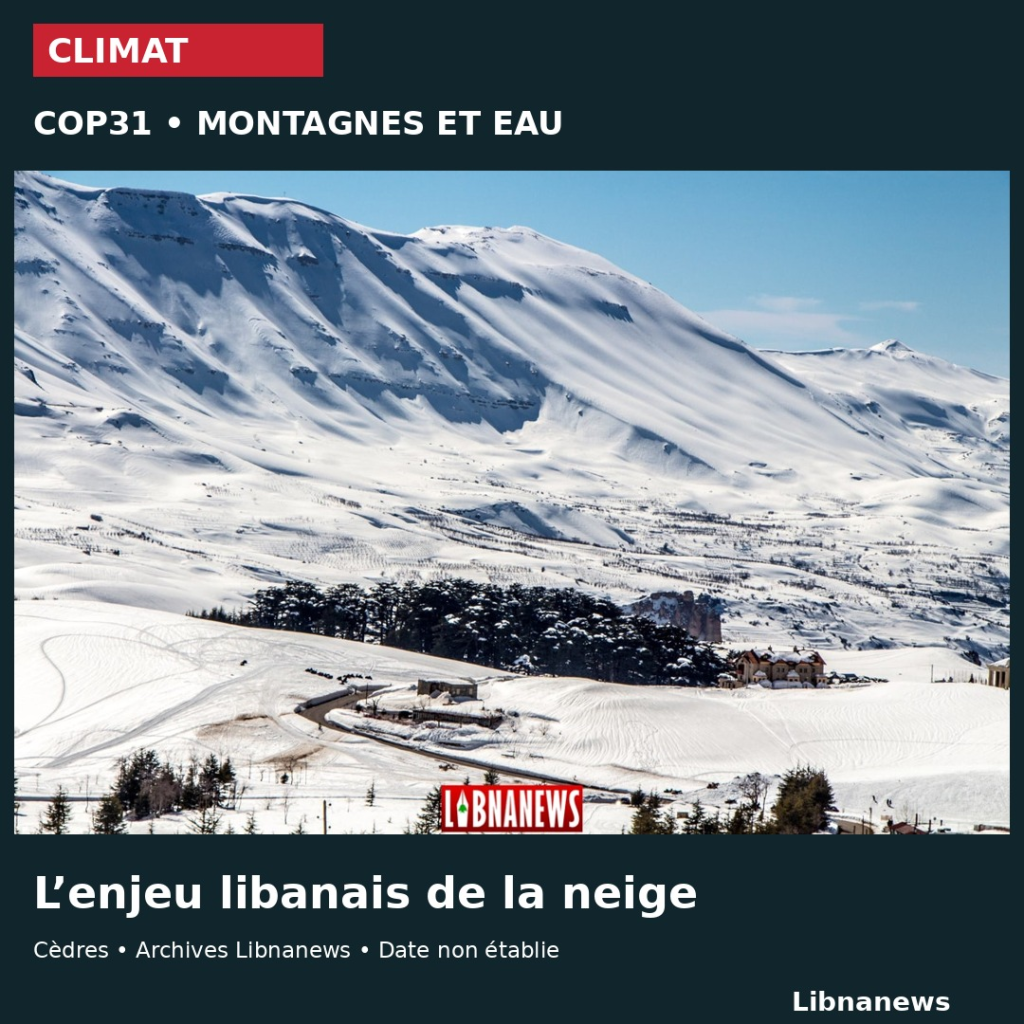
Snowy landscape with cedars, photo archive Libnanews. Date of shooting not established; not a snow condition of November 2026.





Comments