

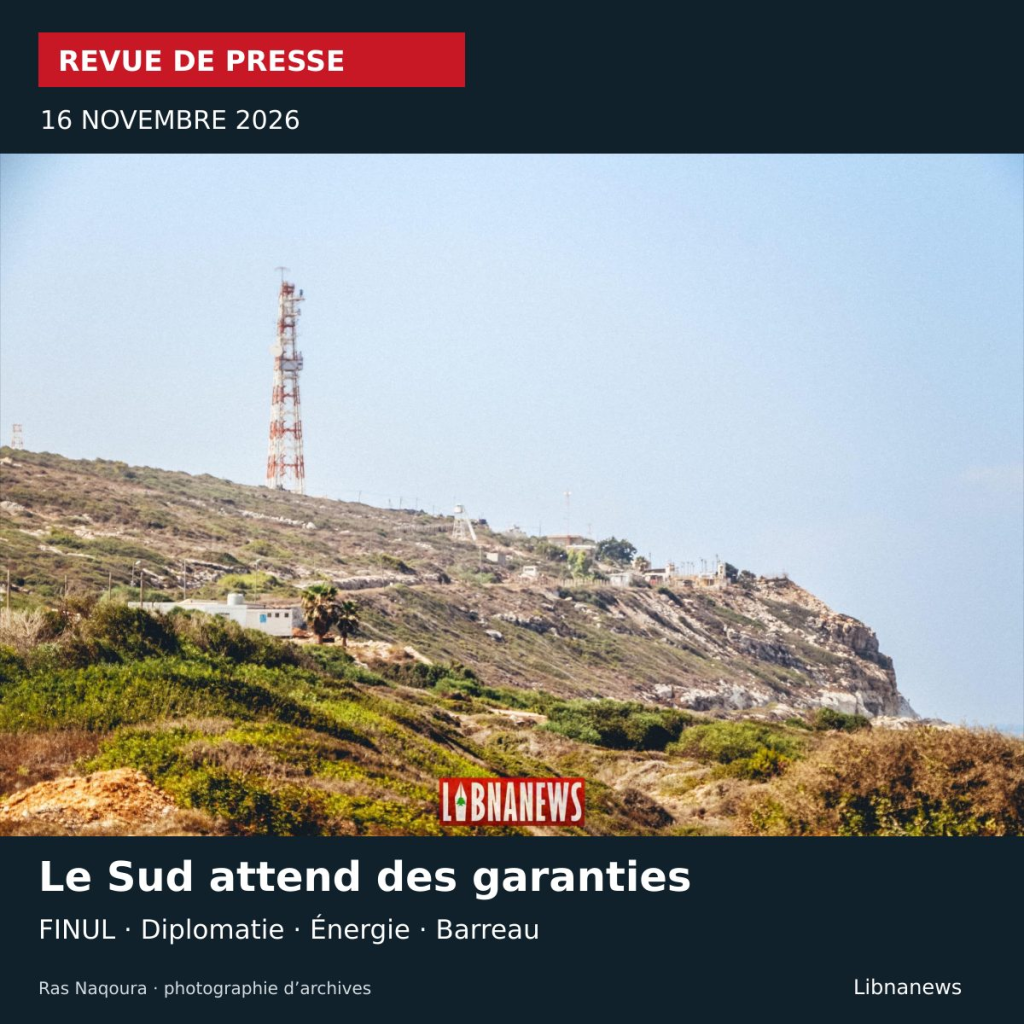
On the front page: the South expects guarantees
The 16 November 2026 press review places Mike Waltz’s visit at the centre of Lebanese expectations. The newspapers describe a dense diplomatic sequence, without announcing a fixed solution for the post-FINUL. They also devote their headlines to Nawaf Salam’s energy talks in Qatar and the results of the Beirut Bar Association.
In its 16 November edition, An-Nahar brings American, Saudi and Turkish movements closer together. The daily does not, however, present them as a common mission. He stressed that each visit followed his own programme. Bilal Erdogan completed a three-day tour. Yazid ben Farhan arrived on Saturday, while Waltz joined Lebanon on Sunday.
An-Nahar sees this succession as a renewed attention to Beirut, but also a concern for the South. The newspaper announces talks with key Lebanese officials and the army commander. It distinguishes these appointments from assumptions about a future international force. The perspective of a Sinai-inspired device remains, in this narrative, a point of discussion.
Diplomacy: Who would frame the international presence?
Nidaa al-Watan, in its 16 November edition, insists on the clarifications that Beirut would request before responding to the American proposals. The newspaper refers to a structure combining civilian and military personnel. It does not publish signed agreement. The questions relate to its composition, powers, methods of intervention and relations with the State and the army.
The daily notes a major difference with the Sinai precedent: Egypt and Israel have concluded a peace treaty. Lebanon and Israel did not reach such a conclusion. This distinction limits the scope of a sometimes summarized comparison to the observer format alone.
Nidaa al-Watan also reports the words of a spokesman for the State Department. It links the stages of Hezbollah’s disarmament to corresponding Israeli measures. This is the American position reported by the newspaper, not the observation that a withdrawal or disarmament has already been achieved.
Al-Joumhouria, in its 16 November edition included in the editorial compilation, focuses on Lebanese reserves. An unnamed figure says that no sufficiently specific project has yet emerged under UN mandate. The daily describes a commitment to Resolution 1701 and a United Nations presence. These elements remain attributed to the newspaper’s interlocutors.
The difference between these readings therefore concerns the degree of progress of the options, more than the existence of the problem. A draft referred to by a diplomatic source is neither Lebanese acceptance nor a mandate adopted by the Security Council.
Economy: in Doha, negotiation and not delivery
In his article posted on November 15th at 11:14 pm for the next day’s edition, Ad-Diyar details the electrical discussions. Nawaf Salam and Joe Saddi visited Doha on Sunday. Their meeting with the Qatari Prime Minister covers several components: electricity production, gas supply and infrastructure projects.
Ad-Diyar mentions power plants, a floating storage and regasification unit, as well as trade through Syria. The newspaper refers to the negotiation of a Qatari supply of liquefied natural gas over 20 years. This period concerns the contract envisaged, not an undertaking whose signature would be acquired.
The daily reports the progress announced by Salam in preparing an agreement between governments. However, he opposed this political advance to the time limit for equipment. An unnamed source estimates that the projects would not produce electricity for at least 18 months. This estimate is not a confirmed contractual timetable. No price, guaranteed volume or date of commissioning can be deducted.
Local politics: Bar-tested alliances
Sunday’s results offer another angle to the headlines of November 16. The selection of titles published by Beirut 24 highlights the contrast between Ad-Diyar, which highlights a surprise, and Al-Akhbar, which insists on the failure of the candidates of the Lebanese Forces and Kataeb. This vocabulary is part of their political reading of the ballot.
The four elected officials cited in the proceedings are Elie Klimos, Wassim Bou Tayeh, Maya Chehab and Wissam Eid. This partial renewal of the board must be distinguished from an election as a stickman. The vote was not about the replacement of Imad Martinos.
The reminder of the electoral process sheds light on the result. Prior to the election, Libnanews had identified fifteen candidates for four three-year terms. The Lebanese Forces, Kataeb and the Future Current supported the same group: Riyad Chidiac, Elie Kazan, Maya Chehab and Elie Klimos. Two members of this group are among the elected, while the two candidates directly supported by the Lebanese Forces and the Kataeb do not win.
Presenting the result as the undifferentiated defeat of the whole list would therefore make this nuance disappear. Bou Tayeh, an outgoing member supported by the Free Patriotic Current, finds a seat. The election concerns a professional institution and its own balance; it is not a national measure of voting intentions.
Regional relations: the security issue in Damascus
The press selection prepared for Radio Liban and published on 16 November by Al Montasher also included Ahmad Hajjar. It notes its discussions in Damascus with its Syrian counterpart, Anas Khattab. The report highlights security cooperation, border crossings and Syrian detainees in Lebanon.
This meeting is distinct from the energy negotiations in Doha. The juxtaposition of the two movements in the newspapers does not prove a global agreement between these capitals. The practical arrangements for coordination, such as the administrative or judicial follow-up of the cases referred to, remain to be established by the authorities concerned.





Comments