An assumed divergence, but no front against Baabda
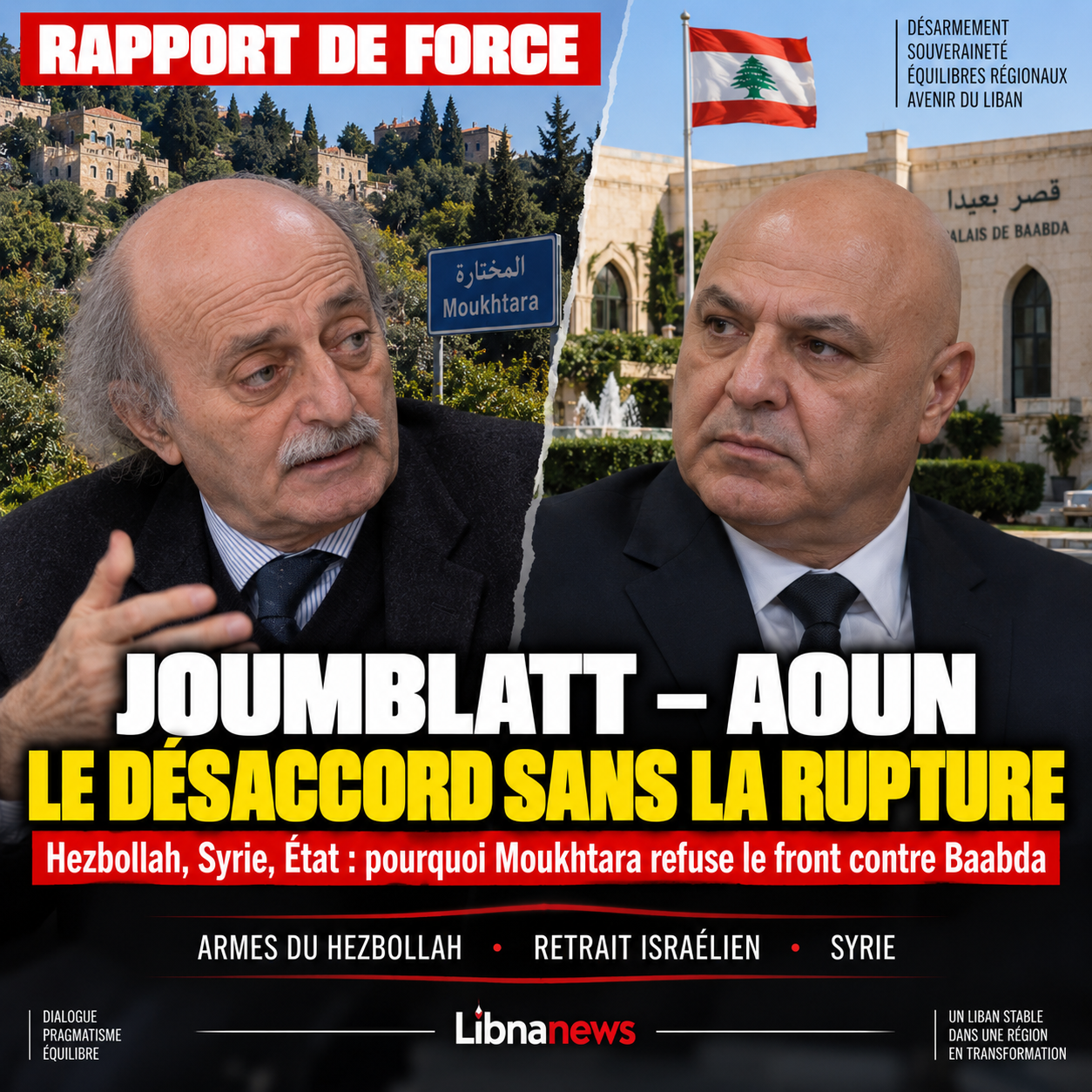
Walid Joumblatt distanced himself from certain orientations of Joseph Aoun, but refused to turn these differences into confrontation with the Presidency. This distinction is at the heart of its current position. Above all, it allows us to understand why the historical leader of Mukhtara can criticize Baabda’s choices, maintain his own relations with Hezbollah and Syria, while avoiding joining a political coalition directed against the President of the Republic.
The first issue is how to address the issue of arms and the recomposition of the State. Jumblatt does not dispute the principle of the monopoly of legitimate force. His approach, however, was to reject a policy that would treat disarmament as an operation isolated from the rest of the Lebanese problem. For him, the question of Hezbollah remains linked to the Israeli withdrawal, the situation in the South, the security of the Shiite community and the new regional balance created by the war with Iran.
This caution is not only ideological. It corresponds to a political method that Jumblatt has long applied: not to be held prisoner of an axis at a time when regional power relations change rapidly. In the context of 2026, this method led to the simultaneous retention of canals with Baabda, the government of Nawaf Salam, Hezbollah, Damascus, Riyadh and several western capitals.
The result may give the impression of an ambiguous position. Rather, it is a strategy for separating files. Joumblatt may disagree with Joseph Aoun without considering that the weakening of the presidency serves his interests.
The first dispute concerns how to deal with Hezbollah
The Government’s decision of July 2026 to put an end to Hezbollah’s autonomous military existence and to reserve the use of force to the state has moved the political debate. The question no longer formally arises as to whether the State should have a monopoly on arms. It has become the calendar, method and conditions of its application.
Nawaf Salam summarized the government’s position in New York by stating that there could be « two armies » and « two decisions ». Joseph Aoun also insists on strengthening the state and the army.
Jumblatt has no interest in appearing as a defender of a parallel military structure. But neither does he want to support a logic that could lead to an internal confrontation with Hezbollah.
This nuance is fundamental.
Hezbollah is not just an arsenal. It is also a political force with a large social presence in the Shia community. A disarmament operation conducted without political agreement could therefore have consequences far beyond the military domain.
The political entourage of Jumblatt has long insisted on this dimension. The question is not simply to recover weapons, but how to integrate them into a new state architecture without causing a break with a part of the population.
The debate thus joins that of strengthening the army. In order for the State to replace Hezbollah in a sustainable manner as a guarantor of security, it must be able to offer credible protection to the people of the South and the Bekaa.
Israel still occupies positions in Lebanon and continues its operations. In these circumstances, calling for rapid disarmament without at the same time obtaining Israeli withdrawal creates a politically difficult equation.
Jumblatt does not believe in disarmament obtained by simple injunction
Former Minister Ghazi Aridi, who remains one of the most experienced political relatives of Mukhtara, gave a particularly clear reading of the problem. According to him, Hezbollah does not simply surrender its weapons to the state because a government decision demands it. On the contrary, the public statements of the party leaders show that they condition their position to the evolution of the military and political situation.
This assessment does not mean that Jumblatt wishes to maintain the Hezbollah arsenal indefinitely. It means that he does not believe in a solution based solely on administrative constraint.
The problem is all the more complex as Washington and Israel expect rapid results from the Lebanese army. The United States conditionally supports the consolidation of state authority. Israel uses the existence of the Hezbollah arsenal to justify the maintenance of certain positions and the continuation of its operations.
Jumblatt is very wary of this mechanics.
If Israel conditionalizes its withdrawal on complete disarmament, while Hezbollah conditions the discussion of its weapons upon Israeli withdrawal, the Lebanese State finds itself trapped between two incompatible conditions.
Taking sides exclusively for one of the two sequences can lead to an impasse.
The Joumblatt method therefore consists more of looking for a process than an ultimatum.
The divergence with Baabda also concerns the rhythm
Joseph Aoun is under considerable international pressure. It must demonstrate that the Lebanese State is capable of fulfilling its commitments, strengthening the army and extending its authority over the territory.
Joumblatt has a different position. He no longer directs the executive and can reason on a longer political calendar.
This difference in responsibility naturally produces a difference in pace.
Baabda must respond to American and international demands. Mukhtara can focus more on internal risks.
For Jumblatt, a theoretically correct decision can become dangerous if it is applied in bad conditions. The history of the Lebanese civil war weighs heavily on this approach. Any attempt to transform a political conflict into a confrontation between institutions and communities is a particularly sensitive line for him.
He also knows the cost of religious polarization.
This is one reason why he avoids presenting the issue of weapons as a confrontation between the state and the Shia.
The problem must remain that of an autonomous military organisation, not that of a community.
Israeli factor prevents Jumblatt from going to break up with Hezbollah
The Israeli presence in South Lebanon is an essential element of this position.
As long as Israel occupies parts of the territory and continues its operations, Hezbollah has a powerful political argument to justify the maintenance of its arsenal.
This argument can be challenged. It can’t be ignored.
For Jumblatt, obtaining an Israeli withdrawal would allow a profound change in the terms of the internal debate. Hezbollah would find it more difficult to justify military autonomy if the army effectively controlled the territory and Israeli violations decreased.
This logic explains why Mukhtara insists on the link between support for the army, Israeli withdrawal and dealing with the issue of arms.
It also explains why Jumblatt does not join the political forces who wish to make immediate disarmament the precondition for everything else.
He does not want to give Hezbollah a permanent right to retain its weapons. Above all, it refuses Lebanon to accept an equation in which Israel retains its positions while the State alone takes the risk of internal confrontation.
Syria is the second major parameter
The position of Jumblatt cannot be understood solely from Lebanon. Syria has become a key element of its strategy.
For Chief Druze, this case has a personal, historical and community dimension. His relationship with Damascus has been extremely violent. But the 2026 situation obliges us to look at Syria differently.
The Druze question in Syria, especially in the South Syrian, places Mukhtara in the face of a stake directly related to the security of the community. Jumblatt seeks to preserve the Syrian Druze while avoiding their transformation into an instrument of a separatist project or an Israeli strategy.
This line is essential.
Joumblatt has historically defended the unity of Syria. He is wary of the projects of Community cantons, including when they are presented as guarantees of protection for minorities.
For him, the protection of the Druzes must not lead to the detachment of their regions from the Syrian state or to their placing under Israeli protection.
This position leads him to seek relations with Damascus while maintaining his capacity for criticism.
The Golan precedent weighs on his reading of the Druze question
The relationship between Israel and some Druze communities in the region is a particularly sensitive subject for Jumblatt.
Israel can present its policy as protecting the Druze against the threats they face in Syria. Mukhtara, however, mistrusts any strategy that would make the community a relay of Israeli influence.
The history of the Golan reinforces this mistrust.
A significant part of the Druze in the occupied Golan maintained its Syrian identity for decades despite Israeli annexation. For Jumblatt, therefore, the Druze community should not be transformed into justification for a redefinition of borders or sovereignty.
This approach also explains its interest in the stability of the Syrian state.
A collapse of the central authority could create rival community areas and place the Druzes in front of the need to seek outside protectors. This is precisely the scenario he seeks to avoid.
Lebanon provides sufficient examples of the consequences of a system in which each community seeks its own regional support.
It is here that his position is paradoxically similar to that of Joseph Aoun
The disagreement between Jumblatt and Aoun should therefore not mask an important point of convergence.
The President said that the Lebanese must stop seeking their strength outside against their internal opponents. On 23 September, he called on the various components of the country to « support one another » rather than to use foreign powers in their conflicts.
This concept joins part of Joumblatt’s current strategy.
The Druze chief has many external relations. He did not want Lebanon to be transformed into a group of communities each protected by a different power.
His refusal of a front against Baabda must also be read from this angle.
Weakening the presidency as the state tries to rebuild its authority could produce exactly the fragmentation system that Jumblatt seeks to avoid in Syria.
He can therefore challenge Joseph Aoun on the method while considering the stability of the presidency as a best interest.
Why doesn’t he join Baabda’s opponents?
This is probably the most interesting political issue.
In the Lebanese system, disagreement with the President can quickly lead to the formation of a coalition of discontented people. Several forces have grievances against Baabda. Some challenge the management of appointments. Others criticize the issue of arms or the conduct of diplomacy.
Jumblatt could use these tensions to rebuild an opposition bloc.
He doesn’t.
The first reason is Nawaf Salam. Jumblatt has no interest in simultaneously destabilising Baabda and the government as the country goes through a particularly dangerous phase of negotiations.
The second is the absence of a clear alternative. Forming a front against Joseph Aoun would not answer either the question of Israeli withdrawal or that of weapons.
The third is regional. The relationship between Riyadh, Washington, Damascus, Tehran and other capitals remains too fluid to ensure that it is prudent to lock up on a rigid Lebanese axis.
The fourth is historical: Jumblatt knows that in Lebanon coalitions built around a confrontation often exist less long than the consequences of this confrontation.
Mukhtara prefers to keep a pivot position
This strategy allows Joumblatt to remain in contact with actors who talk little to each other.
He can support the state without joining the toughest campaigns against Hezbollah. He can speak with Hezbollah without resuming his military strategy. It can maintain relations with the Gulf countries while maintaining Syrian channels. He can criticize Baabda without trying to bring down the president.
This position has particular political value in a fragmented system.
It allows Mukhtara to become useful again when reports are blocked.
The choice is also consistent with the gradual transition from Progressive Socialist Party leadership to Taymour Joumblatt. However, Walid Jumblatt retains a decisive influence on the broad guidelines, particularly when they concern Syria, Druze and regional balances.
A frontal confrontation with Baabda would lock his son and his party in a specific camp when the family strategy was to preserve relations with several poles.
So the question is not whether Jumblatt « supports » Aoun
Reducing the relationship to a choice between support and opposition would be misleading.
Jumblatt can support Joseph Aoun when he defends the unity of the state, the strengthening of the army or the refusal of foreign community protections. It can move away from it when it considers that the pace imposed on weapons could lead to confrontation or that regional conditions do not yet allow the implementation of a decision.
This flexibility can be criticized as a form of opportunism. It is also the political method that Jumblatt has used for several decades to preserve his community and influence in the midst of brutal regional changes.
In 2026, this method was particularly useful.
Lebanon is at the junction of three crises: Israeli confrontation, transformation of the role of Hezbollah and recomposition of Syria. For Jumblatt, these files cannot be dealt with separately.
This is precisely what sometimes distances him from the Baabda method.
But that is also what prevents him from turning this disagreement into a political war against Joseph Aoun. A weakened presidency, a disputed army and a paralysed government would not give further guarantees to the Druze, in the South or the rest of the country.
The calculation of Mukhtara therefore appears more accurate than a simple distance take:leave Joseph Aoun the responsibility to rebuild the authority of the State, challenge methods deemed dangerous, maintain dialogue with Hezbollah and Damascus, but refuse to participate in a coalition whose aim would be to weaken Baabda herself.
It is less spectacular than a political front. In Walid Jumblatt’s logic, this is precisely what makes it worth it.