






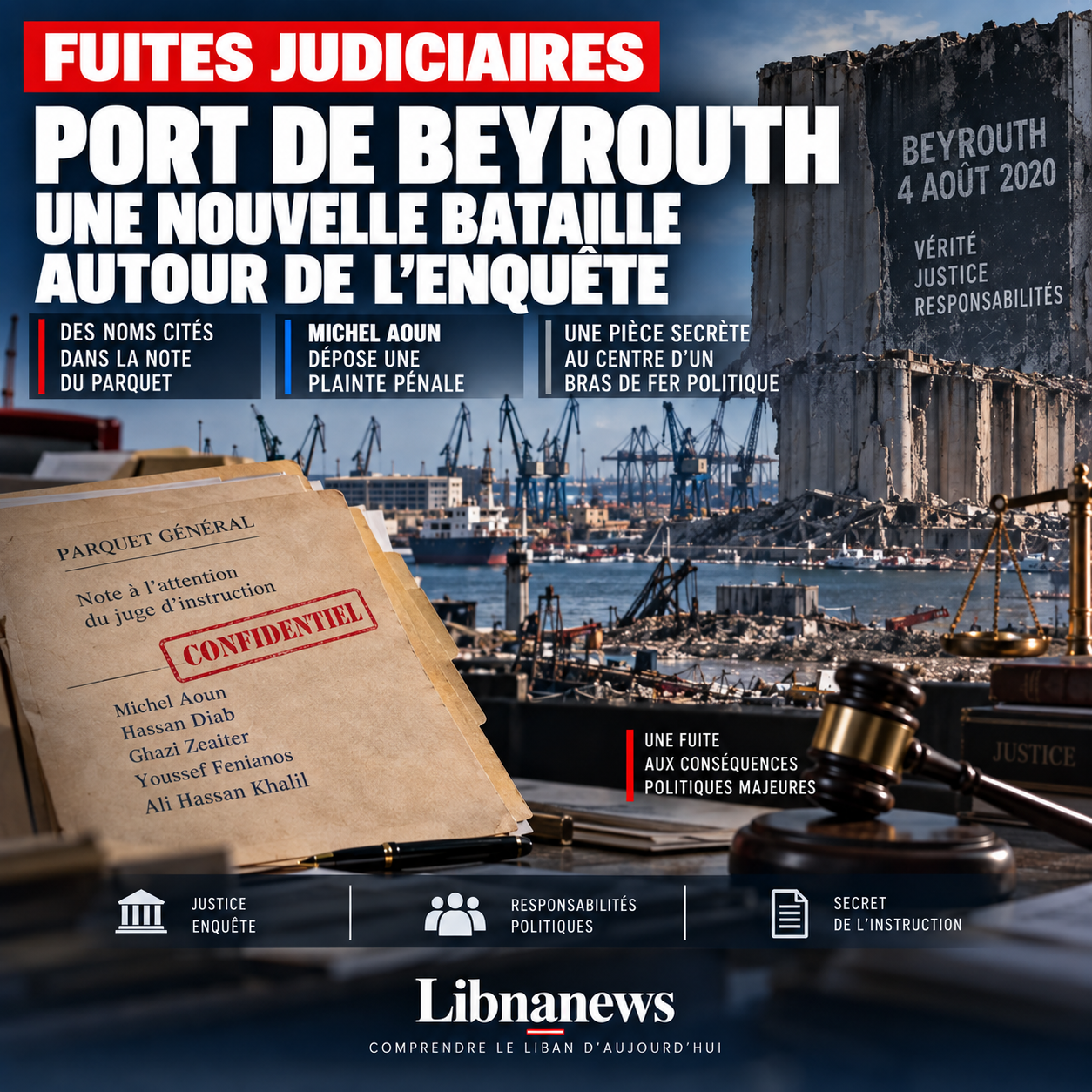
A procedural document supposed to remain secret is at the centre of the public debate
The investigation into the explosion in the port of Beirut is undergoing a further displacement of its centre of gravity. Even before the investigating judge Tarek Bitar issued his decision, information attributed to the General Prosecutor’s note began to circulate. They concern several former politicians and immediately provoked reactions, accusations and judicial proceedings. So the debate is not just about responsibility in the explosion. It now concerns the disclosure of a piece of proceedings, its actual content and the political effects produced by its premature publication.
Al Quds of 17 September 2026 reports that information from a judicial source reported a request by the prosecutor’s office to hold criminal responsibility against several officials in the port’s file. The daily quotes former ministers Ghazi Zeaiter, Youssef Fenianos and Ali Hassan Khalil, as well as former Prime Minister Hassan Diab. The name of former President Michel Aoun also circulated, with the mention of responsibility for negligence.
At the heart of this sequence is a note written by Attorney General Mohammad Saab and forwarded to Judge Tarek Bitar. This document became public in fragments before the proceedings produced its final judicial result. It is precisely this chronology that fuels controversy.
Ad Diyar of 17 September 2026 reports the explanations of the former Minister Salim Jreissati. The court insists on the legal nature of the document transmitted to the judge. According to him, the prosecutor’s note is secret and has no binding character. It is a position of the Public Prosecutor’s Office handed over to the investigating judge, but is not confused with a decision of the judge or the indictment expected in the case.
This distinction is essential. The names circulating cannot be treated as those of persons definitively indicted solely on the basis of the information disclosed. Judge Tarek Bitar retains his discretion over the continuation of the proceedings.
The flight, however, created a political reality even before the judicial decision.
Michel Aoun responds with a criminal complaint
Michel Aoun’s reaction was immediate. Nahar of 17 September 2026 reports that the former president announced the filing of a criminal complaint after the publication of information presenting his name as concerned by the note of the Attorney General’s Office.
Michel Aoun invokes several offences. He denounces the fabrication of false information, defamation and violation of the secrecy of investigation. He claims to act in the name of respect for victims and the protection of truth and justice.
This is also reported by Al Binas of 17 September 2026. The wording adopted by the former Head of State was important: his complaint was not only about his name appearing in the press. It also attacks the process that has enabled information presented as a result of a confidential procedure to enter the public debate.
Al Quds of 17 September 2026 gives more details on the subsequent political reaction. Former MP Amal Abu Zeid wonders about the nature of the procedure after the release of the name Michel Aoun. It refers to the risk of selective justice or a disguised political trial.
Other reactions were more nuanced. Al Quds reports that former MP Farès Souhaid refused that the issue was a succession of names disclosed. He has refocused the debate on a more fundamental question: should the explosion of the port be legally understood as an explosion or as an act provoked? He also wondered whether the circulation of names might divert attention from the substantive issues expected since the beginning of the investigation.
According to the same newspaper, Eli Mahfoud, president of the Change Movement, takes a different position despite his political opposition to Michel Aoun. He believes that the judicial process concerning the former President should not give rise to jubilation or a logic of revenge. For him, politicization and revenge do not bring the Lebanese closer to the truth about the port.
The leak therefore immediately produced what the investigation has been seeking for years to avoid: a new line of political fracture around the judicial procedure.
A prosecutor’s note is not the indictment
Confusion between the different stages of the procedure is one of the main dangers of the sequence.
In his interview with Ad Diyar on 17 September 2026, Salim Jreissati recalls that the note awarded to Prosecutor Mohammad Saab was forwarded to the Attorney General’s Office before being handed over to the investigating judge Tarek Bitar. He points out that this exhibit remains a legal assessment and is not binding on the judge.
In other words, its content does not automatically prejudge the decision to be taken by Tarek Bitar.
This distinction becomes all the more important as disclosure occurs in a case where each judicial development is immediately interpreted politically. The port of Beirut remains associated with years of blockades, recourse, conflicts of jurisdiction and confrontation between judges and politicians. The premature circulation of a document can therefore alter the perception of the case before the judge has completed his work.
The problem is not just media. It affects the balance of the procedure.
A note from the Public Prosecutor’s Office may contain an analysis of the facts, a legal qualification and an assessment of responsibilities. However, the investigating judge remains responsible for deciding on the follow-up to be given to the evidence gathered. By publishing fragments of this analysis before the decision, the public debate risks treating as a conclusion what is still only a step.
It is precisely on this point that political reactions are focused. Michel Aoun’s opponents may be tempted to read disclosure as confirmation of liability. His supporters can see it as a political operation. In both cases, judicial proceedings may disappear behind the confrontation.
Behind the names, a constitutional question comes to the fore
The circulation of information about former ministers and Hassan Diab also reacts to an old legal conflict: which court can sue presidents and ministers for acts related to the exercise of their functions?
Al Quds of 17 September 2026 points out that the elements attributed to Mohammad Saab’s note put this issue at the forefront. Former ministers Ghazi Zeaiter, Youssef Fenianos and Ali Hassan Khalil as well as former Prime Minister Hassan Diab are listed among those responsible for whom criminal responsibility would be attributed.
The problem lies in the division of competences between the ordinary justice system and the High Council for Judges of Presidents and Ministers. This controversy accompanied much of the port investigation.
It therefore exceeds the newly mentioned persons.
If the alleged facts are considered directly relevant to the performance of ministerial functions, the question of a special court may be raised. If they are described as ordinary offences detachable from political exercise, the jurisdiction of the judiciary can be defended.
The leak puts this debate on the table even before the final acts of the investigation are known. This adds a new layer of legal confrontation to a case already marked by appeals and jurisdictional challenges.
The risk is obvious: a procedural battle could begin on the basis of a document whose full content has not been officially made public.
Who better get the information out?
The question of the origin of disclosure is now inevitable.
Salim Jreissati, interviewed by Ad Diyar on 17 September 2026, believes that a complaint against unknown could be filed to determine the leaker. He also referred to the possibility of bringing the matter before the judicial inspectorate if a magistrate was to appear at the origin of the disclosure.
His reasoning does not stop at the violation of secrecy. Jreissati questions the timing of the operation. He noted that the information had emerged at the same time as Parliament was examining the government’s action.
This coincidence feeds political accusations. However, it alone does not identify the leaker or establish his intention.
The timetable nevertheless deserves attention. On 17 September, Lebanese news was dominated by the parliamentary questioning session of the government of Nawaf Salam. MEPs are fighting over disarmament, the framework agreement, the economy, electricity and negotiations with Israel. The tension between the Free Patriotic Current and the government is particularly strong. At the end of the session, Gebran Bassil requested a vote of confidence.
It is in this atmosphere that Michel Aoun’s name appears in the port file.
Al Quds also reported a political reaction that explicitly attributed to the flight a desire to divert attention from the parliamentary sitting. That charge belongs to the political register. However, it illustrates the effect produced: instead of remaining confined to the judicial record, the note immediately becomes a weapon in the confrontation between camps.
The identity of the person who transmitted the information then becomes almost as sensitive as their content.
The risk of a parallel media inquiry
The port folder carries a particular load. The explosion caused death, injury, massive destruction and lasting trauma. Each information concerning the investigation is therefore followed with exceptional attention.
This expectation also creates a political and media market for leaks.
When the procedure proceeds slowly, each document becomes likely to be presented as a decisive revelation. Names circulate before decisions are made. Assumptions are transformed into accusations. Political reactions sometimes precede the publication of judicial documents.
The danger is that there will be two parallel investigations.
The first is conducted by Tarek Bitar and follows the rules of procedure. The second takes place in the public space, using fragments of documents, information from judicial sources and partisan reactions.
These two temporalities are not compatible. The judge may need weeks or months to stop a qualification. Media space demands immediate response on those responsible.
The leak of Mohammad Saab’s note accentuates this tension.
It creates the impression that the findings are already known while the judge has not yet rendered his final decision. It also allows each camp to select the part of the folder that supports its own reading.
For the families of the victims, this situation can be particularly severe. They expect a response on the responsibilities in the explosion. A new battle over flight may once again shift the debate about the disaster itself to institutional and political conflicts.
The central issue remains responsibility
The reactions reported by Al Quds on 17 September 2026 show that some politicians are already trying to bring the debate back to the bottom.
Farès Souhaid thus raises the question of the very nature of the disaster. The priority, according to his daily intervention, remains to determine what actually happened. This question refers to the expectations that accompany the investigation since the explosion: origin of the substances, conditions of their presence at the port, responsible persons informed of the danger, decisions taken or not taken and chain of responsibility.
The circulation of a list of names does not answer these questions.
It can even mask them if attention focuses solely on the identity of the politicians mentioned.
The future act of Judge Tarek Bitar must instead build a legal chain. He will have to explain the facts against each person, on what basis and on what qualification. It is this architecture that will measure the actual scope of the survey.
The public prosecutor’s note is only one component.
A leak that could open an investigation into the investigation
Michel Aoun’s complaint now adds a file to the file.
If investigations are conducted, the court will have to determine how the information on the prosecutor ‘ s note was obtained and disseminated. The issue could lead to a review of the document’s path and the people who had access to it.
This parallel investigation would be particularly sensitive if it involved members of the judiciary.
Salim Jreissati refers precisely to this possibility when he talks about a possible referral to the judicial inspection. At the same time he defends the reputation of the magistrates Mohammad Saab and Tarek Bitar, whom he presents as above suspicions. His accusation is therefore directed less at the two main actors in the proceedings than at the mechanism that allowed the flow of information.
The paradox is striking. An investigation to establish responsibility for one of the most serious disasters in Lebanon’s recent history could now generate a second procedure to establish responsibility for the disclosure of its own documents.
The way this case is handled will have a direct effect on the credibility of the future.
If the origin of the leak remains unknown, each new judicial information may be suspected of being used politically. If an investigation clearly establishes the channel of disclosure, it can instead help separate judicial work from partisan battle.
The real appointment, however, remains in the hands of Tarek Bitar. Until its decision is rendered, the information attributed to Mohammad Saab’s note is not the last word of the investigation.
On September 17, 2026, the port file was therefore at a strange moment. Responsibilities are beginning to be mentioned publicly, but the exhibit that would mention them is not intended to replace the judge’s decision. A complaint is filed for breach of secrecy, while political reactions are already increasing around the names disclosed.
The next battle will not only focus on those likely to be pursued. It will also focus on the capacity of the justice system to regain control of a procedure that has just been removed from the judicial file and entered the political arena prematurely.