When US refusal to intervene in Yemen forces Saudi Arabia to look differently at its alliance with Washington
There are alliances that die in the crash of a denounced treaty. And there are others who turn off more slowly, almost silently, on the day one of the partners discovers that the promise that he believed was acquired is no longer automatic. Perhaps that is what has just happened between the United States and Saudi Arabia.
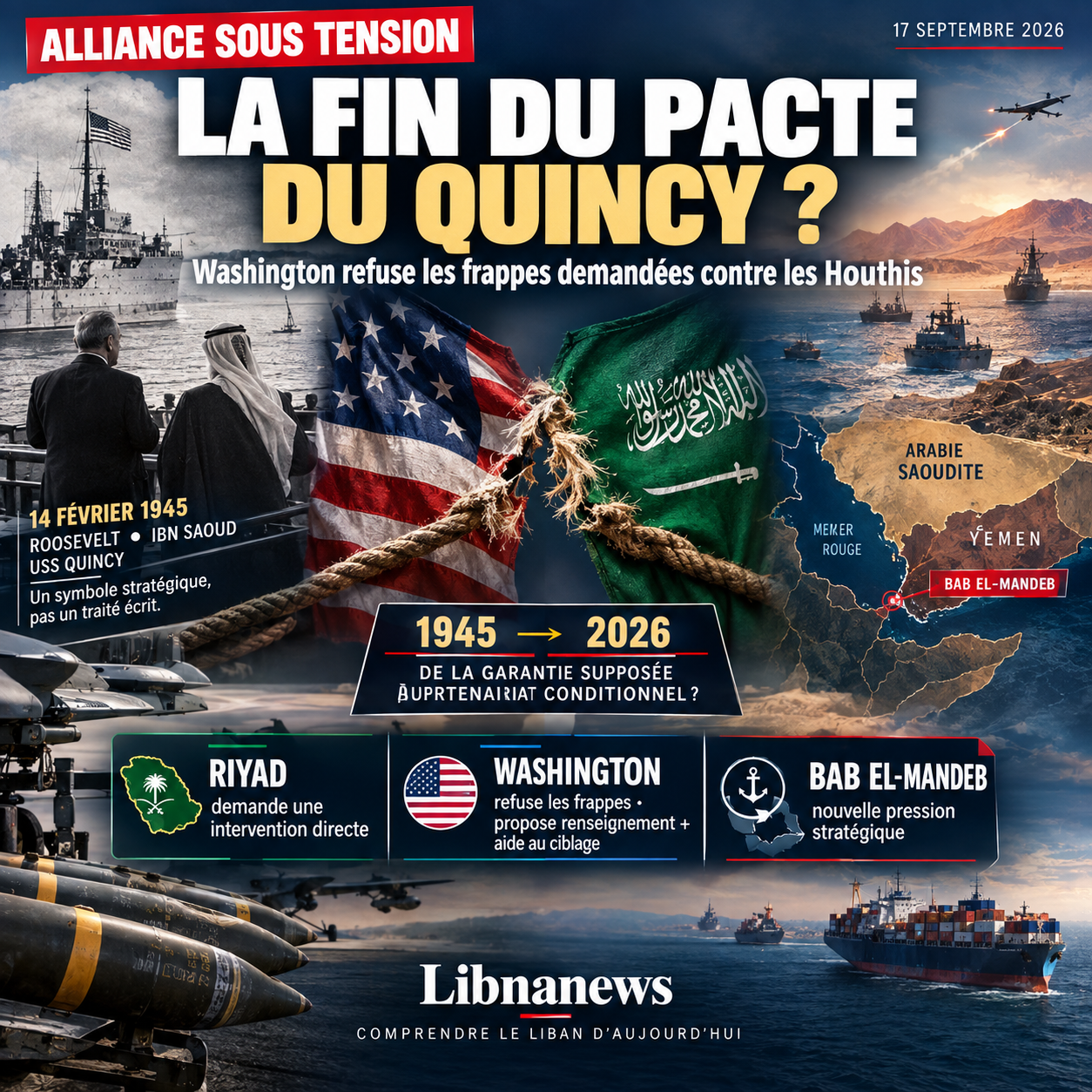
In September 2026, as the Houthis were advancing on the Yemeni Red Sea coast and consolidating their grip around the Bab al-Mandeb Strait, Saudi Crown Prince Mohammed bin Salman asked Donald Trump for direct US military intervention. According to Reuters, Washington refused to conduct the required strikes, while offering intelligence and targeting assistance. This refusal does not mean the abandonment of any military cooperation between the two countries. But its symbolic significance is immense.
Because behind this episode is a story more than eighty years old: that of Quincy.
14 february 1945: a meeting that becomes a symbol
On 14 February 1945, on the return of the Yalta conference, Franklin D. Roosevelt met King Abdelaziz Ibn Saud aboard the American cruiser USS Quincy, on Grand Lac Amer, in the Suez Canal. The official record of the conversation shows that they are talking about Palestine, the regional future, agriculture and the development of the kingdom. There is no written treaty in this document saying in a few lines: « oil for military protection ».
Yet history has retained something else. It made the meeting the founding symbol of a progressively consolidated strategic arrangement: Saudi Arabia became a central energy and political partner in Washington; In return, the United States contributed to the security, stability and military modernization of the kingdom. The American archives of the time explicitly show the importance Washington already attached to Saudi stability and access to the country’s immense oil resources.
This is more than the text of a non-existent treaty, commonly referred to as the « Quincy Pact ». An unwritten but extraordinarily lasting pact: oil and Gulf stability on one side; American power, armament and one form of strategic guarantee of the other.
Quincy was not just an interest arrangement. In time, he had become a promise of trust.
An alliance crossed by crises
This relationship has never been simple. It survived the creation of Israel, the 1973 war, the oil embargo, the Iranian revolution, the Gulf War, 11 September, disagreements over Iraq, the Arab spring, the Khashoggi affair and differences over Iran. Each crisis seemed to herald a break; Each time, strategic interests ended up sticking together.
But something has gradually moved. The United States has become less dependent on oil imported from the Gulf than it once was. Asia has become the dominant outlet for Saudi oil. Riyadh, for its part, sought to diversify its partnerships with China, Russia, India and other powers. The alliance has not disappeared; It has become more transactional, more conditional, less instinctive.
The turning point is psychological as well as military: Saudi Arabia can no longer assume that any serious threat to its security will automatically trigger a US military response.
Bab al-Mandeb: the moment of truth
That’s why Bab al-Mandeb’s episode is so important. The strait is not a peripheral theatre. It links the Red Sea to the Gulf of Aden and is one of the major arteries of world trade. The Huthie progression on the coast and towards the island of Perim gave the Yemeni movement allied with Iran an additional lever on this maritime route.
For Riyadh, the threat is direct. It is military, economic and strategic. Saudi Arabia had long thought protected by the depth of its American partnership. Now, at a time when she is calling for direct military action to push back a breakthrough that she considers dangerous, Washington essentially responds: we can help you see, identify, target; We will not necessarily wage war in your place.
The difference between the two sentences must be measured. It holds in a few words, but it can separate two epochs.
An alliance exists as long as the two partners give the same meaning to the word « security ».
Is this really the end of Quincy?
It would be excessive to say that only one US refusal legally terminates eighty years of strategic relationship. There is no « Treaty of Quincy » to denounce. The United States continues to cooperate with Saudi Arabia, provide weapons systems, intelligence, defence capabilities and a very high-level military dialogue.
But alliances don’t just live on texts. They live from perceptions. They rely on what each partner believes the other will do when the critical moment comes. From this point of view, the current episode can mark a profound break: not the administrative end of an agreement, but the end of a certainty.
For decades, the kingdom could think: if a major strategic threat endangers regional balance, the United States will eventually intervene. Today, the question becomes: in what specific circumstances will Washington consider that Saudi security still coincide with its own national interest?
Iran and the new geography of power
The other actor in this story is obviously Iran. The Houthis are not mere Tehran executioners: they have their own objectives, their history and their Yemeni interests. But their military cooperation with Iran and Hezbollah is widely documented, and their progress objectively increases the strategic leverage of the Iranian camp around the Red Sea.
Geography makes this development particularly sensitive. To the east, the Strait of Ormuz controls maritime access to the Gulf. To the west, Bab al-Mandeb commands access to the Red Sea and beyond the Suez Canal. Any power capable of simultaneously threatening these two doors has a disproportionate pressure on global energy and trade flows.
This does not mean that Iran mechanically « controls » both straits, or that Washington renounces to contain Tehran. The United States remains militarily engaged in the region. But this means that Washington’s Arab allies must now consider an almost unthinkable assumption: America can choose to fight for its own red lines without automatically fighting for their own.
The new solitude of Gulf powers
Perhaps this is where the most human dimension of this story lies. An alliance of eighty years creates habits. It creates a collective memory, military reflexes, generations of officers trained together, contracts, bases, diplomatic networks, but above all a sense of security. Then, one day, the partner discovers that he may have to learn to defend himself differently.
For Saudi Arabia, this can mean three things at a time: strengthening its own military capabilities; seeking more partners and regional alliances; and maintaining a dialogue with Iran and the Houthis precisely because the American guarantee is no longer seen as unlimited.
This development does not necessarily condemn the relationship with Washington. It can even lead to a more adult, more balanced relationship, where responsibilities are better distributed. But it ends the comfortable illusion that American power is a risk insurance.
From protection pact to conditional partnership
The world of 1945 was that of Roosevelt, a still poor Saudi kingdom, an oil whose geopolitical importance was exploding and an America entering its century of power. The world of 2026 is multipolar, saturated with drones and missiles, crossed by Chinese-American rivalry and much more autonomous regional powers.
It would have been surprising if Quincy passed through such a change of era intact.
What may be dying is not the American-Saudi alliance. It is its ancient form: that of a protector and a protégé, that of a guarantee supposed to be automatic, that of a Middle East where the last decision almost always came back to Washington.
In its place appears a colder world. The United States chooses its battles. Saudi Arabia must choose its dependencies. Iran is testing the voids. Regional powers learn that they will sometimes have to balance themselves.
The end of certainty
The Quincy may not have died the day Donald Trump refused strikes against the Houthis. History is rarely so clear. But this day could remain like the one when Riyadh realized that the pact no longer meant exactly what he had meant for several generations.
Large alliances often end before their institutions disappear. They end when confidence changes in nature.
In 1945, on the Quincy bridge, two men met in the middle of a world emerging from the war. Behind them was a relationship that would structure the Middle East for eight decades. In 2026, off Yemen, it is not a treaty that breaks apart. It is perhaps an old conviction that, when the danger becomes existential for the kingdom, America would necessarily be there.
If this conviction disappears permanently, then the real legacy of Quincy will have ended — not in a diplomatic ceremony, but in the silence of a refusal.
Benchmarks and sources
• U.S. Department of State, Office of the Historian, memorandum of the Roosevelt–Ibn Saud meeting aboard the USS Quincy, 14 February 1945.
• Council on Foreign Relations, The Case for a New U.S.-Saudi Strategic Compact, 2022, on the historical and strategic significance of the Quincy meeting.
• Reuters, 11 September 2026, on Saudi demand for US military action against the Houthis and the refusal of direct strikes, accompanied by an offer of intelligence and targeting assistance.
• Reuters, 16–17 September 2026, on the haughty advance around Bab al-Mandeb, the Saudi situation and the American-Houthis contacts in Oman.
The end of Quincy’s pact? • 17 September 2026