





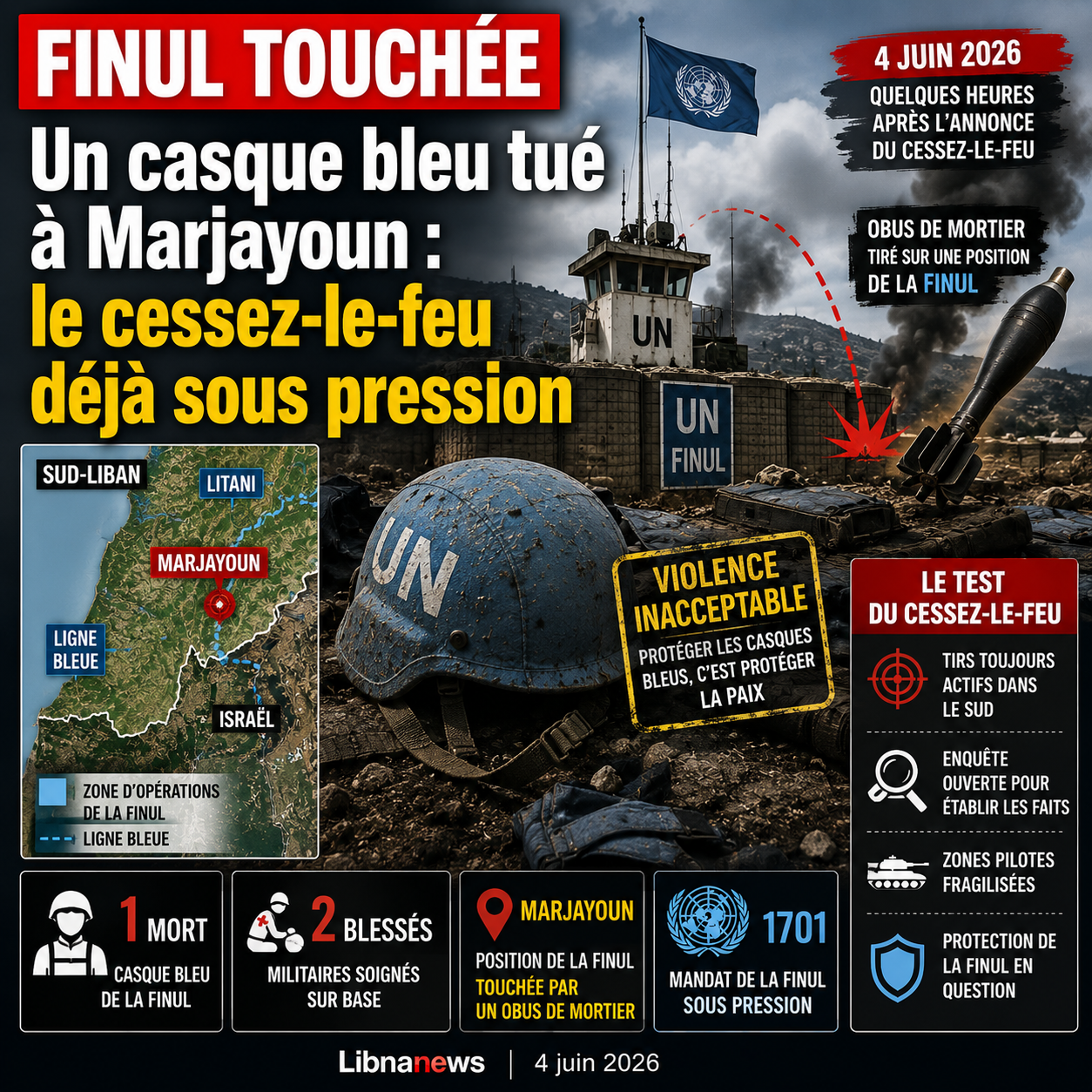
A UNIFIL blue helmet died early Thursday, 4 June, 2026, as a result of critical injuries sustained after the fall of mortar shells at its position near Marjayoun, in south-eastern Lebanon. Two other United Nations force personnel were injured and treated in a medical facility at the mission base. The victim was evacuated to a hospital in Beirut after the incident that occurred late Wednesday night, before succumbing to his injuries. UNIFIL has initiated an investigation to establish the exact circumstances of the shooting. The announcement comes at the most sensitive moment: a few hours after the presentation of a conditional ceasefire between Lebanon and Israel, while the UN mission reports a very high number of trajectories and impacts in the South. The death of the blue helmet thus transformed the issue of the ceasefire into an immediate test of credibility.
The affected position near Marjayoun is not a secondary point. This region of south-eastern Lebanon is located in one of the most exposed areas of the UNIFIL area of operations. It is close to the Blue Line, border localities, military axes and areas where exchanges of fire have intensified since the resumption of the conflict between Israel and Hezbollah. The release of the United Nations force does not designate any person responsible. He does not say whether the shells came from the Lebanese, Israeli or an intermediate combat zone. Nor does it say whether it is a direct shot, a deviated shot or an impact linked to wider exchanges. This caution is essential because the area is saturated with projectiles, drones, strikes, counter-tirs and military positions.
UNIFIL stresses, however, that violence must cease. This formula is not just humanitarian. It says the exhaustion of an international mechanism set up for months in the midst of a war that it cannot stop or control. The peacekeepers are supposed to observe, report, accompany the Lebanese army and contribute to the implementation of resolution 1701. They are not designed to serve as a shield between two forces in open war. When shells hit a UN position, it is not just an individual tragedy. This is a sign that security lines, de-conflict channels and minimum obligations to international staff no longer work.
UNIFIL: A Death at the Heart of a Fragile Ceasefire
The death of the blue helmet comes in a brutal paradox. On the one hand, negotiations in Washington led to the announcement of a comprehensive ceasefire between Lebanon and Israel, conditional on the complete cessation of Hezbollah fire and the evacuation of its operators from the southern Litani sector. The text also provides for the establishment of pilot areas under the sole control of the Lebanese army. On the other hand, UNIFIL is still seeing an increase in trajectory and impact in the South. The agreement therefore exists in diplomatic language, but the ground remains crossed by war.
This contradiction weighs heavily. A ceasefire that did not protect international observers did not protect civilians further. While an identified UNIFIL position may be affected by mortars, neighbouring villages, return roads, ambulances and Lebanese army patrols also remain vulnerable. Stability has not been established since Washington. It is measured by the actual reduction in fire, the halting of strikes, the silence of artillery and the ability of each actor to control its units. In Marjayoun, the message on the ground already contradicts diplomatic communication.
The incident also weakens the idea of pilot zones. These sectors must be entrusted to the Lebanese army, with the exclusion of non-State armed actors. But the army will not be able to deploy with credibility if the firing continues around UNIFIL positions. Nor will it be able to reassure the inhabitants if the international observers themselves do not receive effective protection. The project to return the State to the South therefore depends on one precondition: the end of firing around the areas of deployment, whatever their origin.
A mission between mandate and military reality
UNIFIL has been present in Lebanon since 1978. Its mandate was strengthened after the 2006 war by Security Council resolution 1701. This includes the cessation of hostilities, the deployment of the Lebanese army to the South and the absence of unauthorized weapons between the Blue Line and the Litani. On paper, the mission has a central role in stabilizing the border. In practice, it depends on the cooperation of the parties, the freedom of movement of its patrols, the security of its bases and the ability of armed actors to respect its status.
The recent war has reduced this margin. Patrols are harder. The bases are more exposed. Peacekeepers must arbitrate between their mandate and their own survival. When the exchanges of fire become massive, the observation itself becomes dangerous. A mission that cannot circulate freely loses some of its usefulness. A mission that leaves its positions is losing its role as an international presence. It is this impasse that is repeated in southern Lebanon: UNIFIL remains necessary, but the conditions for its action are deteriorating.
The death of a blue helmet near Marjayoun also shows the fragility of the notification mechanisms. The UN positions are known. Contact details of bases and posts shall be communicated to the parties. Military forces should in principle avoid any action that would endanger United Nations personnel. Yet, incidents are multiplying. This can result in loss of control, excessive fire intensity, poor identification, imprecise firing or, in the most serious cases, a desire for pressure. The investigation will have to determine the scenario. But in all cases, the obligation of protection failed.
The investigation will have to establish more than one path
UNIFIL announces an investigation to establish the exact circumstances of the incident. This formulation covers several issues. Where did the shells come from? What type of mortar was used? Was the position directly targeted? Was there simultaneous fire nearby? Had any alerts been issued? Were the parties informed of the position’s activity? Have deconfliction communications worked? These responses will be decisive to qualify the event.
The investigation must also avoid two traps. The first would be to limit itself to a technical conclusion. A trajectory, calibre or starting point is not enough to understand a responsibility. The chain of command, rules of engagement, warnings and knowledge of the United Nations presence must also be examined. The second trap would be political: let the incident disappear into the mass of daily violations. The death of a blue helmet cannot become a secondary data of war. It directly affects the authority of the Security Council.
UNIFIL calls on the relevant national authorities to investigate, identify perpetrators and ensure criminal responsibility. This request is aimed primarily at Lebanon, as the incident occurred in its territory. But it also concerns all actors capable of shooting in this area or influencing operations there. International humanitarian law not only protects United Nations soldiers on a moral basis. It imposes concrete obligations. Any deliberate attack on peacekeepers constitutes a serious violation. It can be described as a war crime if intent, knowledge of the target and circumstances are established.
Previous of the murderous incidents
The death announced on Thursday does not occur in a vacuum. The past few months have already been marked by deadly incidents involving peacekeepers in southern Lebanon. Indonesian soldiers were killed at the end of March in two separate events, one linked to a projectile that struck a base and the other to an explosion that destroyed a vehicle. Investigations and cross-accusations followed. In April, French UNIFIL soldiers were also killed in an attack attributed by French and United Nations sources to Hezbollah, which the movement challenged. This accumulation has changed the perception of the mission: it is no longer only exposed to the risks of conflict, it itself becomes a potential target or a recurring victim of operations.
This series of incidents poses a difficult political question. Could UNIFIL still fulfil its mandate if its security was not guaranteed by the parties? A peacekeeping force is not a peace enforcement force. It operates in an environment where a minimum of consent is assumed to exist. When this consent disintegrates, the mission loses its space for action. She can remain physically present, but her role is reduced. It observes less, circulates less and signals from more restricted positions. Armed actors continue to produce the facts.
The contributing countries are observing this development with concern. No government sends its soldiers to become collateral victims of a war without control. The repeated death of peacekeepers may affect decisions to withdraw, reduce participation or change the mandate. It can also weaken the international presence at a time when Lebanon needs it to accompany the return of the army to the South. This is one of the most dangerous paradoxes of the current sequence: the more necessary UNIFIL becomes, the more vulnerable it becomes.
Resolution 1701 at its breaking point
Resolution 1701 remains the common language of all diplomacy. Lebanon invokes it to demand respect for its sovereignty and Israeli withdrawal. Israel invokes it to demand the removal of Hezbollah north of the Litani. The United States uses it as a framework for the ceasefire and pilot zones. UNIFIL is the instrument visible on the ground. But the death of a blue helmet near Marjayoun reminds us that the text is only valid by its application.
For years, the resolution has been partially implemented. Hezbollah maintained a military presence in the South, even when it was not always visible. Israel has increased Lebanese airspace violations, strikes and, more recently, continued incursions or positions. The Lebanese army, for lack of means and political consensus, could not impose the legal monopoly of force alone. UNIFIL reported, accompanied, protested and sometimes absorbed tensions. The system held as long as the intensity remained contained. It cracks when the war becomes open again.
The death of 4 June should therefore be read as a warning about the viability of the current framework. If the actors want UNIFIL to accompany a de-escalation, they must first stop turning its area into a firing range. If the pilot areas are to emerge, they must be preceded by real operational guarantees. If the Lebanese army must control the ground, it must be able to do so without being caught between Hezbollah and Israeli strikes. Resolution 1701 cannot survive as a slogan if its guards are killed.
Shared responsibility, responsibilities to be established
Caution on immediate attribution should not lead to a general dilution. All actors have obligations. Hezbollah, like any non-State armed actor in the South, must refrain from firing from areas that expose UNIFIL positions or civilians. Israel must respect the integrity of United Nations facilities and not conduct operations that endanger peacekeepers. The Lebanese State must investigate, cooperate with the mission and ensure, as far as possible, the safety of international personnel present in its territory. American mediators and members of the Security Council should avoid treating such incidents as secondary damage.
Criminal responsibility cannot be collective. It must be established by facts. The type of ammunition, angle of fire, radars, recordings, communications and testimonies can help determine the origin of shells. The issue of intent will be more complex. Shooting can be deliberate, reckless or misdirected. The three assumptions do not produce the same legal qualification. But none can be trivialized. Even without direct intent, the use of explosive weapons in an area known to harbour United Nations positions has a serious responsibility.
This distinction is important for Lebanon. The country must refuse its territory to become a space where peacekeepers can be killed without consequence. It must also prevent every incident from becoming a propaganda battle. The only credible way is through a rapid investigation, documented and made public in its key findings. The families of the victims, the contributing countries and the people of the South need more than a statement of condolences.
South Lebanon expects evidence, not statements
The people of the South know the difference between an announced ceasefire and a lived ceasefire. The first one is in sentences. The second is measured by the silence of the drones, the end of the bombings, the opening of roads, the return of families, the resumption of schools and the possibility for farmers to join their land. The death of a blue helmet near Marjayoun is therefore a disturbing signal. It shows that the open phase in Washington has not yet transformed the local reality.
The risk is that each camp will use the incident to reinforce its narrative. Israel can see this as evidence that Hezbollah militarizes the South and makes it impossible for international forces to secure. Hezbollah can see this as a consequence of an Israeli war that ravages Lebanese territory and exposes everyone. The Lebanese authorities can denounce the infringement of sovereignty and demand an international investigation. UNIFIL, for its part, seeks to preserve the only line that counts: to establish the facts, to protect its personnel and to recall that peacekeepers must never become targets.
The credibility of the ceasefire will therefore be achieved through immediate actions. The parties must submit their data to the investigation. They must stop firing around the UN positions. They must ensure medical corridors, safe patrols and ongoing communication with the mission. Above all, they must accept that the protection of UNIFIL is not a favour, but an obligation. Without this guarantee, the pilot zones, the negotiations of the week of 22 June and the speech on the return of the state will remain suspended at the next salve.
The death of the Marjayoun Blue Helmet finally puts the Security Council before its own responsibilities. For years, it has renewed, adjusted, debated and criticized the mandate of UNIFIL. But a mission cannot be judged solely on its results when the basic security conditions are no longer met. The death of 4 June comes at a time when negotiators are talking about peace, armies are still firing and civilians are waiting to know if they can return home. The investigation may say who fired. The rest will tell if this death changes anything to the way South Lebanon is protected.