

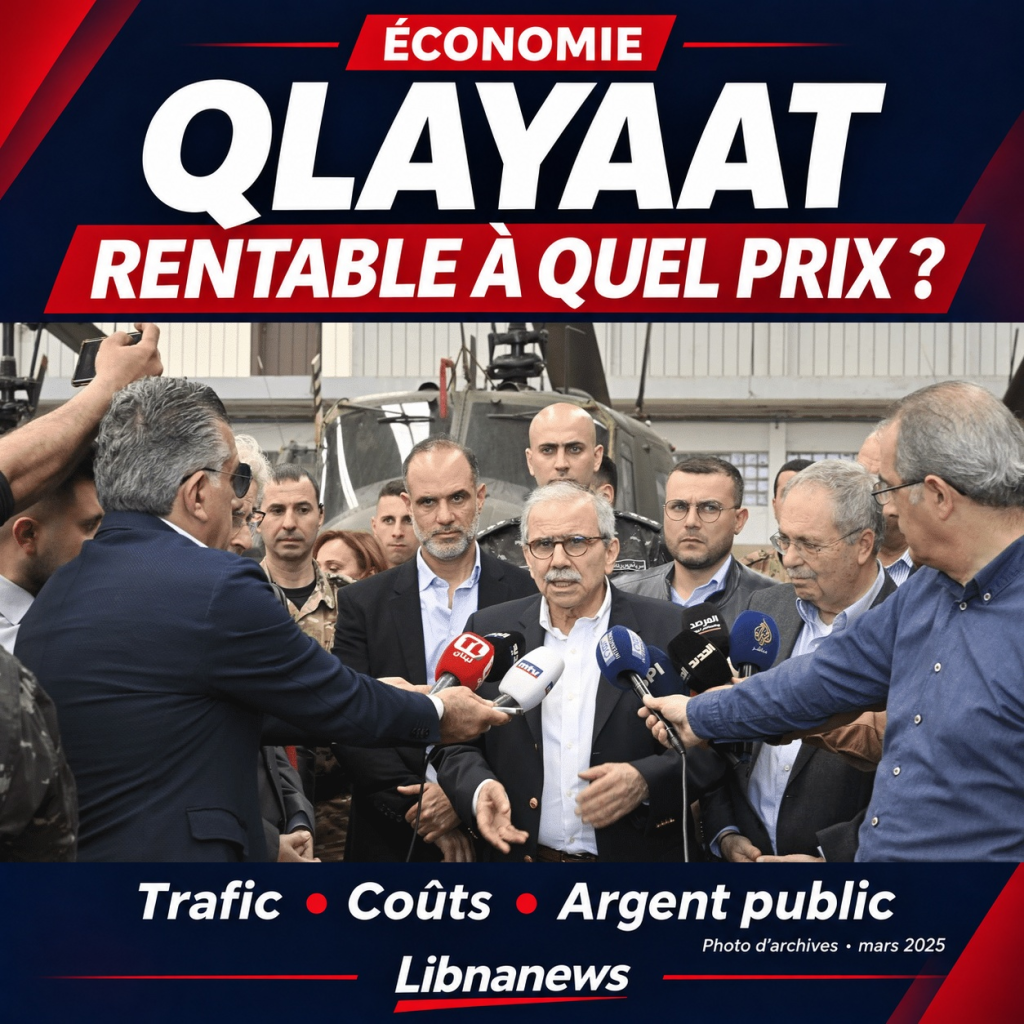
Qlayaat airport can find a place in the Lebanese economy. But today’s public evidence does not show that it can finance its operation on a sustainable basis, repay the capital committed and return to the state without indirect support. The distinction is decisive: opening up a path to commercial traffic, making a profitable operator and creating additional wealth for Lebanon are three different results. The first proves neither the second nor the third.
As of November 8, 2026, the project is still between operational readiness and service announcements. November 15 is presented as a next deadline, especially for a flight to Cairo. This schedule is not valid for established commercial network. The economic question must therefore be asked before the first take-off is transformed into a certificate of success: who will pay the full costs, how many travellers will actually buy tickets and what portion of the revenue will remain in Lebanon?
Reading the documents of the Lebanese Civil Aviation Authority provides an important first correction. The chosen offer provides for a rate of 10% of the operating income concerned. This is not simply a share of net profits. The specification defines precisely income, exemptions and an annual minimum. These parameters change the threshold of profitability. They show above all that a serious analysis cannot be built on the contradictory summaries disseminated around the inauguration.
A small commercial airport, not yet a second national platform
The current project is not that of a large, fully-built airport. It is based on the re-use of an existing site and on an interim facility to enable civilian activity. This difference makes it possible to enter service less expensive than a new infrastructure. It prohibits, on the other hand, adding the benefits imagined from a large complex future to the limited expenses of the start-up device.
The technical annex to the specifications provides, in the event of a new construction, for a modular terminal of around 1,500 to 2,000 square metres. It also authorizes the conversion of the officer’s building, after structural expertise and authority agreement. There are therefore several possible configurations, whose costs and financial counterpart are not identical. Presenting a single envelope as the final price for the entire project would be misleading.
The document requires concrete equipment: check-in posts, passport checks, baggage inspections, emergency groups, fire-fighting devices, video surveillance and runway equipment. It provides for two boarding doors. The modestity of the terminal does not remove these obligations. Safety and security are not reduced in proportion to the number of passengers: an airport with little traffic must also have trained teams, controlled procedures and maintained equipment.
This draws a reasonable strategy, provided that it assumes it: start small, measure demand and expand only when observable revenues justify it. The danger would be to simultaneously sell a frugal start and a large regional platform, and then gradually finance the second without reconsidering its economic interest. The runway and the available terrain are an initial advantage; they are neither a customer nor a profit or loss account.
What the tender documents actually say
The proceedings re-launched on 23 April 2026 are distinct from the one that was cancelled. The official notice of provisional award, drawn up after consideration of the May 19 offers, designates Sky Lounge Services. He states that three bids were submitted, but that Spot Jet Services’ bid was rejected at the administrative and technical stage. The other two were examined financially. Talking about three qualified competitors would therefore distort the document.
The official table mentions, for Sky Lounge, an amount of $1,122,527.66 including VAT and a rate of 10%. The amount in a concession bid should not be confused with the construction budget. Nor does it report that the Consolidated Revenue Fund will receive this amount each year. The notice must be read with the terms of reference, the signed contract and its terms of execution.
Article 23 of the specification retains a share of the revenue from the operation: commercial activities, parking, advertising and various services to passengers, companies or freight. The minimum is $200,000 per year for periods subject to this fee. It also provides for exemptions of up to two years if the operator builds the temporary terminal at its own expense, or up to one year if it rehabilitates the existing building, after receipt by the authority.
This architecture therefore does not allow to mechanically multiply $200,000 by four to announce a guaranteed recipe throughout the duration. Nor is it possible to calculate the levy on earnings after wages, fuel, subcontracting and depreciation. Apart from the applicable exemptions, a company may have to pay a fee on its business even if its final result is in deficit.
In purely arithmetic terms, 10 per cent of $2 million in income is $200,000. This is the crossing point between this rate and the floor, subject to the exact contractual basis. This is not a threshold of profitability for the airport. To establish the latter, additional charges, investments, financing and public bonds that are not included in the operator’s accounts must be added.
Four years to invest: a major constraint
Article 22 lays down a four-year operating period beginning after the 90-day preparation period following the entry into force of the contract. The latter is linked to the issuance of the necessary permits for the work. The distinction between signature, authorization, receipt and start-up of operations counts financially: expenses can start before the first revenue.
A short term requires examining the recovery of capital. If an operator commits ten million dollars and has to recover this amount in full in four years, it must release, on average, 2.5 million dollars a year before its investors pay. This calculation is not a description of Sky Lounge accounts. It measures the order of magnitude of full recovery, without residual value or subsequent compensation.
Another organization is possible: resellable equipment, a recovery value recognized at the end of the contract, a contractual repayment or a longer operating prospect. Each potentially reduces the annual effort, but each must be documented. An expected extension cannot serve as an economic guarantee until it exists legally. A future compensation payable by the State is a deferred public expenditure.
The short concession can also create bad incentives. An operator seeking to quickly recover its bet will favour immediate revenues, high rates or profitable services, while regional interest sometimes requires attractive prices and a gradual increase in charges. This conflict does not involve any fault. It calls for a coherent contract, legible tariff rules and explicit risk allocation.
The figure of ten million does not close the budget
The $10 million envelope was presented by the operator as covering the terminal and several works and systems. Additional security requirements, estimated in information published in October at approximately $6 million, were also mentioned. This second amount is not a final expenditure audited. However, it points to an essential question: is the advertised price perimeter the perimeter needed to open and operate?
The specifications already distinguish between responsibilities. It requires the investor to maintain temporary spaces and provides for a division of labour, spare parts, rehabilitation and modifications for certain permanent infrastructure. It also mentions equipment available in Beirut that bidders must inspect. The transfer of existing equipment may reduce the need for cash; it does not make this material economically free.
A full estimate must therefore include initial work, equipment transferred, military or public interventions, road access, navigation and communication systems, maintenance and renewal. She must indicate who pays each line. Without this consolidation, a project may seem private because the terminal is financed by the operator, while a substantial part of its cost remains borne elsewhere.
The good comparison does not consist in opposing ten million to an immense theoretical value of land. It involves comparing the additional resources mobilized with the additional benefits obtained. Public land has an opportunity cost, public officials have a salary cost and equipment has a lifetime. Their presence in another budget does not make them disappear from the national analysis.
One hundred thousand passengers do not represent one hundred thousand different customers
At the end of October, Elias Sfeir, a member of the Sky Lounge team, spoke about 100,000 passengers in the first year, then between 600,000 and 1 million in the next four years. These are corporate ambitions, not observed results. Their realization depends on companies actually present, marketed frequencies, tariffs and sustained demand outside peak periods.
First, the unit must be specified. In the usual airport statistics, arrivals and departures are counted. A returner can therefore generate two passages. One hundred thousand passes do not mean an additional hundred thousand foreign visitors or a hundred thousand different inhabitants of the North using the airport. Any estimate of tourism benefits that forgets this point would artificially increase the market.
Let’s take a hypothetical 180-seat machine filled at 85%. It carries 153 people per movement. A rotation involving arrival and departure produces 306 passages if the filling is identical in both directions. It takes approximately 327 annual rotations to reach 100,000 crossings, 980 for 300,000 and 1,961 for 600,000. This corresponds to an average of 0.9, 2.7 and 5.4 daily rotations, respectively.
These calculations do not predict any service. They show what the objectives require materially. A link of three weekly rotations, with the same assumptions for 52 weeks, brings 47,736 annual passages. Two lines of this type approach 100,000 passages. Reaching 600,000 requires a much more supplied network, higher frequencies, larger aircraft or a combination of these elements.
The announcement of several destinations is therefore not sufficient. A destination served once a week is not worth a daily destination. A seasonal link is not worth an annual link. And a proposed seat is not a sold seat. The determining table must present the actual rotations, the capacities, the passengers transported and the average recipe, not only the names of the cities announced.
The northern basin exists, its solvency is not decreed
Qlayaat can reduce the land journey of travellers whose final destination is in Akkar or the North. It may also be of interest to a part of the diaspora that finances its travel with income earned abroad. These benefits are credible. But the number of people living nearby is not enough to quantify the air market: it is necessary to know their travel frequency, their destinations, their incomes and the people who pay the tickets.
Poverty data recall this limitation. The World Bank assessment published in May 2024, based on a 2022 survey in five governorates covering about 60 per cent of the population, showed a 70 per cent income poverty in Akkar, compared with 12 per cent in Beirut. These figures are not a measure of the situation in November 2026. However, they demonstrate why a large population pool cannot be assimilated without investigation to a solvent clientele.
The application must be separated into segments: residents travelling to work, family visits to the diaspora, business trips, leisure tourism and one-off trips. A very price sensitive resident and an expatriate looking for a direct flight at Christmas do not respond in the same way to a fare reduction. Adding them in a single projection masks variations in season and purchasing power.
A useful survey would focus on northern travellers using Beirut today. It would request their place of residence, their final destination, the price paid, the number of connections and their willingness to change from airport. It would distinguish between declared intentions and reservations. Saying to prefer Qlayaat when no fare is presented does not mean accepting a more expensive ticket or departure three days later.
The full cost of travel includes these constraints. A family can save a road transfer while losing the advantage if the tickets are more expensive, if the luggage is charged separately or if the schedules require a night in a hotel. Conversely, a well priced direct flight can make the North very attractive. Competition is played on this real basket of spending and time, not on distance alone.
Taking passengers in Beirut does not automatically create
Beirut airport traffic reached about seven million passengers in 2025, according to the available annual balance sheet, up about 25 per cent from 2024. This increase is a market size benchmark, not a forecast for Qlayaat. A recovery after a disturbed year must not be mechanically extended over four years to fill a new airport in a spreadsheet.
Compared to this base of seven million, 100,000 passes represent about 1.4 per cent, 600,000 about 8.6 per cent and one million about 14.3 per cent. Limited capture may be sufficient to initiate a small activity. But the top of the range announced already corresponds to a significant share of the reference market. It requires either a significant transfer or a new request or both.
For the Qlayaat operator, travellers transferred from Beirut are customers. For the Lebanese economy, they are not all an additional activity. Displaced parking expenses from one airport to another change beneficiaries without necessarily increasing national wealth. The real gain can come from time saved, increased competition, a previously abandoned journey or new spending in the North.
The balance sheet must therefore reduce losses elsewhere. If Beirut loses revenues while keeping almost all its fixed costs, the airport system can become more expensive despite the growth of Qlayaat. Conversely, if some of its congestion is relieved and expansion investments can be delayed, a collective advantage appears. This economy must be measured, not assumed.
A common operator on both platforms could optimize investment but also limit their commercial competition. Two separate operators could improve tariffs while increasing expenses. No mounting is automatically superior. The regulation must specify whether the primary objective is competition, reducing congestion, territorial development or revenue, and then measure the corresponding results.
Companies have their own profitability threshold
An open airport does not create an obligation for carriers to serve it. A company compares Qlayaat with other possible uses of its aircraft. It must cover fuel, crews, maintenance, insurance, stopover costs and the cost of capital. A reduction in airport charges can help; it does not compensate itself for a link which is insufficient in demand.
Filling, often highlighted, is not enough. An almost complete plane can lose money if tickets are sold too low. A less busy road can be cost-effective with a more rewarding professional clientele. Projections should therefore include per-passenger revenues, ancillary sales and possible connections, not just the percentage of seats occupied.
The imbalance between senses is particularly important for family travel. A highly requested flight to Lebanon before the holidays can leave less full, then encounter the opposite problem at the end of the stay. Calculate all year with the best summer filling rate gives a false picture of the economy of the line. Winter frequency reductions also affect the incomes of businesses and ground providers.
The minimum requirements for the availability of equipment included in the specifications should not be confused with firm company commercial commitments. The economic dossier should identify carriers, guaranteed frequencies, withdrawal conditions and possible aid. A letter of interest is not a service contract; a service contract does not eliminate the risk of suspension.
Three levels of traffic, three revenue constraints
In the absence of detailed public operating accounts, it would be artificial to announce a precise threshold for Qlayaat’s profitability. However, a transparent test can be constructed. The following figures are calculation assumptions, not airport accounting data. They are used to see what parameters need to be demonstrated and under what conditions a small platform can hold financially.
Suppose three million dollars of annual expenses to be covered after taking into account variable costs in a net contribution per pass. This contribution corresponds to the revenue actually retained, less additional traffic-related expenses and relevant levies. With 100,000 passes, it takes $30 per pass. At 300,000, we need ten. At 600,000, five is enough.
If the annual requirement is $5 million, the amounts become $50, $16.67 and $8.33. If it reaches seven million, it increases to $70, $23.33 and $11.67. This is not the price of a ticket or a tax to be imposed on the passenger. This is a global contribution from the operator’s various activities, linked to traffic to make the scenarios comparable.
The reverse reading is just as enlightening. With a net contribution of fifteen dollars and five million fixed charges to cover, the theoretical threshold is about 333,333 passages. At ten dollars, it goes up to 500,000. Twenty dollars, he’s down to 250,000. A few dollars of difference in the revenues actually retained therefore greatly alter the traffic required.
It remains to be clarified whether these charges include the recovery of the investment. In an example where three million fixed costs add to 2.5 million annual capital recovery, the need is 5.5 million, excluding additional financial compensation. With $15 in contribution, it takes approximately 366,667 passages. An operating balance of 200,000 passes would then not be sufficient to fully finance the investment.
These scenarios reveal the real problem of the first year at 100,000 passages. The operator must have either a very low fixed cost, high ancillary income, a cash reserve or financing accepting initial losses. He may also benefit from contractual exemptions. None of these mechanisms is illegitimate; their lack of publication simply prevents the conclusion that self-financing starts.
The traffic shock must be planned before opening
A central projection is not enough in a country exposed to traffic interruptions. Let us take the example of 300,000 passages contributing $15: the available resource is $4.5 million. A 30% drop in traffic reduces it to 3.15 million. The shortfall is 1.35 million if fixed charges do not decrease. This test does not predict any crisis; It measures a vulnerability.
Not all costs adjust to the speed of reservations. There is a need to maintain security, retain skills, maintain facilities and comply with regulatory obligations even with fewer flights. Closing certain spaces or adjusting schedules can reduce the bill, but dismissing qualified teams and then reconstructing them also has a cost. A liquidity reserve is therefore not a management luxury.
Funding must specify who is absorbing this deficit. If the shareholders bring the funds, the private risk is real. If a minimum revenue is guaranteed by the State, part of the risk falls to the taxpayer. If payments to suppliers are delayed, the problem is shifted to local businesses. If the operator requests a free extension, the state pays otherwise, giving up a future competition.
Insurance against certain interruptions does not necessarily cover any commercial loss or all the circumstances of war. Its franchises, exclusions and ceilings must be incorporated into the model. It would be as excessive to declare Qlayaat invulnerable because he is far from Beirut as to consider him condemned in principle. Geographical diversification protects against localized incidents, not national airspace closures.
Shops cannot save any traffic
Non-aeronautical revenues are important: parking, cafes, advertising, shops, lounges and services. They do not allow the balance to rest on company charges. But their potential depends on the number of visitors, their purchasing power, the time spent on site and the contracts concluded. An attractive trade concession in Beirut does not automatically translate into a small northern terminal.
The turnover of a shop must be distinguished from that of the airport. One hundred dollars spent in a business does not become a hundred dollars of revenue for the operator: it receives a rent, commission or combination of both. The same accounting caution applies to fuel, on-board catering and outsourced services. Adding the total sales of each actor would create a fictitious turnover.
Parking also has limits. Some of the travellers are dropped off by relatives or use a taxi. Too high rates can push to outdoor parking. Trade shows must find sufficient paid customers or agreements with companies. As for advertising, its value depends on the actual audience. Therefore, ancillary revenues must be based on observed contracts and expenditures.
International data from the International Airport Council recall the difficulty of small platforms. The agency reports that 97% of the airport’s assessment deficit accounts for less than one million passengers. This does not mean that 97% of all small airports lose money. However, the finding confirms the importance of fixed costs and the impossibility of deducing the profitability of a simple, inexpensive terminal.
Freight: a possibility to contract, not a magic formula
The proximity of agricultural areas in the North gives meaning to the examination of freight activity. But the aircraft is especially suitable for products whose value, urgency or fragility justify expensive transport. The presence of crops does not prove the existence of an exportable volume by air. You have to check buyers, prices, certifications, the cold chain and the cost to the customer.
For an exporter, a few kilometres of saved road can count less than an insufficient frequency or than a break in temperature. A perishable product loses value if it waits for a flight several days. A cost-effective supply chain requires cold rooms, reliable power supply, quick controls and coordination with carriers. These facilities add investment and fixed costs to the passenger project.
Cargo in the hold of scheduled flights may reduce the initial risk, but capacity depends on aircraft, baggage and operational restrictions. An all-cargo aircraft requires another level of demand and a balance of flows. A rotation almost empty and leaving loaded must cover both segments. The export tariff can then cancel the proximity advantage claimed to the producers.
The relationship with the port of Tripoli must be subject to the same examination. Large and inexpensive sea flows do not naturally become air flows. Sea-to-air complementarity requires suitable goods, customs procedures and ready-to-pay customers. The map is a starting point; only volume and price commitments can enter into a financing plan.
The Syrian market is also an option, not an acquired recipe. It depends on border crossings, formalities, the safety of routes, competing airports and carrier decisions. Adding it to the central scenario would expose the project to a risk that it does not control. A robust strategy must be able to start with a demonstrated demand without simultaneously requiring all favourable assumptions.
The taxpayer must see subsidies, even indirect subsidies
Exemptions may be useful for initiating an activity. However, their cost must be published. Uncollected tax, equipment provided by a government or a security service funded by the budget are different forms of support. Presenting them as free benefits prevents the comparison of Qlayaat with other public spending likely to favour Akkar.
A distinction must also be made between a contractual exemption already provided for and a tax advantage proposed in a draft budget. Provisions discussed for 2027 considered additional benefits to attract companies. Until their adoption and exact scope are established, they should not be counted as an acquired right. A viable plan only thanks to a measure still discussed remains dependent on a political decision.
The relevant question is the public cost per additional service obtained. If a launch aid allows scheduled flights that then become autonomous, it can have a collective return. If the companies leave as soon as it is abolished, the subsidy finances a temporary activity. The contract must therefore provide for measurable objectives, duration, service obligations and repayment conditions in case of non-compliance.
Above all, the State must avoid guaranteeing revenue while abandoning cost control. This assembly would make the public bear the bad surprises and leave the private the essential of improvement. Remuneration for entrepreneurial risk is justifiable where this risk really exists. It is much less so if losses are systematically transferred to the budget in the form of amendments or compensation.
The jobs promised must be clean, local and sustainable
An airport creates direct jobs and can support suppliers. But the figure announced must distinguish between construction site, permanent operation, subcontractors and simply displaced activities. A handling post transferred from Beirut represents an opportunity for the North without necessarily constituting a net creation for the country. Both readings are legitimate; Confounding them inflates the national balance sheet.
The cost per job must also be examined. A highly subsidized project can show a lot of recruitment while mobilizing more resources than a training programme, access to electricity or support to exporting companies. The comparison does not mean that the airport is useless. It requires that it be shown that it is a good development instrument, and not just a visible symbol.
The quality of posts counts as much as their number. Stable, declared, aviation-trained jobs can improve local incomes. A few weeks of activity, based on precarious labour or external recruitment, has a different effect. Commitments should therefore indicate the share of local recruitment, the training funded and the duration of contracts.
Finally, the effects on tourism require complementary services. A visitor arriving in Qlayaat can reach Beirut directly, stay with his family or spend in the North. The impacts differ according to these behaviours. Reliable transportation, accommodation, accessible sites and local businesses determine the share of expenditure retained in the region. Airport facilitates travel; It does not alone manufacture a tourist destination.
Future public-private partnership does not guarantee sustainability
The project sheet published by the International Finance Corporation in July 2026 confirms a mission to advise the government on a long-term concession concerning Beirut and, potentially, Qlayaat. The indicative timetable for this assistance runs until June 2028. This document describes a structuring work, not a final investment decision or a financing commitment covering all the costs of the second airport.
The intervention of an international adviser can improve studies, competition and risk allocation. It does not replace the revenues of travellers. The word « potential » is important: the final modalities still need to be assessed from studies and public choices. Presenting the association in Beirut as proof that Qlayaat is profitable in isolation would be an economic error.
A bundled concession could allow one profitable platform to support another. This may be a public service choice, but it must be transparent. Otherwise, a cross-subsidy will be hidden in the tariffs, in the duration of the contract or in a lesser revenue paid to the Treasury. The citizen must know what he or she finances and what commitments he or she obtains in exchange.
The transition between the interim arrangement and the future partnership must also be written. Who owns the equipment? Who evaluates them? Who takes over employees and commercial contracts? What compensation exists in case of early transfer? Without answers, infrastructure can become expensive precisely when the state wants to move on to the next stage. The urgency of opening must not produce a lasting contractual dependence.
The right decision: financing evidence, not a promise
The economic case calls for a proportionate commissioning, followed by a public evaluation, rather than for a major development undertaken in advance. The first objective must be a small but regular network, with identified companies, sufficient cash flow and consolidated costs. The extension should only take place after the observation of sustainable traffic and revenue covering the corresponding commitments.
A monthly dashboard would be used to assess: scheduled and realized flights, arrival and departure passengers, filling, cancellations, aeronautical and commercial revenues, public costs, permanent employment and cash flow. Annual data must then be audited. This monitoring is more useful than the announcement of a cumulative total of travellers that would mix strong season with low season, profitable activity and subsidized activity.
The decision thresholds must be set before the following expenditure. An increase in passengers accompanied by increasing losses is not a financial success. A modest but stable activity, covering its costs and improving access to the North, can justify the project. The size of the terminal or the number of destinations should not replace these criteria.
The answer to the initial question is therefore clear. Qlayaat is defensible as a small regional airport, developed in stages and subject to strict financial discipline. Its full profitability is not demonstrated by available public information. At 100,000 crossings, start-up requires a highly contained cost structure or explicit funding of initial losses. At several hundred thousand, the balance becomes more accessible in the scenarios, but only if revenues by passing, expenses and investments follow the assumptions made.
Akkar does not need a project declared profitable by regional patriotism and then rescued discreetly by the taxpayer. It needs useful equipment whose accounts withstand examination. Publicizing the contract performed, any amendments, full costs and company commitments is the next expected proof. The first plane will show that Qlayaat can accommodate a flight. The first accounts will tell what this flight actually brings to Lebanon.





Comments