

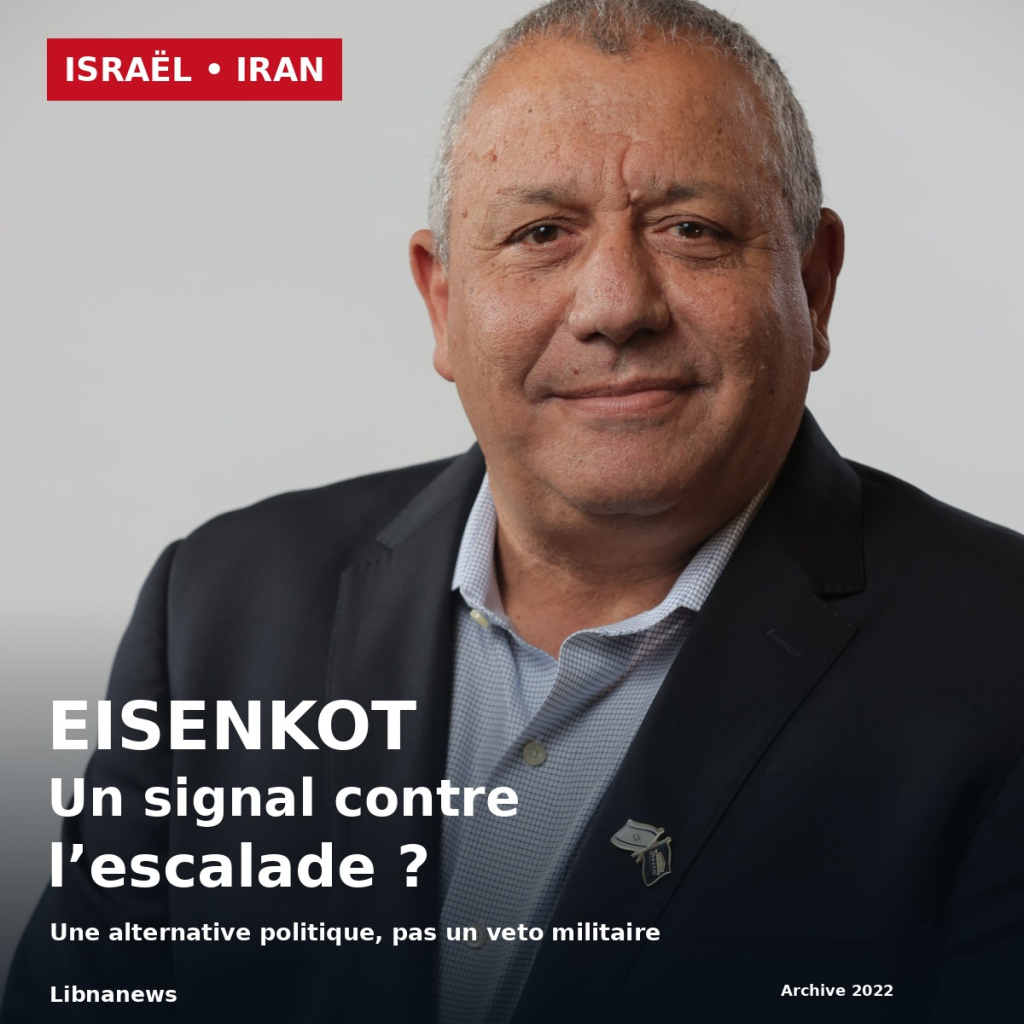
The announcement of Gadi Eisenkot’s choice to form the next Israeli government can be read as a political signal against a new escalation with Iran. It makes a possibility of alternation visible when Benyamin Netanyahu again invokes the Iranian threat to defend a united government. But it does not withdraw any military power from the outgoing Prime Minister. And the chronology forbids presenting the event as a hasty appointment during the Shabbat: Isaac Herzog announced his intention Saturday night, after its end, maintaining the formal surrender of the mandate on Sunday 8 November at 5 p.m.
The hypothesis therefore deserves to be examined in its solid form: by publicly setting the next interlocutor responsible for forming a majority, does the president reduce the political space in which a security emergency could postpone alternation? The answer is yes for the possible political effect, not for a legal impediment to war. As for the President’s personal intent, none of the news releases reviewed established this.
What was announced Saturday, what remains scheduled Sunday
The starting point is the presidential communiqué of 5 November. After consulting the formations represented at the next Knesset, Herzog had announced additional exchanges during the weekend and indicated that he wanted to entrust the mandate the following Sunday. Two days later, he made public the name chosen. The ceremony and formal act remained on Sunday calendar.
The document of 7 November specifically distinguishes the two stages: inform Eisenkot of the presidential intention, then receive him the next day to entrust him with the formation of the government. This distinction explains the gap between titles already referring to a designation and a procedure not yet completed at the time of publication. It alone does not reveal an exceptional acceleration.
The press release also sets out an immediate political reason to choose: 67 MPs recommended Eisenkot, compared to 46 for Netanyahu, while a group of seven elected representatives recommended no one. He mentioned in-depth discussions with politicians and meetings with the two rivals. He does not report an imminent military threat that imposed a decision before Sunday.
The Shabbat argument is therefore not convincing. A post-closure advertisement does not constitute a religious derogation that would deduce an emergency situation. To defend the idea of an exceptional calendar, it should be established that a stage scheduled for Sunday has been moved and then show why. On the contrary, the public documents consulted establish the continued delivery of the mandate.
Why the Iranian hypothesis is not free
The absence of demonstrated change in the timetable does not make the Iranian context secondary. A political transition and a military crisis can be countered: the opening of a new confrontation changes parliamentary priorities, increases pressure for unity and can make an alternative coalition more difficult to negotiate.
This mechanism does not assume that any security alert is manufactured. A real threat can produce the same political effects as an instrumental threat. This is precisely why there is a need to distinguish between the assessment of danger, which is the responsibility of intelligence and defence institutions, and the use that politicians make of this danger in their negotiations.
Netanyahu defended a united government by associating this project with the sustainable elimination of the Iranian nuclear threat. Eisenkot, for his part, set a different threshold for the transition period. On 31 October, he stated that prior to the installation of a new government, his support for military operations would be limited to direct and immediate threats that could not be expected.
This disagreement is concrete. It concerns the justification for a decision now, not only on the opposition in principle to Iran. An operation necessary to counter an imminent attack and a campaign to permanently change regional balance do not call for the same degree of urgency. By demanding that the threat cannot wait, Eisenkot challenges the transformation of any strategic rivalry into a need to act during the transition.
A new political authority, not a second executive
Making the choice of Eisenkot public has an identifiable effect: the discussions no longer concern only the maintenance of Netanyahu, but the constitution of another government. The parties know who the president intends to give the first opportunity to form a majority. Foreign partners can also distinguish between the government and the leader who can succeed it.
This can increase the political cost of a disputed military initiative. The outgoing Prime Minister can no longer present the absence of alternative as an indisputable fact. A candidate recognized by the presidential procedure may set out another timetable, challenge the urgency invoked and request that lasting choices be assumed by a newly invested government.
However, it would be excessive to infer that Herzog thus closed an operational window. Article 30 of the Basic Law on Government organizes the continuity of the executive until its successor is installed. Receiving the mission of forming a coalition does not give Eisenkot the command of the army, the leadership of the security cabinet or a veto on the decisions of the outgoing government.
Article 40 governs the engagement of a war or a military operation that could almost certainly lead to it. The decision is the responsibility of the government, with possible delegation to the appropriate ministerial committee. The same article reserves the other actions necessary for the defence of the State and for public security. The president therefore does not replace the government in the military decision-making chain.
The main risk remains the duration of the transition
The political effect of the announcement will depend mainly on the ability of Eisenkot to transform a presidential preference into a government. The recommendations gathered during the consultations do not constitute a coalition agreement. A party may prefer to obtain the mandate while refusing to participate in its cabinet, support its program or vote for the concessions necessary for its formation.
The deadline for this negotiation is 28 days, with a possible presidential extension of up to 14 days. In other words, the designation opens a period during which political competition continues while the outgoing executive remains in command. A communiqué does not eliminate this coexistence.
In order to effectively limit the risk of an external crisis absorbing the transition, we must therefore look at the following actions: the existence of an agreement between partners, the division of responsibilities, the common guidelines on security and, ultimately, the installation of the government. The decisive step is not that of presidential silence to the public announcement, but that of a candidate appointed to an invested executive.
The test will also be military and diplomatic. A documented alert, verifiable preparations, a change in the defence system or a formal decision would weigh more in the assessment of Iranian risk than the interpretation of an hour of publication. On the other hand, a political call to the Union does not prove that an operation has been decided.
Reducing uncertainty without promise of peace
The most defensible editorial hypothesis is therefore that of a signal of political stabilization: quickly identifying the candidate to negotiate a majority prevents uncertainty about the succession from remaining total. In a context of tension with Iran, this effect counts. It makes it less automatic the equation that any new crisis should be resolved by maintaining the outgoing team.
But giving this announcement the power to prevent a war would go beyond its institutional effects. There is also no way to turn a possible political result into a demonstrated secret motive. The public record shows a procedure that goes ahead, a disagreement on the military emergency and an outgoing government that is still competent.
The distinction is essential to understand the region: Eisenkot can challenge an escalation decided during the transition without becoming a conciliatory leader towards Tehran. What changes immediately is the existence of an officially identified political alternative. What could change next, if it comes to power, is how to decide, justify and coordinate the use of force. This is not yet the disappearance of this option.





Comments