

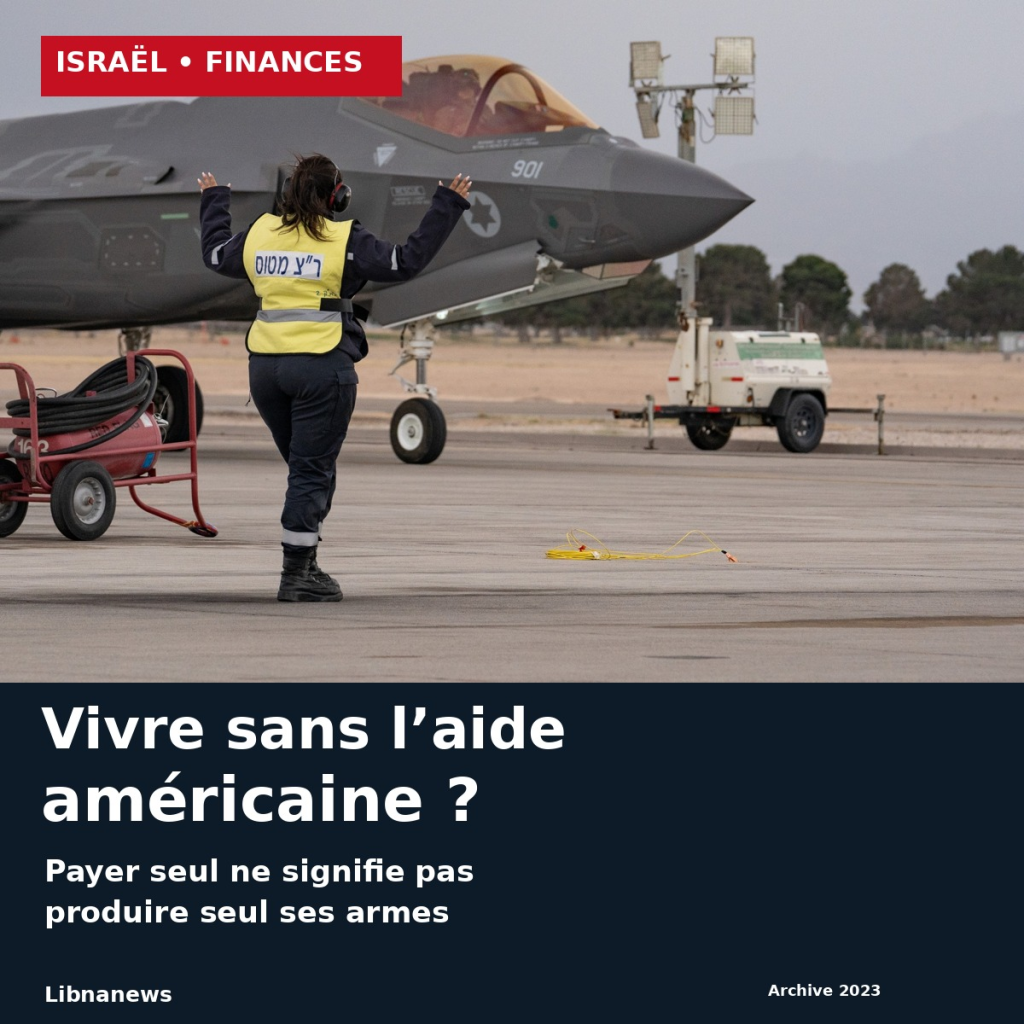
Israel could absorb the disappearance of US military donations, but the financing of its defence would place more on its own resources. This capacity does not mean that the operation would be painless or that the country could quickly replace American equipment, parts and services. The decisive question is the nature of the proposed withdrawal: stop paying, stop selling or challenge a strategic relationship.
The announcement made by Donald Trump on November 3 reinvigorated this debate. The U.S. president said he wanted to end the annual aid from 2027, while pursuing arms sales. The budgetary and contractual arrangements for this transition remain to be established. A political declaration is not enough to declare the cancellation of existing appropriations, payments or commitments.
Asking if Israel can « survive » without this help thus mixes several issues. A State can finance more expenditure alone while remaining dependent on a supplier. It can also preserve its arsenal at the cost of sacrifices in other areas. To measure the potential impact of the US decision, capacity to pay, material availability and political support must be examined separately.
An effort below one point of GDP
The regular reference envelope amounts to $3.8 billion per year: 3.3 billion military funding and $500 million for missile programmes. It does not constitute a general subsidy for all Israeli public services. Traditional bilateral economic aid has been phased out, while contemporary support has focused on defence.
According to World Bank data, Israeli GDP stood at $610.78 billion in 2025. Compared to this base, ordinary aid accounts for about 0.62% of gross domestic product. This proportion makes it possible to exclude the image of an economy whose resources would rely mainly on the US payment. It alone does not allow us to determine which tax increase or what expenditure to reduce.
GDP measures annual output, not respendable revenue in state funds. The replacement of a subsidy for military procurement requires the mobilization of an additional portion of national resources. The amount can be economically bearable while becoming politically difficult to allocate. A sustainable expenditure for the country as a whole is not necessarily the same for each household.
An already widely funded defence by Israel
SIPRI estimates Israeli military expenditures at $48.3 billion in 2025. The 3.8 billion ordinary aid corresponds to about 7.9% of this amount. This approximation gives an idea of the additional effort, but it does not mean that the United States is funding exactly 7.9 per cent of the Israeli military budget.
The statistical method used for international comparisons accounts in principle for military aid in the donor’s expenditure, not in the recipient’s expenditure. Budgetary schedules, deliveries and exceptional financing further complicate reconciliation. Presenting a quotient between two amounts as an accurate accounting breakdown would therefore create a false accuracy.
The order of magnitude remains enlightening: Israel is already committing far more military resources than ordinary annual support. His disappearance would not suppress the financing of the entire army. However, it could have a significant impact on some dollar-concentrated purchases, although its weight appears to be limited when it is related to all expenditures, including salaries and operations.
Taxpayer becomes first arbitrator
The first possible answer would be fiscal. According to the Bank of Israel, fiscal measures amounting to about 1.5 per cent of GDP had entered into force in 2025. This precedent shows that a significant budgetary mobilisation is achievable. He also recalled that the population had already been involved: that past effort did not constitute a new reserve from which to draw a second time.
A replacement of donations would require clarification of who pays. An increase in consumption taxes, a change in income tax or a reduction in tax benefits do not distribute the burden in the same way. The choice would also affect the acceptability of the transition. The debate on financial independence could quickly become a debate on living standards.
Reducing civilian expenditures is another option, but there is a deferred cost. Postponing an investment can improve a year’s accounts without improving the long-term situation. The relevant question would then be what programmes were sacrificed, how useful they were and how long the postponement was. Displaying an accounting economy is not enough to demonstrate economic gain.
Borrower gives time without erasing the bill
Israel maintains access to international markets. A $6 billion sovereign issue, spread over several maturities, was completed in January 2026. This type of operation shows that funding of several billions can be obtained. It does not guarantee the same conditions for future issues or unlimited debt capacity.
Debt would smooth a transition, especially if payment needs were concentrated over a few years. But to finance a recurrent expenditure on new loans on a sustainable basis carries forward its cost. Interest is added to the amounts to be repaid and reduces the resources available for other purposes. A credible replacement schedule would therefore be as important as the amount of the first issue.
Foreign exchange reserves are another element of strength: they reached $237.773 billion at the end of October 2026, according to the Bank of Israel. This stock contributes to external financial resilience. However, it is not a case of the Ministry of Defence. Converting a monetary security indicator into years of financial military purchases would give a misleading representation of its role.
Growth that does not fill all the caisses
The Bank of Israel’s October 2026 forecast describes tense public accounts. The expected budget deficit reached 4.4% of GDP in 2026 and 4.6% in 2027. Debt to official GDP would increase from 68 per cent to 66.5 per cent. These figures are projections, prepared in a context where the defence budget of 2027 remains uncertain.
A second measure gives a less favourable reading: by excluding production made abroad and recorded in Israeli GDP, the debt ratio would reach 70 per cent by 2026 and 70.5 per cent by 2027. Part of the increase in GDP therefore does not correspond to an equivalent increase in domestic activity or fiscal resources. Growth outside external production is forecast at 3.4% and then 5.1%.
The budget issue therefore exceeds the only replacement of US funding. At the same time, the country seeks to finance its security, invest in productive capacity and regain a more favourable debt path. Taking on additional expenses would make this arbitration more difficult. This does not demonstrate an impossibility of paying, but reduces the place left to other priorities.
A powerful industry does not produce everything
The Israeli defence industry has significant capabilities. According to the Israeli Ministry of Defence, the new export contracts signed in 2025 reached $19.2 billion, a record. Missiles, rockets and air defence systems account for 29% of the contractual volume; observation and optronic equipment account for 22%. These results describe strong industrial specialization.
However, their interpretation requires two precautions. Contracts signed are not all receipts received in the year. Business turnover is also not a fully available budget revenue. Manufacturers must produce, pay their employees, buy their components and deliver their customers. Therefore, arms exports cannot be subtracted from the cost of defence to calculate net national financing.
Further development of local production could reduce certain dependencies. However, this strategy would require investment before its effects can be realized. It should target the equipment that it is realistic to manufacture, the necessary volumes and the lead times for capacity. Industrial autonomy is built programme by programme; It does not automatically derive from the commercial success of other categories of equipment.
The first scenario is financial replacement
In the case of the nearest US announcement, subsidies would cease while sales and cooperation would continue. Israel could continue to use its equipment and place new orders with more domestic resources. The main change would then concern the allocation of the invoice.
A gradual transition would give more time to adjust the budget. A rapid interruption would require more focused choices: maintaining priority purchases, deferring others or accepting a temporary increase in debt financing. The consequences would also depend on the payments already covered. Without a consolidated schedule, there is no meaningful estimate to convert the reference annual amount into an accurate invoice for each subsequent year.
This scenario does not justify a prognosis of state disappearance. Rather, it raises a question of public policy: what level of military spending should be maintained, with what levies and what waivers? The response could vary between a temporary transition effort and a permanent increase in the national burden.
The second scenario concerns supplies
The situation would change dramatically if Washington also limited deliveries, parts or services. According to SIPRI, all Israeli combat aircraft currently in operation are of American origin. The United States also accounted for 68 per cent of Israel’s major arms imports between 2021 and 2025, compared with 31 per cent for Germany. These proportions measure transfers of large equipment, not all military purchases.
In this case, finding money would no longer solve all the difficulty. An available device has a different operational value from a future device ordered from another supplier. Replacing a fleet requires adaptations, training and a new organization of support. Time limits could weigh as much as the purchase price.
Nor would self-financing remove the US export framework. Certain obligations and restrictions would continue to apply to paid sales from Israeli funds, although their scope varies depending on the arrangements. The end of a subsidy is therefore not a general authorization to acquire or use any material. Washington’s decisions would remain important after a change of payer.
The third scenario concerns the strategic relationship
A broader withdrawal would include military cooperation and diplomatic support. These functions cannot be assessed by simply adding an amount to the budget. In the Security Council, the American veto of 18 September 2025 prevented the adoption of a text on the ceasefire in Gaza, hostages and humanitarian access, despite the support of the other fourteen members. This support is a political decision, without any directly purchaseable industrial equivalent.
However, it would be inappropriate to deduct the end of this support from the only donation announcement. A change in funding may accompany the maintenance of close relationships. Conversely, general political deterioration could produce effects that exceed military spending. The analysis must therefore consider these changes as separate assumptions, not as inevitable steps in the same process.
For Lebanon and other countries in the region, this distinction counts. The decline in subsidies does not prove an immediate reduction in Israeli capabilities, let alone an automatic change in military decisions. Sales authorizations, supply continuity and diplomatic positions would provide more concrete guidance on the evolution of the relationship.
Israel thus has the economic means to consider replacing ordinary financial aid. The cost would be borne elsewhere in his accounts and in his company. On the other hand, there is no budgetary operation that can instantly rebuild all the American capabilities to which its military apparatus is linked. Payment autonomy seems accessible; Strategic autonomy requires a much longer transformation, the price of which is not just 3.8 billion a year.





Comments