

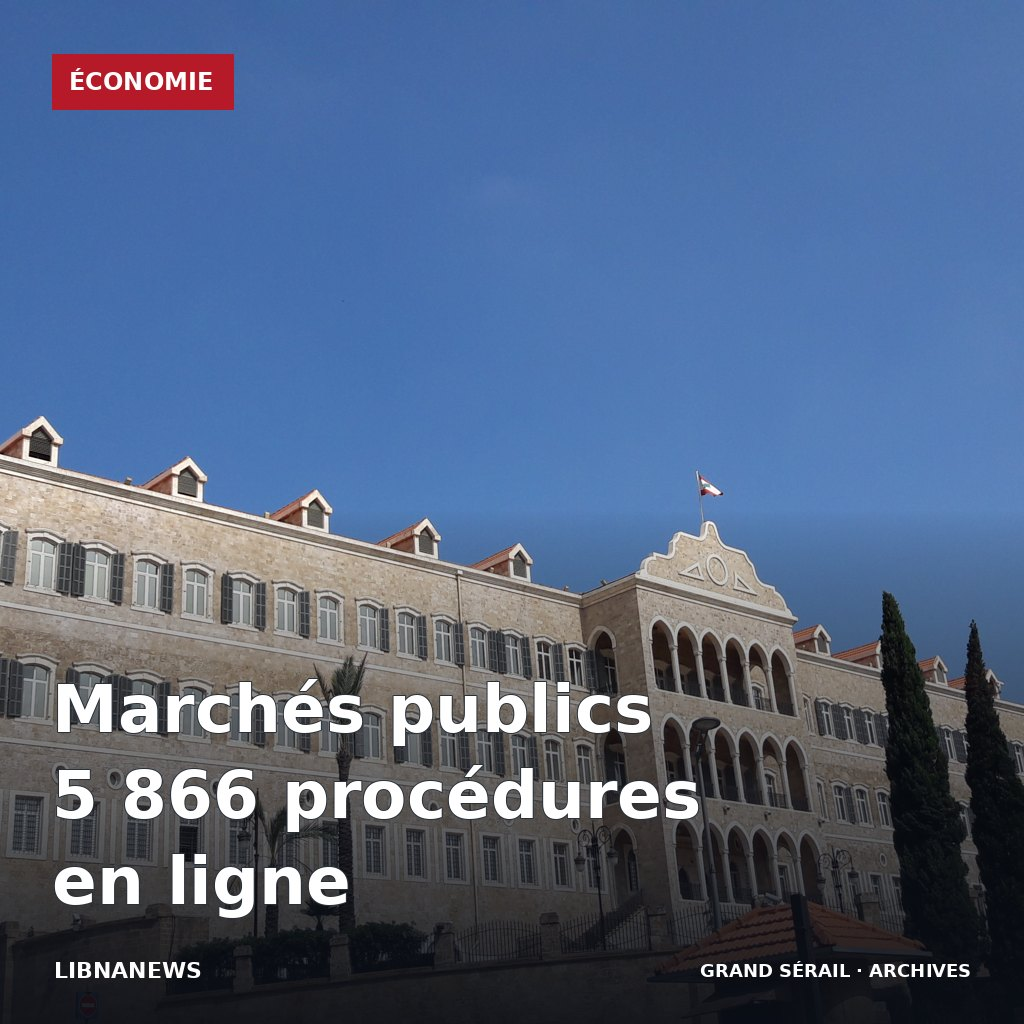
The Lebanese Public Procurement Authority published its first progress report on Wednesday, 25 November. Between August 2022 and December 2025, 5,866 proceedings were published on its portal. By the end of this period, 282 purchasing agencies were registered, but only 207 had published them. In the Grand Sérail, Prime Minister Nawaf Salam announced that the Council of Ministers would monitor compliance by the administrations based on the Authority’s indicators.
The number of published proceedings decreased in 2025
The portal identified 203 procedures from August to December 2022, then 1,135 over the whole of 2023. It recorded 2,347 in 2024 and 2,181 in 2025, or 166 fewer, a decrease of 7.1 per cent. These figures measure publications on the portal, not the total number of contracts launched in the country. The opening of an account is not enough to show an administration’s purchases in these statistics: 75 registered agencies had not published by the end of 2025.
The Authority is equal to 70.7 % of the share of contracts awarded under a competitive procedure among those awarded over the period. This proportion relates to the number of allocations, not their value. It also does not measure the number of tenders received per contract. The law allows non-competitive procedures in certain circumstances: their share, 29.3% in this count, therefore does not correspond to an irregularity rate.
What the Council of Ministers says it wants to follow
Act No. 244 of 2021 entered into force in July 2022, giving the Authority a role of regulation, control and support to administrations. The redesigned version of the portal, launched in June 2025, structure information on several steps from planning to implementation. The report distinguishes this publication tool from the full deployment of e-procurement and notes that integration with other public systems remains to be completed.
Nawaf Salam recalled that compliance with the law involves officials of the buying agencies. It linked transparency of spending to Lebanon’s ability to mobilize funding for reconstruction. The report places among the priorities the registration of bodies still absent from the portal and the monitoring of the application of the rules. As at 31 December 2025, its tables followed only actual transactions.
Grand Serail, Beirut, August 12, 2017 (archives). Pjposullivan1 / Wikimedia Commons. Photo framed and titled by Libnanews; licensed membershipCC BY-SA 2.0.





Comments