

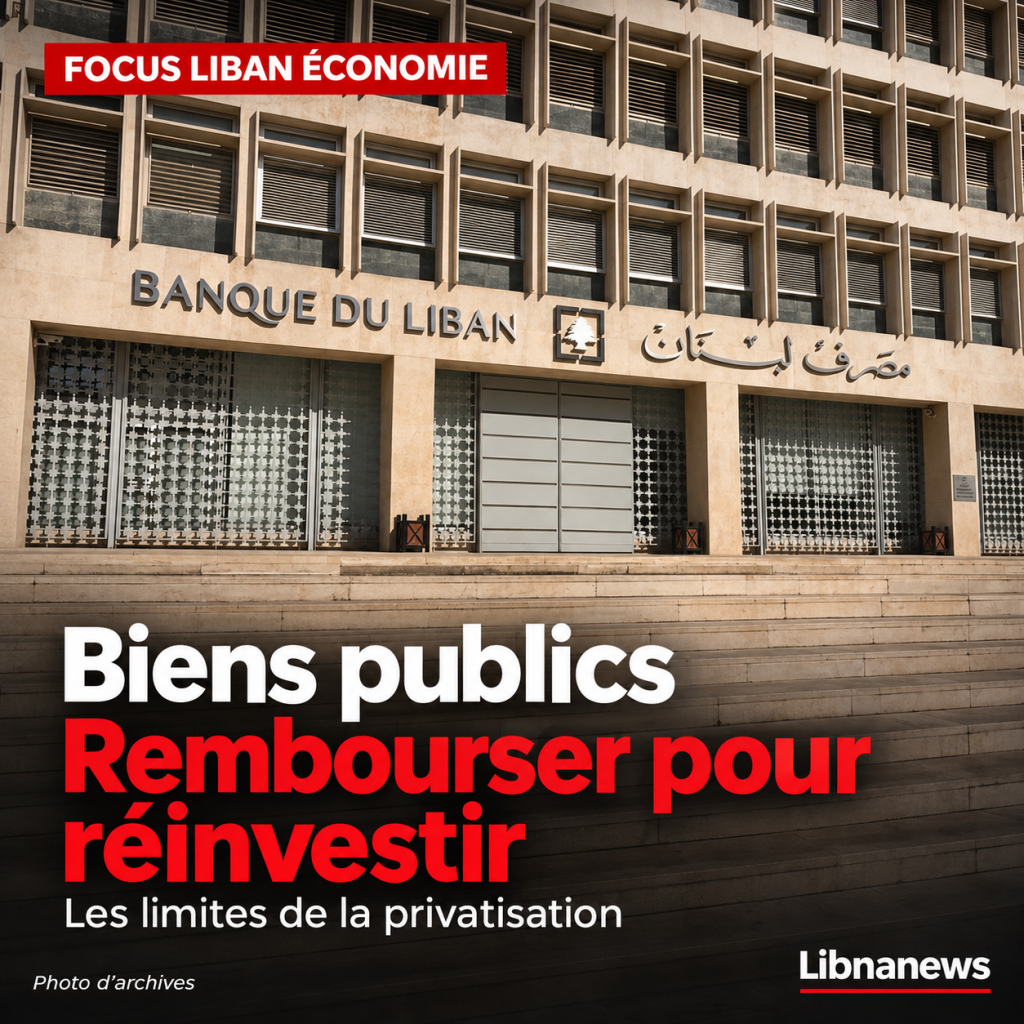
Lebanon will not emerge from its banking crisis by replacing blocked deposits with the promise to sell its land. The studies on public goods in Lebanon reduce political valuations to much more limited amounts, without guaranteeing their conversion into available dollars. The real issue therefore goes beyond restitution: how to return their money to depositors while rebuilding the financing of companies, rather than organising a new capital outflow?
Farid Boustani’s proposals, which refer in particular to the mobilization of public real estate, revived an issue that had arisen since the banking collapse began. Can a state with businesses, land and infrastructure use this wealth to settle the commitments of its financial system? A contribution is possible. But its value, its timing and its beneficiaries must be established. Above all, a repayment that balances a debt does not automatically create the conditions for recovery.
The country can lose an asset and see the currencies obtained in exchange. It can also return funds to households that spend them locally, or to entrepreneurs that invest them. These trajectories do not have the same consequences. Their distribution will depend on trust, restitution rules and actual funding opportunities. There is currently no documented amount to present the leakage of all amounts repaid as an acquired fact.
Public goods in Lebanon: the limits of billions announced
A research responds directly to the promise of a heritage capable of filling losses. Albert Kostanian, economist and host of Vision 2030, directed for the Institute Issam Farès of the American University of Beirut the report of January 2021 « Privatization of Lebanese Public Assets: No Miracle Solution to the Crisis ».
Its estimates placed the assets studied, excluding concessions, between $11,660 and $21,520 billion. Gross revenues from a divestment program were significantly lower: between 5.880 and 13.365 billion under the scenarios. A reserve changes the reading of these figures: the report used the rate of £1,507.5 per dollar and stated that they should be widely regarded as local bank dollars. They therefore do not constitute a current estimate in fresh dollars or the guaranteed product of a sale.
This work contradicts the idea of an immediately mobilizable body. They do not demonstrate that each plot would be overvalued today. Overall political valuations, the value of certain assets and achievable revenues are three different objects. The 2021 figures cannot be presented as a sale price in 2026.
A building may have gained value in a neighbourhood and lost value elsewhere. A company can improve its revenue while requiring new investments. The price obtained will also depend on the competition between buyers, the rights transferred and the risk accepted. An updated national amount requires recent expertise and accounts. It does not result from a uniform multiplication by monetary depreciation.
Wealth is still not auditable
The January 2026 report « Lebanons State-Owned Enterprises: What We Know About Them », by Sami Geadah, Sarah Borgi and Nizar Bou Karroum, provides an institutional and economic inventory. It does not propose a new consolidated valuation. The authors describe fragmented financial information, with different years of data for different companies. This limit prohibits the presentation of a total as a result of a uniform and recent public balance sheet.
The document also distinguishes state interests, those of the Bank of Lebanon and the different land tenure systems. This distinction counts for reimbursement. The owner of the asset, the debtor of the claim and the institution responsible for payment are not necessarily the same. Their membership in the public sphere is not enough to make all resources interchangeable.
Before promising a distribution, you must identify the property, its legal owner, the rights of the occupants and any charges. It is then necessary to determine what amount would actually go to the body responsible for refunds. A minority stake is not worth the entire undertaking. A real estate value may already be included in a company’s value. Adding both without reprocessing would artificially inflate the wealth.
Nor should future profits be counted twice. If a company’s price is based on the expected revenues, the community cannot simultaneously present this prize and all of the same revenues as two new resources. After the sale, their beneficiary changes. A share may come back to the budget through tax, but it does not amount to the profits previously attached to the property.
The repayment fund does not create currencies
The May 2020 Bank Association proposal illustrates this difficulty. Its « Contribution to the Lebanese Government » provided for a 40 billion-dollar State-owned Defancing Fund. It was to issue long-term securities to the BDL in settlement of the corresponding public debt. It was therefore not simply a matter of immediately selling all goods to the private sector.
But moving assets into a structure does not make them liquid. The amount entered on the securities depends on the resources to ensure payment. If these are insufficient or arrive later, the holder has a long and risky debt, not the equivalent of one dollar available. The LBA document also stated that its information had not been independently verified or audited.
An asset-backed obligation may arrange a return over time. It must then be presented for what it is: an instrument with a maturity, risk and specific rights. If a depositor has to resell it quickly to pay for care, the price offered may be less than its face value. Loss reappears as a discount, even when no nominal deposit reduction is announced.
The possibility of negotiating the title does not remove this problem. It allows to exit earlier, at a market price. A credible mechanism must publish expected flows, payment priorities, fees and valuation assumptions. It must also show what happens if the revenues decrease. Without these elements, negotiability turns an opaque promise into a transferable risk.
Not all land is transferable or available
The report « Legislative and Administrative Land and Property Rights Framework: Lebanon », published by UN-Habitat and the Global Land Tool Network in 2024, documents cadastral gaps and diversity of rights. In particular, it distinguishes between the public and the private domain of the State. Inadequacies in registration and designation of owners complicate a reliable inventory. Thus, an area announced by itself does not allow the calculation of a sales product.
The land of an operating infrastructure is not a free land reserve. Its disposal may require a reorganization of the service, work or rehousing. Sales income must be compared to expenses incurred. Selling an administrative building and then renting it does not produce the same lasting gain as assigning an unused parcel without a predictable public service.
The authorized destination also changes the value. Agricultural use, easement, inadequate access or environmental constraints may limit projects. Raising them to maximize a price would be a planning decision, with its beneficiaries and costs. A theoretical increase in value therefore does not exempt from examining water, networks, transport and collective uses.
Finally, the rate of transfer is important. The price of a small transaction cannot be applied without caution to a massive programme. A seller that puts many assets on the market can reduce its bargaining power. It also risks selecting buyers based on their immediate availability in foreign currency, rather than on the quality of their project. Transparency and competition are not added formalities after valuation: they influence the price obtained.
Repayment can finance a new capital outflow
Suppose an assignment actually earns fresh dollars. If depositors receive these dollars and then transfer them to external accounts, the debt to them decreases. This result has a real value for those reimbursed. But it alone does not restore the financing of Lebanese enterprises. The country has transferred an asset without necessarily maintaining a productive financial capacity in return.
Two circuits must be distinguished. A foreign buyer brings new currencies, some of which may return after distribution. A resident buyer can use dollars already present in the economy. In this second case, the operation reassigns an existing resource first. The amount of the sale does not automatically amount to additional external financing.
The applicant who transfers his savings does not, however, commit an economic or moral fault. After years of restrictions, seeking safety is rational. The expenditure of a household living outside Lebanon may also explain these transfers. A public policy cannot ask the victims of the crisis to restore only the confidence destroyed by the institutions.
The answer must therefore concern the conditions for reinvestment. A saver will hesitate to reposition his funds if the accounts remain opaque, changing rules and uncertain exit. High pay does not correct these defects. It may even mask an additional risk. The credibility of the right to withdraw and the resolution of disputes is as important as the proposed rate.
Keep the value productive, not lock the dollars
An external transfer can finance a machine installed in a Lebanese factory. It can purchase energy equipment, software or raw material for export. Preventing all international payments on behalf of maintaining funds in the country would also block such investments. The boundary between productive financing and flight does not simply correspond to foreign currency movements.
Conversely, locally held money can remain in a safe, fuel a speculative land transaction or circulate between related companies without creating new production. The location of the dollar does not provide sufficient information on its economic utility. The objective must be the ability to produce, use and generate sustainable revenues.
This approach requires an examination of the funded project. How many currencies does he initially consume? What revenue or savings can it generate next? On what horizon? Imported equipment can improve the external balance after several years, but this improvement is not guaranteed. Forecasts must include maintenance, renewal, energy and opportunities. The « productive » label does not replace a business plan.
The context reinforces this requirement. In its economic monitoring published in August 2026, the World Bank forecasts a contraction of 6.4 per cent for the year, after revising growth from 2025 to 4.2 per cent. Infrastructural damage and disruptions to activity affect projects. These figures describe the macroeconomic environment; they do not give the return on an investment or the discount on a particular asset.
Three circuits, three economic effects
- Sale and transfer to an external account:the claim is reduced without automatic local productive financing.
- Repayment and voluntary investment:companies may receive capital, subject to viable projects and governance guarantees.
- Purchase of machinery abroad:currencies come out, but a productive capacity can be created in Lebanon.
Reading of possible mechanisms, not costed forecasts of capital movements.
A protected refund, then an investment option
A coherent arrangement could separate two decisions. The first concerns the right to refund, as determined in the banking restructuring. The second concerns the voluntary use of part of the sums recovered. Merging them would be a condition of repayment upon acceptance of a new risk. The applicant must not discover that his old block has simply changed his name.
A liquid tranche must meet immediate needs, particularly for small depositors and urgent social situations. Its amount and timing require identified funding. Without a consolidated balance sheet of resources, no credible repayment threshold can be set. A generous but unfunded promise would repeat the commitments that the system is already unable to fulfil.
Aside from this refund, a reinvestment option could be proposed. It should explain the duration, risks, costs and exit conditions. The applicant could choose to commit only a fraction of its funds. A share investment, a loan to a company and a share of funds do not have the same rights. None should be presented as a secured deposit if not legally and financially.
Incentives can encourage this choice without making it mandatory. Independent co-financing, a reduction of certain fees or a capped tax advantage may be considered. Their cost must appear in the budget and be compared with the actual additional investment. Subsidizing an operation that would have taken place in any event would mobilize public resources without improving recovery.
A promised return is not worth a refund
An error would be to compare an immediate refund to the nominal value of a long investment. Receive a hundred dollars available today does not amount to a one hundred dollar promise in ten years. Waiting has a cost, plus the risk of non-payment and fees. Even without a reduction in the amount entered, the two liabilities do not have the same economic value.
This difference must be reflected in the documents submitted to applicants. A voluntary investment can justify a higher expected return, but this return is not earned. A project may fail, contract contract or cost increase. Preserving rights means making these opportunities visible, without concealing the risk behind an undeniable national objective.
Liquidity must also be organised realistically. Financing a factory takes several years; promising all investors an immediate exit exposes the vehicle to a mismatch between its assets and liabilities. Appropriate maturities, a liquidity reserve and known divestiture rules can reduce this risk. They must not be discovered at the time the applicant requests his money.
For a household, diversifying investments can be prudent. For the country, concentrating all the savings returned on some major projects would create a new fragility. The financing of small and medium-sized enterprises deserves its place, with a risk analysis proportionate to their size and without lowering transparency requirements.
Temporary checks, with an announced output
Capital control can protect a repayment schedule against a sharp outflow of resources. It does not guarantee their productive investment. In its statement of 23 March 2023 on Lebanon, the IMF recommended temporary controls in a strategy that included the restructuring and unification of foreign exchange. The aim was to protect available currencies and to make the treatment of depositors more equitable.
The Fund’s doctrine, set out in its December 2023 operational note, admits a temporary role of exit restrictions during a crisis or imminent crisis. It does not present them as a substitute for reform. This distinction precludes the transformation of an emergency measure into a sustainable lock-in of savings for politically designated investments.
To be defensible, a Lebanese scheme should be based on a clear law, public ceilings, common rules and remedies. Exceptions for care, studies or business needs should be defined and verifiable. Persons with political access must not be able to circumvent the restrictions imposed on others.
A review clause and a conditional lifting schedule are essential. Transparency should cover the amounts allowed and the reasons, while protecting personal data. Too broad measures can discourage new inputs, push towards cash and promote informal channels. Temporary protection of resources should therefore be assessed with its own costs.
Reinvest without rebuilding the capitalism of connivance
A vehicle intended to finance companies must not become a fund for the best connected groups. Selection must be professionally managed, with calls for projects, published criteria and control of beneficial owners. Relations between managers, banks, promoters and public officials must be declared. Transactions with related parties require enhanced scrutiny.
Vehicle assets must be separated from those of the manager. Audited accounts, an appropriate custodian and independent valuation would limit the possibility of concealment. Costs must remain legible. A management commission calculated on unverifiable valuations could enrich the intermediary while savers receive no income.
The project promoter must also commit own funds and bear an effective share of the risk. Mobilizing only depositors’ claims to finance a company would leave the latter exposed a second time. Co-financing in fresh capital helps to distinguish a new investment from a mere displacement of old losses.
Public guarantees require the same discipline. A free and full guarantee can again transfer losses to the taxpayer. Its ceiling, price, trigger conditions and potential commitments must be published. The project then retains a real economic risk, assessed before the investment rather than discovered after a new crisis.
Sectors should be selected based on their results
Agro-industry, exportable services, energy efficiency and equipment rehabilitation can offer opportunities. But no category is profitable by definition. An agricultural processing unit depends on supply, the cold chain and market access. Digital activity depends in particular on skills, electricity and reliable communications.
Funding must address identified needs such as material investment, working capital, certification or commercial access. The purchase of an existing company must be distinguished from the financing of new capacities. The first operation can improve management; it does not automatically constitute an additional investment in production.
Expected revenues should be examined net of imported inputs. An exporting company can also import a large part of its production value. Conversely, domestic-oriented activity can save foreign exchange by replacing an import in a competitive manner. The sustainable protection of an inefficient producer would make the difference pay to consumers.
The measurement of results must finally integrate the survival of projects and the quality of jobs. The number of approved files does not demonstrate success. Disbursements, defects, repayments, new capital and productivity gains must be monitored. An independent assessment would stop ineffective devices rather than prolong their losses.
Banks must start financing the economy again
Reinvestment cannot circumvent banking restructuring indefinitely. A productive economy needs reliable payments, credit and intermediaries that can assess risks. In September 2026, the IMF recalled that shareholders and subordinated creditors must absorb losses before depositors. It also requested that refunds remain compatible with the viability of banks and the sustainability of public debt.
These conditions prevent public wealth from being treated as the first and only payer. A sale may contribute to a specific regulation; it must not artificially preserve the value of an insolvent establishment. The device must show who receives the funds and what obligations are extinguished. Money for customers should not be lost in an accounting improvement without effective payment.
Trust will return less through an injunction to invest in Lebanon than through proof that the rules have changed. For each proposed mechanism, applicants must be able to read an opening balance sheet, a funded schedule, their remaining risks and their appeal possibilities. For each public asset mobilized, citizens must know the net value obtained and the income abandoned.
The next credible plan will therefore have to publish two separate accounts: that of claims actually repaid and that of new financing actually directed towards production. Without this separation, a transfer of assets can be presented as a stimulus when it has only moved the loss, its beneficiary or its maturity.





Comments