

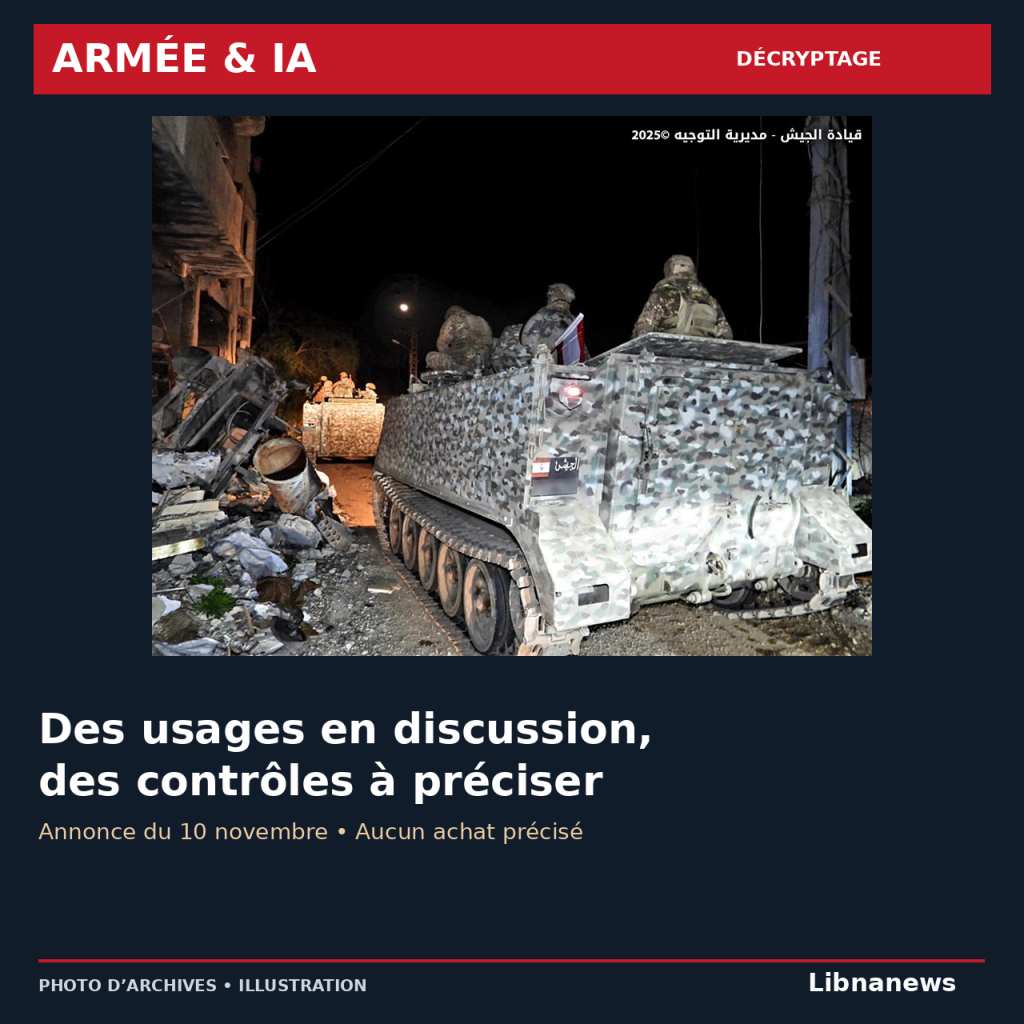
The Lebanese Army confirmed that its commander, General Rodolphe Haykal, received Kamel Shehade, Minister of Displaced Persons and Minister of State for Technology and Artificial Intelligence on 10 November. The discussions focused on the development of AI practices in the institution and the mobilization of human skills.
The press release states that the Minister has proposed to involve experts to overcome the difficulties encountered in this area. It does not describe a contract, a system purchased, or an operational schedule. The scope of the announcement must therefore remain that of a discussion on possible capabilities and cooperation.
The same expression covers very different uses
Talking about military AI may refer to management assistance, information analysis or a tool involved in a force decision. The International Committee of the Red Cross distinguishes between logistics, intelligence analysis, decision support systems and autonomous weapons. These categories do not pose the same risks.
Classifying documents or helping to predict a maintenance operation is not equivalent to recommending a target. This distinction does not prejudge Lebanese projects: the communiqué does not detail them. It indicates what information would be needed to evaluate a future announcement.
A project should specify its objective, the data used, the persons authorized to consult the results and the decisions that remain human. Without this description, the word « modernization » does not make it possible to understand what really changes in the work of the institution.
Data quality precedes displayed performance
A tool can quickly produce a response while working on incomplete, old or misinterpreted information. The situation becomes particularly sensitive when an analysis has to take account of an evolving context. High reliance on software does not replace checking the data that feed it.
In its October 2026 publication on decision support, the ICRC warns about the quality of data in conflict situations, their possible manipulation and the risk of excessive confidence in automated results. He notes that speed can amplify an error when human judgment is no longer actually exercised.
For a training programme, the challenge would be as much to recognize the limits of a result as to know how to use the interface. The experts proposed by the Minister could contribute to this assessment capacity; the press release does not yet announce their selection or mandate.
Human control must be able to change the decision
The formal presence of an operator does not guarantee effective control. However, time, information and authority are needed to challenge a recommendation. If the procedure pushes to validate without examination, a human signature may mask a decision dictated by the system.
This issue particularly concerns uses that may affect the life and safety of people. The ICRC calls for the preservation of human judgment and responsibility. The tool does not relieve those responsible of their obligations under international humanitarian law.
Design choices therefore have a concrete scope: to retain the reasons for a recommendation, to identify the source of the information, to report uncertainties and to suspend use. These are assessment criteria, not confirmed characteristics of a Lebanese Army device.
Next announcements will need to specify the scope
Funding, research agreement or experimentation would be different stages. Each should be described according to its purpose, limitations and controls. A test on a dataset alone would not demonstrate real-world reliability.
Protection of sensitive information, reliance on a supplier and monitoring of errors will also be considered. Their importance will depend on the use chosen. At this stage, the meeting on 10 November confirms a willingness to develop skills. It does not make it possible to announce the entry into service of a determined military capability.





Comments