

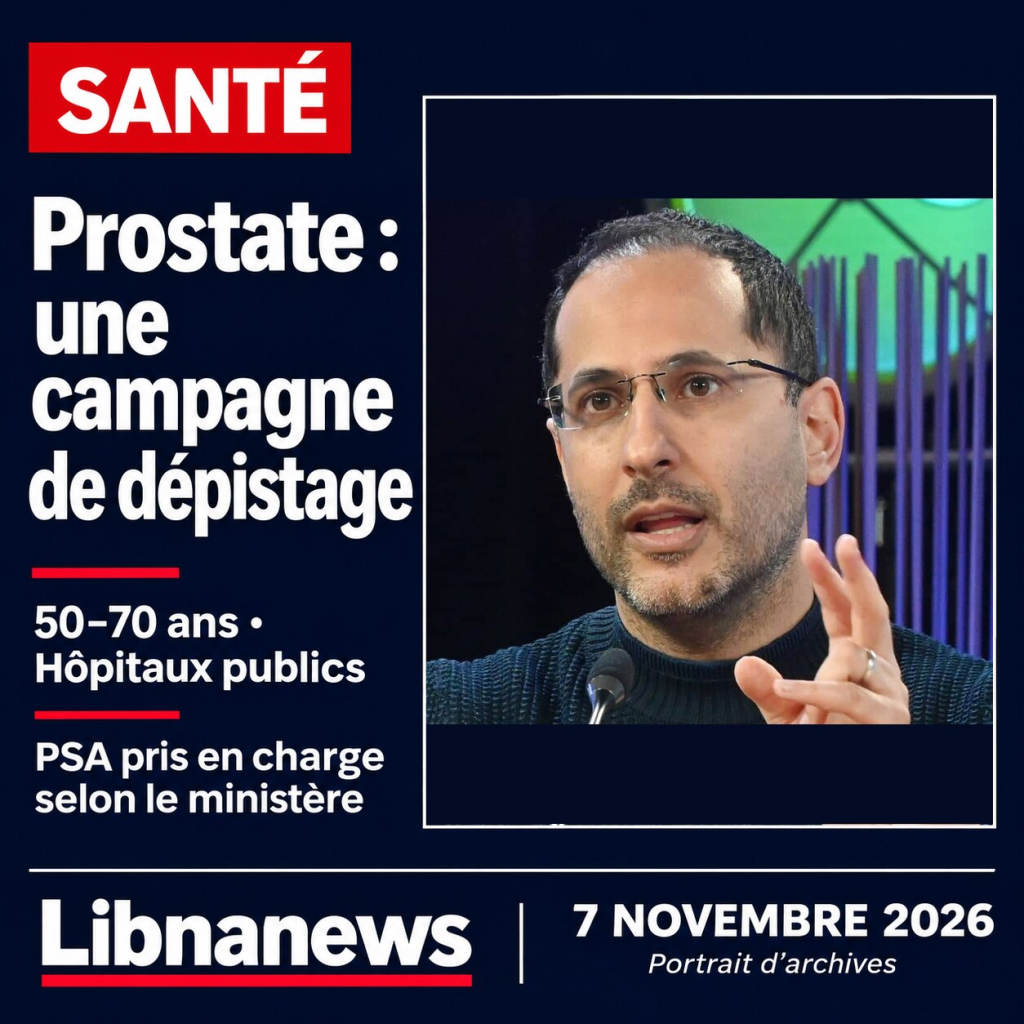
The Lebanese Ministry of Health is launching a prostate cancer screening campaign for Lebanese men aged 50 to 70. Announced on November 7, 2026 by Rakan Nassereddine at Saint Joseph University, it will continue until February 15, 2027. The Minister states that the blood strength of PSA will be taken care of in public hospitals, as well as an MRI when a result of concern justifies it.
The announcement was made at the opening of an awareness conference organized by the Faculty of Medicine of the USJ, under the theme « Together against prostate cancer, from innovation to impact ». Doctors, hospital managers and representatives of professional organisations discussed early diagnosis, access to examinations and treatment developments.
Two examinations supported according to the announced route
The first review described by the Minister is the determination of PSA, the specific prostate antigen. This marker is measured in the blood. The campaign includes funding from the Ministry for Lebanese men in the announced age group in public hospitals.
Rakan Nassereddine states that in case of an indicator of concern, magnetic resonance imaging may also be performed at the expense of the department. It therefore does not present MRI as a systematic review proposed to all participants. The continuation of the journey depends on the outcome and its medical evaluation.
The report of the announcement does not list the participating institutions, their appointment procedures or the administrative documents to be submitted. It also does not specify the biological thresholds used to direct MRI. Before a visit, the persons concerned can check the practical conditions with their public hospital and discuss the interest of the examination with their doctor.
PSA is not enough to diagnose cancer
The age criteria for funding this campaign do not replace an individualized medical decision. A high PSA does not automatically mean that cancer is present. Other prostate disorders may affect this rate. Conversely, a normal result does not exclude all cancers.
The U.S. National Cancer Institute recalls that screening can help identify some cancers earlier, but it also exposes to false positives and overdiagnosis: the discovery of tumours that would not have caused symptoms in life. Complementary reviews and possible treatments themselves have risks. The decision is therefore discussed with a health professional, depending on the patient’s personal situation and preferences.
Twelve MRI hospitals, according to the Minister
Rakan Nassereddine states that twelve public hospitals are now equipped with MRI and nine others are in the process of being equipped. These figures describe the capabilities announced by the department. They do not constitute confirmation of the slots available at each establishment.
The Minister also referred to a new offer of hospital coverage incorporating innovations. A decision on the management of robotic prostate surgery is to be published soon, he said. This perspective remains distinct from the examinations announced for the campaign: the speech does not allow to present this surgery as already funded within this framework.
Awareness raising at the centre of the meeting
The president of the Lebanese Society of Urology, Khalil Ermesh, stressed the delay with which some men consult, sometimes after the appearance of symptoms. He presented the scholarly society’s work on public information, diagnostic and treatment protocols, as well as access to imaging techniques and new care.
The president of the Order of Physicians, Elias Chellala, also stressed the importance of not delaying a consultation out of discomfort or fear. The announced campaign opens a period of funding for examinations for a defined population. Its practical access will depend on the practical information provided by public hospitals and the medical path offered to each patient.





Comments