

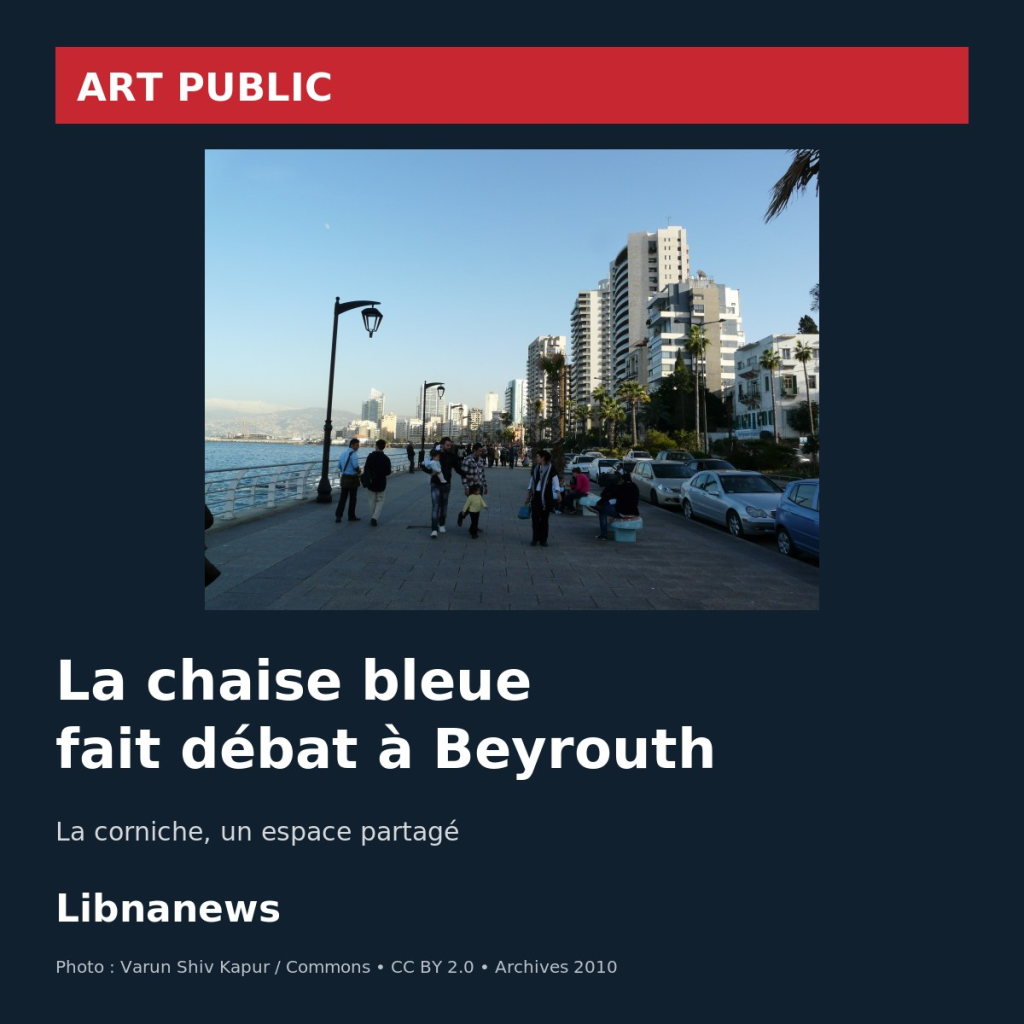
The blue chair in Ain el-Mreisse opened a debate on art in the Beyruthin public space. Inaugurated on October 27, 2026 in the presence of Nehmat Aoun, the work of French artist Sabine Géraudie, known as SAB, introduces a familiar object into the landscape of the cornice. His installation invites us to discuss his meaning as well as his encounter with the place.
A chair spontaneously evokes stop, look and conversation. On a seafront frequented by walkers and fishermen, this form takes on a particular meaning: it refers to the possibility of staying facing the sea. But the immediate recognition of an object is not enough to create a common commitment to its establishment.
The blue chair and the memory of the cornice
The cornice already has its uses, habits and memories. His interest also lies in the fact that he does it without a program: walking, sitting, watching the water or finding other people. A new work thus meets a living space, not an available decor.
It is on this ground that the discussion becomes fruitful. Sculpture can provide a landmark and generate new curiosity. It may also seem alien to those who recognize the place in other, more ordinary forms. These divergent perceptions relate to the relationship between the object and its environment; they do not allow to deduce an irregularity in the implementation of the project.
A work the artist wants linked to Beirut
Sabine Géraudie presents her Beyrouthine creation as a work thought for the city, not as a mere reproduction of that of Nice. It highlights memory, transmission and dialogue. In her testimony on the installation, she thanked Blue Shores International and the artisans who had participated in its realization.
This intention sheds light on the project, without determining how the inhabitants will receive it. In public space, the meaning of a work is also built after its inauguration: through the encounters it provokes, the looks it attracts and the place it takes in habits.
The aesthetic debate calls for a public discussion
You can appreciate the silhouette and color of this chair, or judge their unconvincing presence on the cornice. Criticism gains in clarifying what it examines: the shape of the sculpture, its scale in the landscape, its implantation or the narrative it proposes from Beirut.
The issues of site selection, maintenance and project presentation are the responsibility of public space management. They deserve documented responses from the officials concerned. It does not mean that funding would be doubtful or that a fault would have been committed.
The blue chair has already produced an observable effect: it makes the seafront known as a common place. The discussion may prolong this effect, provided that there is room for the use of cornice and the sensitivities of those who frequent it.





Comments