

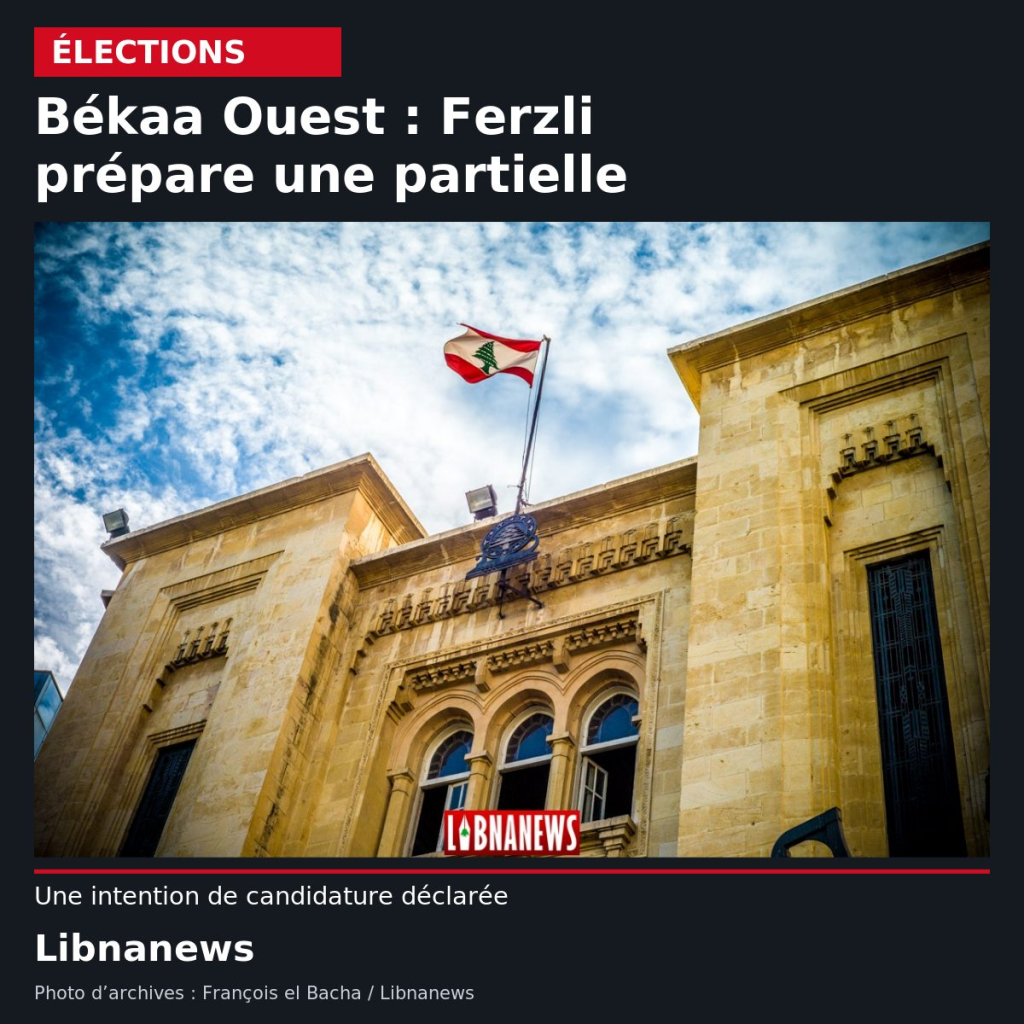
Elijah Ferzli is preparing to run for the seat left vacant by Ghassan Skaff in the West Bekaa. The former Vice-President of Parliament announced his intention to run for a by-election. Preparations by the Ministry of Interior are also reported, while other names are circulating. These political steps are not valid for the official convocation of voters or the registration of candidates.
The issue goes beyond the replacement of a deputy. A consultation in the West Bekaa, a region exposed to security tensions, would revive the debate on the arguments used to postpone national elections. But this alleged political contradiction does not make it possible to announce the cancellation of a poll that has not yet received a confirmed calendar.
Bekaa West : Ferzli shows his intention
The former vice-president of the House, beaten in the legislative elections of 2022, went to Ain al-Tiné. Nabih Berri indicated that he did not oppose the holding of a partial. Ferzli then reiterated that he was considering running, while stating that he had not asked the President of Parliament to push for the organisation of the election.
This positioning distinguishes two approaches. A politician can support the principle of an election. The decision to convene it and the necessary administrative acts follow another process. The support expressed to Ain al-Tinah should not be presented as an electoral decree.
Ferzli has political visibility linked to his previous presence in the Chamber. However, it would be premature to give it a winner or even to present the competition as definitely constituted. The stated intentions do not set out the list of participants or any alliances that may form.
Several names, no expected result
Maysam Skaff, widow of the disappeared MP, is one of the personalities mentioned. His trip to Baabda fueled discussions on a possible application. Georges Abboud also appears among the names supported in the reported political exchanges, on the side of the Lebanese Forces.
Thierry Sabounji, an active businessman between Beirut and Riyadh, is quoted as another possibility proposed by Waël Abu Faour. These names describe a political debate. They do not constitute an official list of candidates who have filed their files.
Press reports also indicate that the Lebanese Forces and the Progressive Socialist Party are reluctant to continue the discussion on partiality. The same level of caution must be maintained: exchanges between parties, even if consistent, do not replace a public decision on the holding of the vote.
National calendar returns to debate
The political reasoning advanced is simple: if a local election can be held in a threatened area, the security argument used to postpone a national deadline deserves to be reconsidered. This question concerns the consistency of party positions, not automatic equivalence between the two operations.
A partial in a constituency and general elections do not mobilize the same means. Their scope, organization of offices and administrative coordination differ. It is therefore necessary to examine the constraints specific to each election before concluding that the feasibility of one demonstrates that of the other.
Nor is safety the only dimension of the calendar. Preparations for voting abroad are reflected in discussions on national deadlines. The technical needs cited must be distinguished from political choices over the duration of a mandate or at the appropriate time to consult electors.
No date may be determined by extrapolation from statements on the time limits for preparation. The relevant acts, instructions from the relevant ministries and measures actually taken should be known. The debates on expat voting alone do not make it possible to conclude that partial voting is impossible.
Administrative acts will make the difference
The monitoring of the dossier must now cover verifiable elements: a decision to convene, a formal timetable and the procedures for submitting applications. Their publication would give another meaning to the intentions announced by the personalities concerned.
In their absence, political unrest remains distinct from the actual start of a campaign. Voters in the West Bekaa are awaiting clarification on the representation of their electoral district. The next step will be a specific institutional act, rather than a new list of potential candidates.





Comments