


RAM prices remain under pressure in November 2026. The demand for data centres, the decline in certain productions and the long-term investments to be realized explain this tension. But an increase announced for chips does not pass mechanically to each bar. To understand the invoice, we need to distinguish between technologies, markets and periods.
A computer doesn’t need to run an artificial intelligence model to get the price of its components up. Industrial decisions to equip servers also influence the memory available for other machines. The link is through factories, investments and supply contracts.
The public update on memory contracts for PC, dated October 30, describes a further increase in the fourth quarter. However, its pace is slowing compared to the previous quarter. Buyers are more resistant to new rates, while sales of mobile phones are weakening. Tension persists because the supply for PCs remains constrained.
This shift explains an apparent paradox: components can still increase even when consumers buy less computers. The available production capacity is not limited to the needs of the general public.
The latest quotations, however, invite us to distinguish between bottom rise and daily movements. On November 6, at 6:10 p.m. in Taipei time, several categories of chips were down on the spot session. DDR5 16 Gb 4800/5600 was down 0.82%, and DDR4 16 Gb 3200 was down 1.06%. These variations relate to chips, not bars sold to households. They are neither sufficient to erase the previous price increase nor to announce a general drop in prices in shops.
AMR Price: Four Years of Turnaround
Data from the same manufacturer are used to measure the magnitude of the cycle. They avoid juxtaposing an old promotion, a recent wholesale price and a bar with different characteristics.
Micron publishes in its annual reports the evolution of the average selling price of its DRAM products. By 2023, this price had fallen by almost half. The group described a decline in percentages in the upper 40s. It had reduced its investment expenditure and the production of silicon slices.
The movement then reversed. For fiscal year 2024, the increase was slightly over 10%. By 2025, it reached the bottom of quarantine. In 2026, Micron reported an increase of about 180% over 2025.
| Fiscal year Micron | Annual change in average published DRAM price |
|---|---|
| 2023, compared to 2022 | Decline in upper quarantine, percentage |
| 2024, compared to 2023 | Increase slightly above 10% |
| 2025, compared to 2024 | Increase in the lower 40s, as a percentage |
| 2026, compared to 2025 | Increase of around 180% |
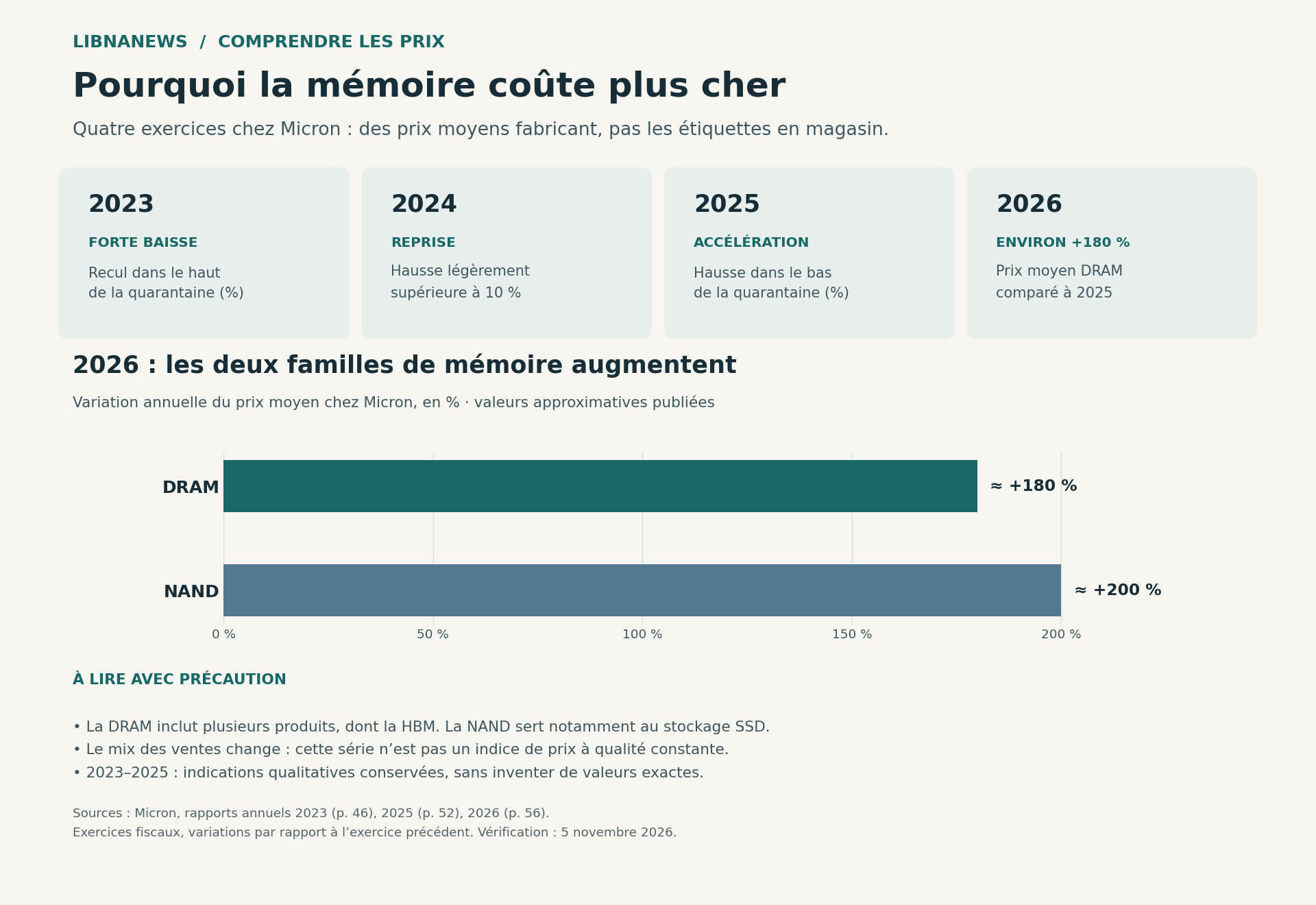
These formulations preserve the accuracy of the reports. They do not justify producing a curve with, for example, 48%, 12% or 42% as exact values.
Exercise 2026 of Micron ends on 3 September. The annual comparison therefore does not correspond to a period from January to December.
The series concerns a manufacturer and his assortment of products. It includes, in particular, the rise of memories for data centres. It does not measure a global index of constant quality, nor does it measure the price of a 32GB kit unchanged. Part of the evolution reflects the composition of sales.
Its teaching remains clear: the sector has moved from a sharp fall in prices to a recovery and then a major acceleration. The cheap memory of 2023 corresponded to a particular industrial situation. It does not constitute a guaranteed normal tariff for subsequent years.
DRAM, HBM, NAND: three terms not to be confused
A computer RAM is used to temporarily keep the data used by the programs. The DDR4 and DDR5 bars belong to the DRAM family. Both generations have different electrical and mechanical characteristics. They are not interchangeable.
The HBM also belongs to the DRAM family. However, its organisation differs from that of a classic bar. Memory layers are stacked and connected to quickly transfer large amounts of data. This architecture responds in particular to the needs of accelerators used in artificial intelligence infrastructures.
Therefore, a buyer does not replace a DDR5 bar with an HBM battery. Competition between these products lies upstream in the allocation of industrial resources. Capacity is not fully interchangeable, but investment and manufacturing trade-offs link markets.
NAND is another use: persistent storage, especially in SSDs. It keeps the files when the device is turned off. Adding storage does not mean increasing working memory.
This distinction counts for reading statistics. In fiscal year 2026, Micron reported an average increase of approximately 200% for its NAND products. The figure of 180% relates to its DRAM products. The two increases relate to different families. They do not add up to measure the increase in the price of a computer.
Why AI exerts pressure on other memories
The industrial explanation begins with the amount of silicon mobilized. By June 2024, Micron had indicated that HBM3E required approximately three times more slices than DDR5. The comparison involved the same number of bits and the same manufacturing process.
This clarification is indispensable. It is not a question of saying that any HBM memory costs three times more. This report does not measure either a selling price or the full cost of a plant. It does not automatically apply to each technological generation.
It describes a capacity constraint. When more resources are used to produce a demanding silicon memory, their availability for other products may decrease. The stacking, assembly and testing steps add their own constraints.
In fact, the AIA does not only request HBM. Servers also need system memory, including DDR5. On 28 October, SK hynix indicated that the expansion of its DRAM business was based on DDR5 server sales. The group also reported an increase in HBM4 deliveries.
The next day, Samsung confirmed a strategy centered on the iA applications. The group plans to expand sales of HBM and DRAM servers. In particular, it intends to increase the offer of rapid DDR5 for these machines.
These announcements explain why sum up the increase to « IA buys all the RAM » would be misleading. Tensions combine several products, several industrial stages and several commercial arbitrations. The memory of a server may compete more directly with that of a PC than is suggested by the only reference to the HBM.
Why an old generation can stay expensive
The seniority of a technology does not guarantee a continuous fall in its price. When producers reduce a range, supply may decrease before the compatible equipment fleet has disappeared.
Not all DDR4 users can switch to DDR5 by simply changing their bars. The motherboard must support this generation. The processor and memory controller must also be compatible. Migration can therefore require a change of platform.
This constraint maintains a demand for older components. It concerns both repairs and certain extensions of existing machines. The price then depends on the relationship between a declining supply and the remaining needs.
The October 30 market point specifically describes separate pressures. DDR5 suffers from limited capacity on advanced processes. DDR4 also undergoes reorientation from suppliers to servers. The same mechanism is therefore not enough to explain all the models available in the shop.
Before purchasing, the comparison must be based on a compatible reference. Total capacity, number of modules, generation and format must match. A laptop bar is not automatically an alternative to a desktop module.
Industrial contracts and shop prices do not tell the same thing
Major manufacturers negotiate supply contracts. The spot market concerns more immediate transactions. The retail price then adds the conditions for distribution.
These levels can evolve at different rates. A distributor can still sell a previously purchased stock. A new delivery can arrive at a different cost. Promotions, guarantee, transport and taxation also change the amount requested from the customer.
On 30 September, a sectoral estimate anticipated a 10-15% increase in conventional DRAM contract prices in the fourth quarter. This forecast compared two successive quarters. It did not mean that each bar would increase by 10 to 15% between September and December.
Nor should it be compared directly with the 180% published by Micron. The first indicator relates to conventional DRAM contracts and a quarterly period. The second describes an average manufacturer price, over an annual exercise, with a different assortment of products.
To measure an increase in detail, the same reference must be followed by comparable sellers on defined dates. Prices must include the same taxes and fees. An unavailable offer or price displayed without delivery is not necessarily worth a feasible purchase.
What memory changes in the price of a PC
The final invoice depends on the weight of each component and the seller’s commercial policy. A significant increase in memory does not automatically produce an identical increase in the price of the machine.
A computer also includes a processor, motherboard, storage and power supply. A laptop includes a battery and a screen. The costs of assembly, distribution and guarantee are also included in the final price.
The mechanical effect is calculated from the initial cost of the memory, its variation and the total cost of the machine. But this calculation requires a real nomenclature. Without this data, assigning a specific percentage of the invoice to the AMR would amount to inventing a decomposition.
The seller can absorb part of the increase in its margin. It can raise its price or change the configuration. Two computers sold at the same price can offer different quantities of memory. Comparing labels alone may mask this evolution.
RAM and SSD should remain two separate lines in this comparison. A 16GB memory configuration and 512GB storage does not replace a 32GB and 1TB machine with constant characteristics.
The announced plants do not deliver immediately
Price increases encourage investment. However, their effect on the quantities available remains staggered. Buildings, equipment, processes and industrial qualifications take time.
The calendar published by Micron on 30 September illustrates this gap. The manufacturer anticipates the first slices of its new ID1 plant in Idaho in mid-2027. It aims at the end of 2028 for ID2 and 2030 for its first plant in New York. These deadlines describe early production, not full instantaneous capacity.
For its part, SK hynix has announced long-term agreements with 14 major customers. The volumes already covered represent more than half of its production capacity for 2027 and 2028. This gives visibility to the manufacturer and secures part of the purchases of the customers concerned.
These contracts do not lead to the conclusion that all world memory would already be sold. However, they show that capacity decisions take several years before an individual buys a bar.
Reorientation can also affect consumer brands. On December 3, 2025, Micron announced its withdrawal from the Crucial consumer business. Its schedule included deliveries until February 2026, with support and guarantee maintained. The group explained that it wanted to better serve its strategic clients in fast growing segments.
In Lebanon, measure before assigning the increase
Global tension helps to understand the evolution of supply costs. It is not sufficient to establish an average increase in RMA prices in Lebanon. The data consulted do not provide a homogeneous local series over several years with identical reference.
For a household, student or small business, the useful method remains concrete. A detailed estimate should be requested and the exact reference for the module should be maintained. The price must specify the taxes, any fees and guarantee conditions. The actual availability must be confirmed at the time of purchase.
A national comparison would require a repeated survey of the same products in several sellers. It should distinguish between old references, new generations and changes in capacity. Without this work, a gap between two advertisements can translate a product difference rather than inflation.
The evolution to follow now concerns the end-of-year contracts and the arrival of new capacities. A slower increase remains an increase. To see a relaxation at the counter, it will be necessary to observe actual decreases on identical, available and comparable references.





Comments