

Twenty samples of olive oil from Nabatiyah governorate meet the Lebanese standard, according to the Ministry of Agriculture. Announced on 30 October 2026, these results concern direct samples from mills. They provide information on the products analysed, while teams still cannot access certain occupied sectors.
Minister Nizar Hani recalled this limit in an interview published on November 2. Available results cover areas where sampling has been possible. Further reviews remain linked to the return of teams to currently inaccessible sectors.
Olive oil: 20 samples in four districts
The laboratories of the Lebanese Agricultural Research Institute, LARI, carried out the analyses. The Ministry’s technical commissions collected samples in Nabatiyah, Hasbaya, Marjayoun and Bint Jbeil districts. The press release indicates their compliance with the Libnor standard for olive oil.
The collection area includes fourteen localities, including Hasbaya, Marjayoun, Deir Mimas, Ansar, Yater, Kafra and Majdal Selm. The Department explicitly links its assessment to the samples in the report. It does not publish in this press release any certification of each mill or lot marketed.
The number of samples makes it possible to know the size of this campaign. It is not enough to establish its representativeness for all the production of the South, let alone that of Lebanon. In order to assess this scope, the sampling plan and the detailed list of parameters analysed should be available.
Inaccessible sectors remain out of control
The announcement takes place in a region where war complicates displacement and agricultural work. Nizar Hani indicates that the occupation of certain areas prevents new sampling campaigns. The department plans to resume these controls when teams can enter.
Geographical distinction therefore counts as much as the result. Compliant analyses in an accessible mill do not provide information on a product from an untested sector. Conversely, the absence of analysis in an inaccessible area does not constitute evidence of contamination.
The data announced also do not allow the past exposure of each olive grove to be reconstructed. Oil testing, water testing and soil analysis answer different questions. The press release of 30 October concerns oil taken from the mills concerned.
Product quality, a marketing issue
The minister took up the subject on 31 October in Hasbaya, at the first olive festival and show announced by his services. It linked support for producers to the quality, marketing and identification of the origin of oils.
Priorities presented include improving harvesting and processing practices, and using packaging that identifies regions and producers. Nizar Hani also called for enhanced controls against fraud and false indications of origin.
Sample compliance and commercial traceability perform complementary functions. The first describes the result of a check. The second allows to link the product sold to an operator and to an origin. A general announcement does not replace batch-specific information.
In Hasbaya, the minister estimated the expected domestic production at about 200,000 tonnes of olives. It distinguished some 30 000 tonnes for table consumption and oil production expected around 30 000 tonnes. These are forecasts for the season, not a definitive balance sheet of the volumes already obtained.
For areas still out of reach, missing information remains the result of new sampling. Their timing depends on the teams entering the field. The conclusions currently announced remain attached to the products actually analysed.
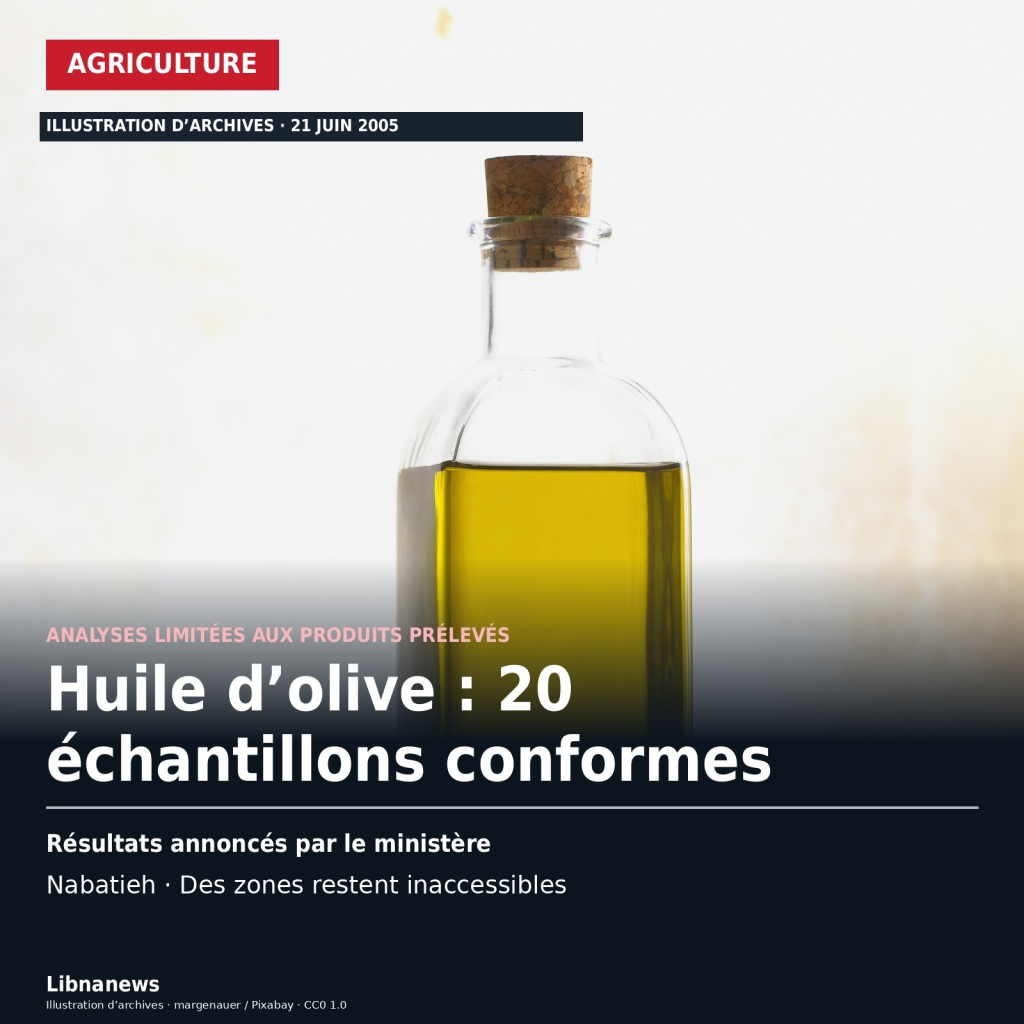
Bottle of olive oil, illustration photograph of 21 June 2005 according to metadata. This product is not one of the 20 Lebanese samples analysed. The image does not document the samples or their results. Photo: marinauer / Pixabay.Original source;CC0 1.0. Frame, resize and add text. No documentary elements added or removed.






Comments