

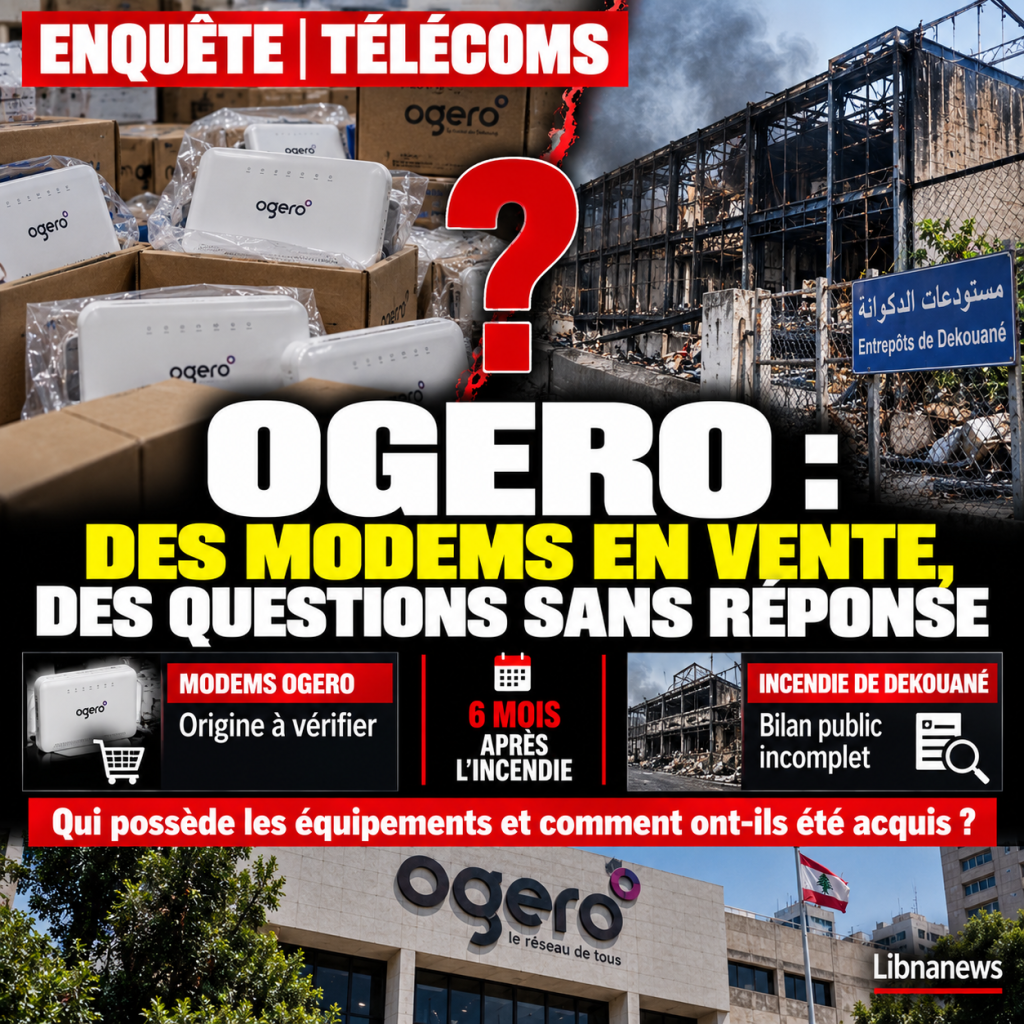
A commercial announcement that raises questions about public equipment
An announcement published on social networks by a private company raised questions within Ogero, the public body responsible for operating the fixed telecommunications network in Lebanon. The advertisement proposed for sale modems presented as originating from the establishment. A photograph showed several devices, some of which were grouped in a cardboard box. According to information made public on 23 October 2026, employees of Ogero contacted the company’s manager for information on the origin of the equipment. He claimed that he had a significant amount of equipment acquired under a single batch. He also alleged to have maintained commercial relations with the public establishment.
These statements raised questions about the conditions under which the aircraft had left, if any, the usual materiel management circuits. Ogero does not normally sell its modems to private businesses according to the operation described in the available information. The presence of such equipment in a commercial advertisement, however, does not alone constitute evidence of misuse. It is still necessary to determine their owner, their exact origin and the conditions of their acquisition. In particular, devices may change ownership in different circumstances, the legality of which depends on the applicable documents and procedures.
However, the situation is of particular interest for the management of public goods. Telecommunications equipment is generally monitored through purchasing, storage, allocation and distribution procedures. When a lot appears in an unusual trade circuit, the first question is whether its transfer is based on an identifiable administrative decision. It must also be determined whether the aircraft still belong to Ogero or whether they have been the subject of an authorized operation. The information published does not provide a definitive answer to these questions.
The head of the company refers to a batch acquisition
One of the central elements of the case is the contact between Ogero’s employees and the company manager. According to the available account, the latter reported having a significant amount of modems from a single batch. He also alleged to have worked with Ogero. These two statements deserve to be examined separately, as they do not necessarily demonstrate the existence of a contractual relationship relating to the equipment offered for sale.
A company may maintain commercial relations with a public body without being authorized to market all the equipment associated with it. The possible existence of a contract would therefore not be sufficient to explain the presence of modems on the market. The purpose, duration and obligations of the parties should be known. It would also be necessary to determine whether the lot concerned corresponds to new equipment, recovered equipment, reformed equipment or property belonging to individuals.
Photographs accompanying the advertisement may provide guidance, but they do not allow a chain of ownership to be established. The presence of several devices in a carton only shows that a quantity of material was offered or presented. It does not determine the total number of units held, their technical status or their administrative origin. No detailed inventory, serial number or transfer document is reproduced in the passages examined.
Identification of devices would therefore be an essential step. Serial numbers could potentially bring them closer to purchase, delivery or distribution documents. Such a comparison would help determine whether they were assigned to subscribers, held in inventory or transferred to a third party. Without such verification, the seller’s statements and the suspicions raised by the advertisement remain insufficient to establish an irregularity.
The fire at Dekouane warehouses returns to the debate
The case takes on an additional dimension due to a fire that occurred about six months earlier in warehouses in Dekouane. These facilities were under the responsibility of the General Directorate of Operations and Maintenance of the Ministry of Telecommunications. The fire had raised questions about the equipment stored and the damage suffered. As at 23 October 2026, no detailed official report had been made public, according to available information, to clarify the causes of the loss, the extent of the losses and the fate of all the property concerned.
This lack of public balance sheet explains why the discovery of modems proposed for sale has revived the questions. Some observers question whether equipment has been moved, recovered or removed from normal post-fire management procedures. However, this is a hypothesis, not a proven fact. There is no verified evidence that the devices listed in the advertisement come from Dekouane warehouses. The chronological proximity between the two cases is not sufficient to prove a material link.
The fire nevertheless raises an issue independent of the sale of modems: that of the traceability of property held in public facilities. After a disaster, an inventory will normally distinguish between destroyed, damaged, recoverable and still usable equipment. It is also used to measure losses and prepare any administrative or judicial proceedings. The absence of public information on these transactions does not demonstrate that they have not been carried out. However, it limits the possibility of assessing the results.
The available documents do not specify whether an administrative or judicial investigation was initiated after the fire. They also do not permit the identification of inventory persons or the determination of whether equipment has been moved to other facilities. This information would be essential to seriously examine the hypothesis of a link between the loss and the devices offered for sale.
Six months without detailed public balance sheet
The delay since the fire is one of the main elements in this case. About six months after the disaster, public information still did not provide precise information on the causes of the fire and all the damage to property. This raises a question of administrative transparency, regardless of any charge of misappropriation.
The management of a public warehouse requires knowledge of the assets stored there. Equipment can represent significant costs, particularly in a sector requiring technical procurement and regular maintenance operations. When a fire occurs, the rebuilding of stocks can assess the financial and operational consequences. It also helps to identify equipment that needs to be replaced to ensure continuity of service.
In the case of Dekouane, a number of information remains to be established. This would include the value of assets stored prior to the disaster, the nature of the aircraft involved and any quantities destroyed. It would also be useful to determine whether the facilities had monitoring systems and procedures for controlling the entry and exit of equipment. The documents reviewed do not provide these details.
The absence of a publicly available balance sheet should not be confused with the absence of any internal control. Administrative procedures may have been initiated without their results being published. However, the dissemination of accurate information would help to answer some of the questions and limit speculation. It would also help to distinguish the actual losses caused by the fire from any anomalies in inventory management.
The checks necessary to establish the origin of the aircraft
The first verification should cover the legal identity of the company that published the advertisement and the conditions under which it holds the modems. Commercial documents could identify the original seller, the date of acquisition and the quantity of devices involved. They would also assist in determining whether the transaction resulted in an invoice, contract or other evidence.
The second check would concern Ogero. The establishment could examine the characteristics of the devices and determine whether they correspond to equipment acquired or distributed in the course of its activities. A comparison with the records of equipment would eventually enable their administrative path to be traced back. In particular, it would be necessary to determine whether the devices were handed over to subscribers, kept in inventory or disposed of under an authorized procedure.
The third audit would cover the Dekouane warehouses. If the equipment proposed for sale were to correspond to models present in these facilities before the fire, it would be necessary to examine inventories and stock movements. However, correspondence between models would not be sufficient to establish their provenance. Only a more precise identification would bring the equipment closer to the goods actually stored.
Finally, the competent authorities could examine the general conditions for the management and disposal of public equipment. The objective would be to determine whether the procedures have been followed and whether any anomalies warrant further investigation. At this stage, no individual liability can be considered established.
A case revealing control issues in telecommunications
The file goes beyond the question of a few devices offered for sale. It highlights the importance of monitoring equipment in a public sector facing financial and technical difficulties. Telecommunications infrastructure requires regular investment, while users depend on the availability of equipment and continuity of services.
Transparent inventory management reduces losses, facilitates maintenance and better planning of purchases. It also helps to protect public finances. When equipment disappears from records or appears in an unusual circuit, the difficulty is to determine whether it is an administrative error, an insufficiently documented authorized operation or an irregularity requiring investigation.
In this case, the information available does not make it possible to choose between these different possibilities. The commercial announcement is a concrete element that justifies questions. The declarations attributed to the seller shall provide information on the alleged source of the consignment. The Dekouane fire is a separate event, whose material consequences remain insufficiently documented publicly.
As of October 23, 2026, there is no verified evidence that the modems proposed for sale were diverted from Ogero or from the burned warehouses. The case therefore remains that of origin to be established, of a trade circuit to be explained and of a public inventory whose results should be clarified. The publication of specific documents on these three points would determine whether the questions raised correspond to an administrative anomaly or facts requiring prosecution.





Comments