

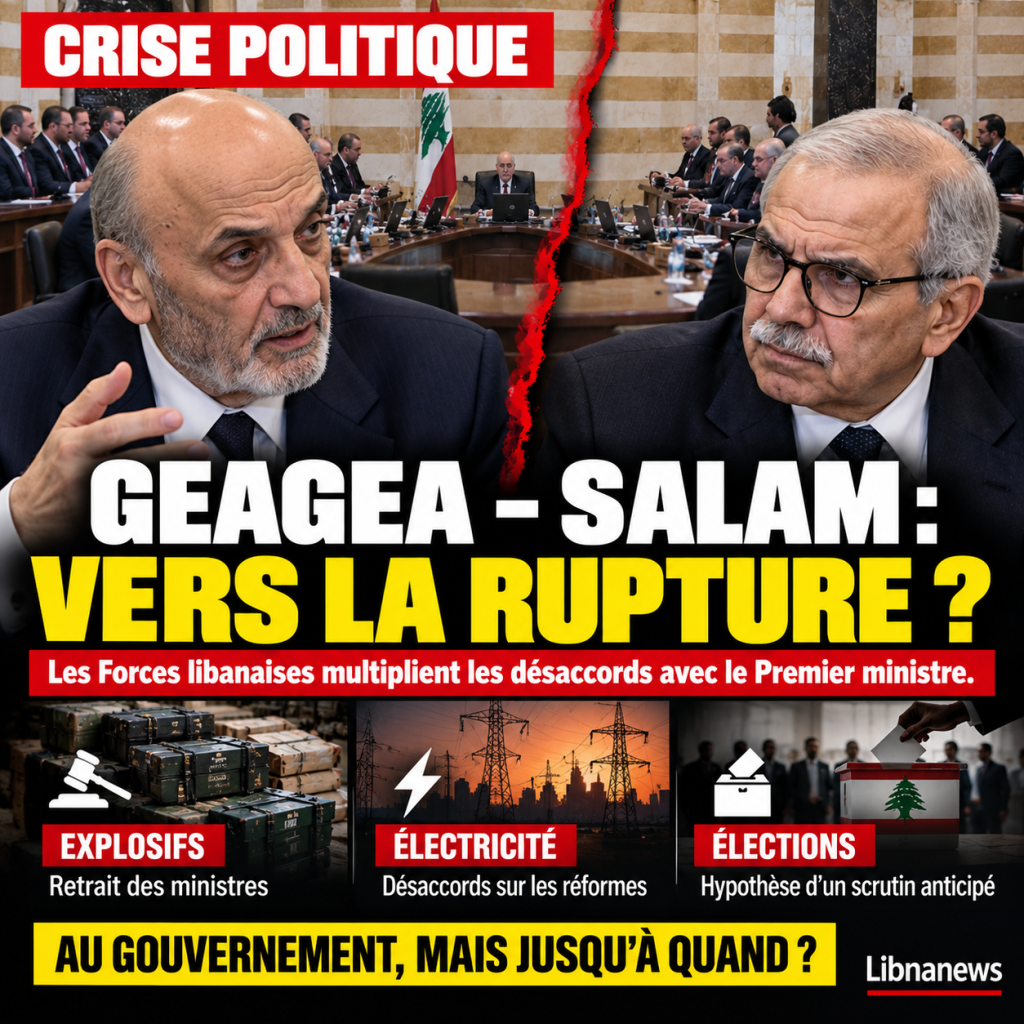
The withdrawal of ministers reveals a deeper political divide
The withdrawal of the Ministers of the Lebanese Forces from the Council of Ministers on 22 October 2026 marks a further step in the deterioration of their relations with the Government of Nawaf Salam. Officially, the protest concerns the postponement of the referral of the Dahr al-Baydar explosive dossier to the Justice Council. Yet this episode is part of a series of disagreements that now affect several aspects of government action. Energy policy, Hezbollah’s weapons, decision-making mechanisms and electoral prospects fuel an increasingly visible confrontation. The question thus goes beyond the fate of a cargo of explosives. It concerns the position that the Lebanese Forces intend to occupy in a coalition of Governments whose directions they contest, while continuing to participate in its work.
The crisis took on a particular dimension when the party ministers left the meeting, while their colleagues close to Hezbollah remained around the table. This reversal illustrated the effects of the compromise negotiated before the meeting. Consultations between Joseph Aoun, Nabih Berri and Nawaf Salam had delayed the judicial decision in order to avoid confrontation with Hezbollah. However, the Lebanese Forces considered this solution to weaken the scope of government commitments regarding the arms monopoly. Their withdrawal was therefore intended to mark both a judicial and a political opposition. It did not, however, constitute a resignation of the government, a distinction essential to understanding the party’s strategy.
This attitude raises a broader question. Are the Lebanese Forces seeking changes in government policy, or are they gradually preparing for their passage into the opposition? The available political information describes an increasingly difficult relationship with Nawaf Salam. They also refer to discussions on early parliamentary elections, which could change parliamentary and governmental balances. However, there is no verified evidence that a final decision to leave the government was made by the party leadership.
From electricity to explosives: a succession of disagreements
Tensions did not arise with the Dahr al-Baydar case. They had already manifested themselves around the operation of the electricity sector and the action of energy minister Joe Saddi, a member of the Lebanese Forces. Its temporary withdrawal from certain government activities, presented in political information as a form of protest, had revealed the difficulties encountered in the conduct of energy reforms. The minister questioned the obstacles to the application of certain guidelines. This situation fueled criticism of the respective responsibilities of government, administrations and politicians in the persistence of the electrical crisis.
The energy issue is a particularly sensitive area. Supply difficulties, production costs and delays in reforms directly affect households and businesses. They are also a major challenge for public finances. The Lebanese Forces seek to defend their ministerial record, while denouncing obstacles that would prevent certain decisions from succeeding. This position has an obvious political difficulty: the party participates in a government whose functioning it publicly criticizes. He must therefore convince that his ministers have a reformist will, but that the results remain limited by decisions or blockages beyond their control.
The explosives case accentuated this contradiction. Unlike the electricity sector, where administrative and financial responsibilities can be divided among several bodies, the request for referral to the Council of Justice required a decision by the Council of Ministers. The Lebanese Forces believed that the Government had the necessary elements to act. The refusal to return immediately was interpreted as a further manifestation of the limits of government action against Hezbollah. Confrontation was therefore no longer limited to the slow pace of reform, but rather to the State’s ability to enforce its decisions in an area of national security.
This succession of episodes explains why some political observers consider the Lebanese Forces to be in a crisis of positioning. Their participation in government allows them to influence decisions and defend their priorities. It also exposes them to criticism of the executive results. Their passage into the opposition would give them more political freedom, but would reduce their direct influence on public policies. This dilemma is now central to their relationship with Nawaf Salam.
Samir Geagea facing the problem of government participation
The Lebanese Forces’ strategy depends largely on the choices of their president, Samir Geagea. The party has long defended a political line hostile to the maintenance of Hezbollah’s weapons outside state institutions. His participation in the Government of Nawaf Salam was based, inter alia, on the possibility of advancing that direction within the institutional framework. Government decisions on the arms monopoly were therefore an important element of its political justification. The Dahr al-Baydar case, however, showed the difficulties encountered in translating these principles into concrete judicial decisions.
For the Lebanese Forces, MP Hassan Fadllallah’s recognition of Hizbullah’s membership of explosives reinforced the need for government intervention. The party considered this statement to identify the organization concerned and justified referral to the Council of Justice. Those in favour of postponement argued for another interpretation, based on the need to complete investigations and clarify individual responsibilities. This divergence has placed the Lebanese Forces ministers at the immediate choice of accepting compromise or expressing disagreement. They chose the second option.
Their withdrawal showed their electorate that they refused to endorse the decision. It also helped to differentiate their position from that of other government components. However, this did not prevent the Council of Ministers from continuing its work. Nor did it lead to the departure of the Minister of Justice, Adel Nassar, yet at the origin of the removal request. The latter remained at the meeting, now the possibility of returning later to the file. This difference in behaviour pointed out that supporters of a referral to the Justice Council did not necessarily share the same political strategy.
The Lebanese Forces leadership must now measure the consequences of this distinction. An ad hoc protest can increase the party’s visibility without compromising its participation in power. Repetition of withdrawals, on the other hand, could weaken its government credibility and increase questions about its intentions. It could also lead Nawaf Salam to seek compromises without relying on the systematic support of party ministers.
Nawaf Salam refuses to turn compromise into political retreat
The Prime Minister adopted a particularly firm position during the meeting on 22 October. His intervention on the arms monopoly recalled that only public institutions have the legitimacy to carry weapons and decide on war or peace. In particular, Nawaf Salam cited the Taif Agreement, Security Council resolution 1701 and the commitments made in connection with the cessation of hostilities in November 2024. He also stressed that the transport and storage of weapons outside authorized structures could pose a threat to public security. These statements confirmed that the Prime Minister did not renounce the principles upheld by the Lebanese Forces on State sovereignty.
Rather, the disagreement was about methodology and timing. Nawaf Salam accepted the postponement of the judicial decision in order to preserve government stability. The Lebanese Forces considered that this precaution might deprive official statements of their practical scope. The difference is important. It shows that two actors can share some institutional principles while opposing how to apply them. The Prime Minister favoured a decision to continue investigations without causing an immediate crisis. The party ministers called for a swift judicial response, even at the cost of political confrontation.
Nawaf Salam’s reaction to the withdrawal of ministers revealed the extent of his irritation. Political information attributed him a particularly severe criticism of their behaviour, assimilated to a form of overbidding. This reaction shows that the Prime Minister does not necessarily see the protests of his partners as an acceptable means of influencing collective decisions. It could also announce more difficult relations at future government meetings, particularly on issues where the interests of the different formations diverge.
The challenge for Nawaf Salam is to preserve a large majority of the Government that is broad enough to continue the reforms. A break with the Lebanese Forces would complicate this task, without necessarily automatically causing the government to fall. Conversely, a multiplication of contested compromises could weaken his political authority. The Prime Minister must therefore maintain a balance between the demands of his partners and the need to preserve the functioning of the institutions.
The hypothesis of early elections is part of the calculations
Government tensions are accompanied by discussions on the possibility of holding early parliamentary elections. This assumption appears in the political analyses on the evolution of relations between the Lebanese Forces and the Government. It would be based on a reduction in the length of the parliamentary term, which would lead to a renewal of the House before its normal expiry. Such an approach would, however, require a legislative decision and sufficient parliamentary support. It could therefore not result from the sole will of a party.
The political interest of this option is linked to the constitutional consequences of Parliament’s renewal. The opening of a new legislature entails the resignation of the government in accordance with the applicable rules. Early elections could thus change parliamentary balances and pave the way for the formation of a new executive. For the Lebanese Forces, this could be an alternative to immediate ministerial resignation, the effects of which would be more limited.
However, several obstacles remain. The first concerns the need for a parliamentary majority in favour of reducing the mandate. The second is electoral uncertainty. There is no guarantee that new elections would produce a more favourable majority for the Lebanese Forces. The third obstacle is linked to the regional context. Military tensions and economic difficulties could make early voting particularly complex.
The information available does not lead to the conclusion that this option currently enjoys sufficient parliamentary support. It appears more as a hypothesis of political pressure than as a decision taken. Its simple evocation nevertheless helps to show that government disagreements are beginning to form part of a broader reflection on the balance of power.
Why immediate resignation remains unlikely
An immediate exit from the government would have several disadvantages for the Lebanese Forces. The party would first lose its ability to intervene directly in ministerial decisions. Its officials could no longer defend their projects from within the executive. This loss would be particularly significant in areas where they have government responsibilities, including energy. It could also allow their opponents to blame them for the interruption or slow down of reforms.
A resignation would not necessarily cause the government to fall. The consequences would depend on the composition of the executive and the constitutional rules governing his resignation. The departure of a group of ministers does not automatically lead to the end of the government mandate. The Lebanese Forces could therefore end up in opposition without any major institutional change. This perspective explains why some observers prefer the hypothesis of continued pressure from within the government.
The party also has other means of action. Its ministers may challenge certain decisions, request further discussions or refuse to endorse compromises that they consider contrary to their commitments. Members of Parliament may intervene in Parliament, particularly in debates on reforms and public policies. Finally, management can use its positions to mobilize its electorate and increase the visibility of its demands.
However, there is a risk of wear and tear. If protests multiply without producing results, they could give the impression of government involvement becoming essentially conflictual. The Lebanese Forces would then be forced to specify their objectives. Do they want to see concrete changes in government conduct, or do they want to prepare for a deeper political breakup?
The Saudi factor and regional balances
Lebanese political calculations cannot be separated from the regional context. Reports attributed to political sources include Saudi Arabia’s commitment to maintaining Nawaf Salam as head of government. This orientation, if confirmed, would be an additional factor limiting the prospects for a major government crisis. It does not mean, however, that Riyadh would intervene directly in Lebanese Forces decisions or that it would have decision-making power over their participation in the executive.
The regional context also reinforces the arguments of those responsible for institutional stability. Tensions between the United States, Israel and Iran expose Lebanon to significant security risks. The Tampa military negotiations did not resolve disagreements over the control of military activities in the South. Israeli operations continue in several border areas. In those circumstances, a prolonged government crisis could complicate coordination between Lebanese institutions and their international partners.
For the Lebanese Forces, this situation presents an additional contradiction. The party considers that regional risks reinforce the need to place weapons under the exclusive authority of the State. Those in favour of compromise believe that these same risks require avoiding internal confrontation. The two positions are therefore based on a different assessment of the means of protecting national stability.
A possible break, but no final decision
As at 23 October 2026, the information available shows that relations between the Lebanese Forces and Nawaf Salam have deteriorated. Disagreements over electricity, the withdrawal of ministers during the discussion on explosives and the mention of early elections are all signs of increasing tension. However, they are not sufficient to establish the existence of a final decision to leave the government.
The party’s strategy seems to be based, for the moment, on a combination of institutional participation and political challenge. This formula allows him to maintain his ministerial responsibilities while affirming his opposition to compromises which he considers incompatible with his priorities. It also offers Samir Geagea room for manoeuvre pending the evolution of security issues and parliamentary balances.
The next test will focus on how the government will deal with a possible new request for referral of explosives to the Council of Justice. A favourable decision could ease tensions. A further postponement could, on the contrary, reinforce the criticisms of the Lebanese Forces. Discussions on electricity and other reforms will also provide guidance on the party’s ability to continue its government action.
The crisis of 22 October did not, therefore, cause a break between the Lebanese Forces and Nawaf Salam. It nevertheless made their differences more visible and complicated their relations. The party remains in government, but its attitude shows that it now intends to publicly challenge certain decisions. The evolution of this strategy will depend on the results achieved, the parliamentary power relations and the regional risks that Lebanon continues to face.





Comments