

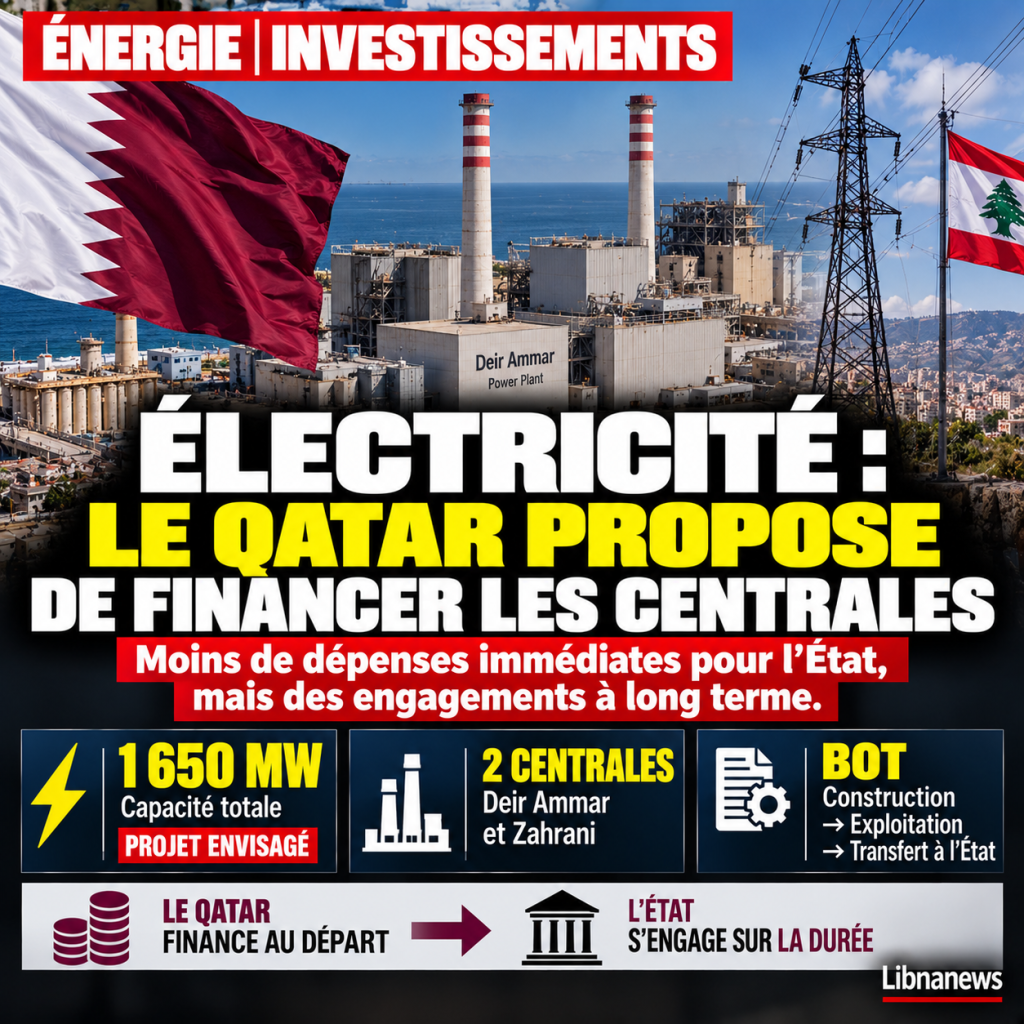
Doha proposes to finance and operate Lebanese electricity infrastructure
Qatar is seeking to strengthen its presence in the Lebanese energy sector through an investment formula that could change the financing conditions for power plants. Discussions with the Government of Nawaf Salam focused on upgrading existing facilities, developing new production capacity and involving foreign investors in infrastructure operations. The stated objective is to reduce the immediate financing needs of the State, while the electricity sector remains one of the main obstacles to the country’s economic recovery.
The talks took on an additional political dimension with the visit to Beirut of the Qatari Prime Minister and Minister of Foreign Affairs, Mohammed bin Abdelrahmane Al Thani. The discussions included investment, infrastructure and energy cooperation. The Lebanese government wants to attract capital to finance the necessary equipment without imposing significant new initial expenditures on the Treasury. This direction comes as public finances remain weakened by the consequences of the economic crisis.
The proposed formula is based, inter alia, on a mechanism for building, operating and transferring ownership. In this model, an investor finances the construction or modernization of an infrastructure, operates it for a defined period contractually, and then transfers ownership to the state. The interest for Lebanon lies in the possibility of developing its electrical capacity without directly financing all the work from the start. In return, operating conditions, tariffs and guarantees granted to investors become decisive.
However, as at 23 October 2026, the discussions did not make it possible to consider that all the projects mentioned were subject to final contracts. The available information establishes the existence of a cooperative approach and investment proposals. They do not confirm a complete construction schedule or a total amount definitively committed.
Deir Ammar and Zahrani at the heart of production projects
The energy projects mentioned in the discussions with Qatar are part of a broader reflection on the modernization of Lebanese production capacities. Deir Ammar, in the north of the country, and Zahrani, in the south, are among the strategic sites regularly associated with electrical development projects.
A detailed proposal mentioned earlier provided for the construction of two new natural gas-fired power plants, each with a capacity of 825 megawatts. The proposed total power would thus reach 1,650 megawatts. The plants would use combined cycle technology to generate electricity from gas turbines while recovering part of the heat to power an additional turbine.
This technology is of significant economic interest. It generally makes it possible to achieve better energy efficiency than a conventional heat station operating in a single cycle. The fuel consumption needed to produce the same amount of electricity can thus be reduced, subject to the technical characteristics of the installations and their operating conditions.
The establishment of two plants of this size would significantly alter Lebanon’s theoretical production capacity. However, their installed capacity would not automatically correspond to an equivalent amount of electricity permanently available. Actual production would depend on fuel supply, maintenance, network operation and operating conditions.
This technical proposal should also be distinguished from the commitments confirmed in the most recent discussions. The characteristics of 825 megawatts per plant belong to a previously mentioned project. The evidence verified by 23 October does not indicate that these capacities have been definitively contracted.
Natural gas as an essential condition for modernisation
The issue of fuel is one of the main issues of the project. The modernization of natural gas-based power plants requires a steady supply at a cost compatible with the financial capacity of the Lebanese electricity sector.
The above-mentioned proposals included a possible 20-year liquefied natural gas supply agreement. They also envisaged the installation of a floating unit to receive liquefied gas, store it and convert it to a gaseous state prior to its use in power stations.
Such infrastructure could reduce reliance on certain liquid fuels, but would require suitable port facilities, connections and long-term contractual commitments. Gas prices, volumes purchased and payment obligations would then be essential elements of the final cost of electricity.
The use of natural gas also does not solve the difficulties of the electricity grid. Even if the plants have sufficient fuel, electricity must be able to be transported and distributed under satisfactory technical and financial conditions. Losses on the network, irregular connections and difficulties in recovering invoices would continue to affect the sector’s revenues.
The government must therefore link investment in production with distribution reforms. Without this coordination, an increase in installed capacity could temporarily improve supply without ensuring a sustainable financial balance in the system.
Renewable energies also concerned
Energy cooperation with Qatar is not limited to thermal power plants. An agreement announced between QatarEnergy and TotalEnergy also concerns the development of a solar installation in Lebanon. This initiative is part of the drive to diversify production sources and gradually reduce dependence on imported fuels.
Renewable energy projects are of particular interest to a country whose electricity supply remains highly exposed to international energy prices. Solar electricity makes it possible to produce without direct fuel consumption during the operation of the installations. However, it requires initial investment and an appropriate organization of the network.
Solar development does not immediately replace conventional power plants. Its production varies according to sunlight and the hours of the day. The integration of large capacities therefore requires additional resources, including pilotable installations and possibly storage systems.
Previous energy proposals also referred to investments in wind energy and batteries. These elements reflect a reflection on the diversification of the electrical system. However, they should not be confused with projects whose funding and timing would already be definitively approved.
A financial formula that avoids initial investment, but not future commitments
The main argument put forward in favour of Qatari participation concerns financing. The government wishes to favour projects in which investors would bear construction or modernization costs before recovering their investment during the operating period.
This approach could limit the immediate funding needs of the Consolidated Revenue Fund. However, it does not mean that electricity produced would be free of charge to the State. The contract should necessarily provide for the conditions of remuneration of the investor, whether they are payments related to production, availability of facilities or other commercial commitments.
The duration of contracts is also an important issue. A long-term agreement may offer financial visibility to the investor, but it also engages public authorities over several years. Clauses concerning tariffs, guarantees, production interruptions and any compensation should therefore be carefully examined.
For Lebanon, the challenge is to secure investment while avoiding the duplication of financial imbalances. The transparency of award procedures and the ability of regulators to monitor contractual commitments will be crucial.
The participation of foreign investors could help to modernize infrastructure. However, its effectiveness will depend on the quality of contracts, production costs and the capacity of the State to organise the sector in a sustainable manner.
Nawaf Salam wants to speed up decisions on electricity
The energy issue remains a government priority. At the meeting of the Council of Ministers on 22 October, Nawaf Salam announced his intention to devote a specific session to electricity within the next two weeks. Another meeting was to address waste management.
This announcement shows that discussions with foreign partners still need to be accompanied by government decisions. In particular, investment projects require clarification of administrative responsibilities, financing conditions and operating procedures.
Energy Minister Joe Saddi is also at the centre of these efforts. His department must examine the technical proposals and their compatibility with the needs of the country. The implementation of new installations requires coordinating energy choices with network capabilities and reform objectives.
Discussions with Doha are also part of a broader search for regional partners. Lebanon has also explored opportunities for cooperation with other countries to improve its energy supply.
As of 23 October 2026, the Qatari initiative therefore represents a significant investment opportunity, but its final scope still depends on contractual and governmental decisions. The proposals for power plants, natural gas and renewable energies will have to be distinguished from the projects actually approved.
The next decisive step will be the definition of the selected infrastructure, its capacity, costs and associated financial obligations. These elements will measure whether cooperation with Qatar can contribute to a sustained increase in Lebanese electricity production.





Comments