

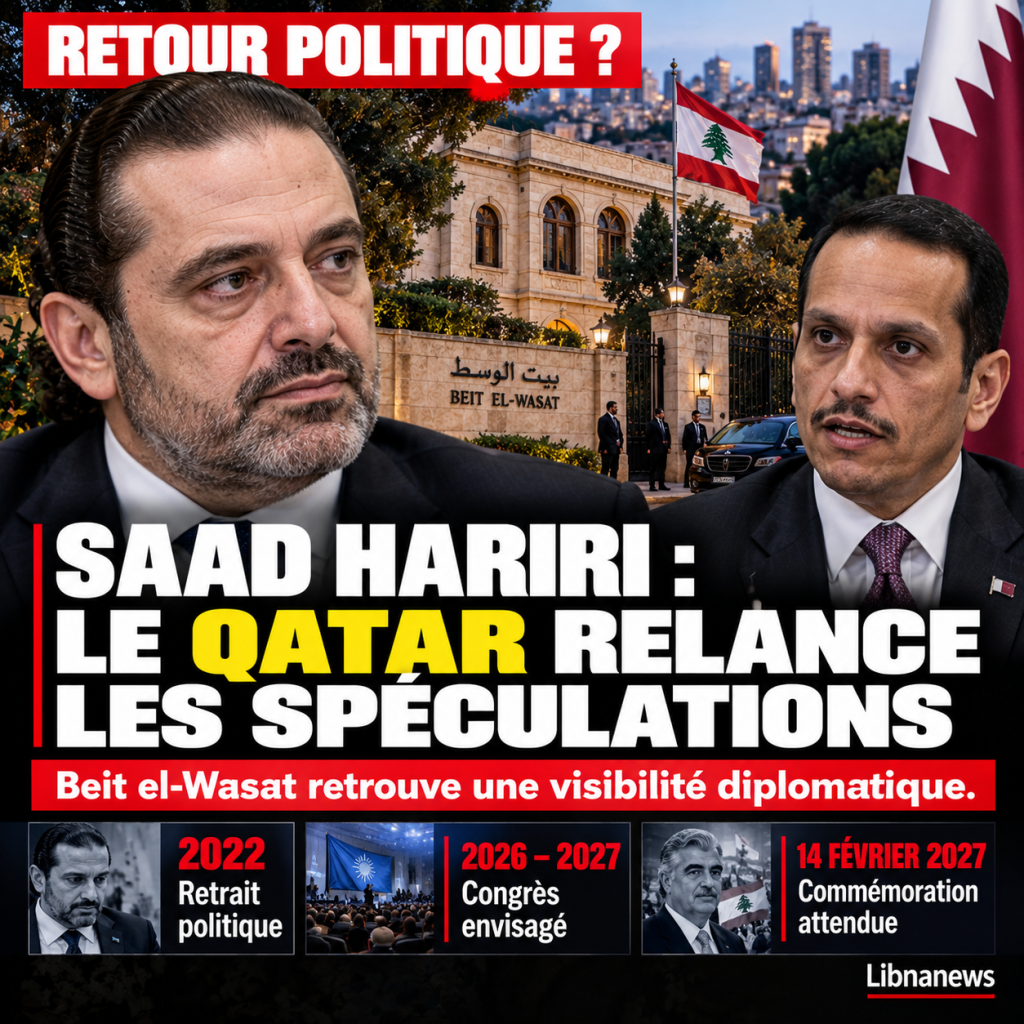
A Qatari visit that breaks several years of political discretion
The visit of Qatari Prime Minister Mohammed bin Abdelrahmane Al Thani to Beit el-Wasat rekindled questions about Saad Hariri’s political future. Displacement is of particular importance because of the location and context in which it operates. According to information published on 23 October 2026, the political residence of the former Prime Minister of Lebanon had for the first time been home to a foreign person of that rank for nearly six years. This opening occurs as the Current of the Future goes through a period of political withdrawal begun in 2022. It feeds the assumptions concerning a reorganization of the movement and a possible resumption of the activities of its historical leader.
The Qatari head of government met with former deputy Bahia Hariri and her son Nader Hariri. The latter had occupied an important place in Saad Hariri’s political circle before moving away from his functions as adviser. The presence of these two personalities gives the meeting a family and political dimension. Bahia Hariri remains an important figure in the Hariri current, particularly in Saida. Nader Hariri, for his part, has a thorough knowledge of the political networks and negotiations that marked the years of power of his cousin.
However, the meeting alone is not an announcement of political return. No formal commitment to the resumption of Saad Hariri’s activities was made public in the available material. The detailed content of the exchanges is not known. It would therefore be excessive to say that Doha has decided to support a new political campaign or that an agreement has been reached on the future of the Future. The visit nevertheless represents a significant event in a political environment where diplomatic actions are often interpreted through their possible consequences on internal balances.
The withdrawal of 2022 and its consequences for the Future
Saad Hariri’s decision to suspend his political activity in 2022 had profoundly altered Sunni political representation in Lebanon. The former Prime Minister had announced his withdrawal in a context marked by the economic crisis, institutional difficulties and the deterioration of his relations with Saudi Arabia. His movement had also renounced participation in the parliamentary elections of that period. This decision deprived the Courant of the future of its main instrument of parliamentary representation and opened a political space to other personalities.
The withdrawal also affected the internal organization of the movement. Local leaders and activists had to continue their activities without having an electoral orientation comparable to previous years. Networks around the Hariri family remained present in several areas, including Beirut, Tripoli, Saida and some of the Bekaa settlements. However, their ability to mobilize could no longer be measured through direct electoral participation under the leadership of Saad Hariri.
The situation of the Future has thus become one of the main unknowns of Lebanese policy. His possible return to the competition could alter the power relations within the Sunni electorate, but also the relations between the main parliamentary formations. However, a resumption of activities would require more than a declaration of principle. It would require internal reorganization, the definition of an electoral strategy and clarification of relations with regional partners.
It is in this context that the Qatari visit takes on special significance. It comes at a time when sources close to the movement evoke the possibility of a new organisational step. It does not prove that this stage is definitely decided, but it helps to place the Hariri family at the centre of some political discussions.
Bahia and Nader Hariri, two interlocutors with different roles
Bahia Hariri’s presence at the meeting with the Qatari Prime Minister is part of his historic role within the family and the political movement founded around Rafic Hariri. Former Member of Parliament for Saida, she maintains links with social, educational and political networks associated with this tradition. Its participation in a high-level diplomatic meeting can therefore be interpreted as a sign of institutional and family continuity.
Nader Hariri’s case is different. Former political adviser to Saad Hariri, he had participated in several important negotiations before moving away from his immediate entourage. The information available indicates that he had reduced his political commitment after being removed from office. His presence in Beit el-Wasat during the Qatari visit therefore attracts attention. She could testify to a resumption of some contacts, not enough to establish her return to an official office with the former Prime Minister.
This distinction is essential. A family or diplomatic meeting does not automatically lead to full political reconciliation. However, it can facilitate the resumption of relations between actors who had occupied important positions in the structures of the Future. In an organization historically marked by the role of the Hariri family, the nature of these relations can have consequences for the preparation of a possible new political phase.
The information published does not specify whether Saad Hariri personally participated in the discussions. Nor can they determine whether Bahia and Nader Hariri have been given a specific mandate to negotiate with Doha. It is therefore appropriate to limit the conclusions to what is established: the Qatari Prime Minister was received in Beit el-Wasat by two prominent figures of the Hararian entourage, in a context of speculation on the political future of the movement.
Qatar, a partner that could facilitate a new stage
Relations between Saad Hariri and the Gulf States are a central element of his political journey. Saudi Arabia had long been its main regional partner. The deterioration of their relations had contributed to his distance from the political scene. In this context, the possible role of Qatar is attracting attention, particularly because of its relations with various Lebanese political components.
Sources close to the Future believe that improving relations between the Gulf countries could create a more favourable environment for Saad Hariri. They include the rapprochement between Saudi Arabia, Qatar and the United Arab Emirates. According to this reading, the former Prime Minister could benefit from a less conflicting regional context than the one preceding his withdrawal.
However, this hypothesis must be distinguished from formal diplomatic engagement. There is no evidence to suggest that Riyadh has formally approved Saad Hariri’s return or that Doha has been given a mandate to prepare for his political reintegration. The information available mainly presents the expectations and analyses of officials close to the movement.
Qatar could nevertheless play a role in the resumption of political contacts. Its relations with the different regional actors give it a capacity for dialogue that could be useful to a personality seeking to rebuild its alliances. But this is not a guarantee. The return of Saad Hariri would also depend on his own decisions, Lebanese political conditions and the ability of the Future to re-establish an operational organization.
A Congress of the Current of the Future at the end of the year
The most concrete information on a possible political recovery concerns the internal organisation of the Future Movement. Sources close to the movement refer to the possibility of holding a general congress in late 2026 or early 2027. This could clarify the party’s orientations, renew certain structures and prepare for a possible resumption of political activities.
The holding of such a congress would be an important step. Since Saad Hariri’s withdrawal, the movement has not had the same institutional presence as before. A general meeting could redefine the responsibilities of its managers and clarify the relationship between the different regional components. It could also provide an opportunity to discuss the electoral strategy, even if no formal decision is made on participation in a forthcoming election.
Another particular feature is the timetable mentioned. It would precede the twenty-second anniversary of the assassination of Rafic Hariri on 14 February 2027. Sources close to the movement anticipate Saad Hariri’s personal presence at this commemoration and organizing a popular gathering. Such an event could be an important moment in measuring the ability of the Hariri current to mobilize.
However, the preparations mentioned must be distinguished from the officially announced decisions. The information available does not confirm a final date for the Congress, nor does it indicate Saad Hariri’s participation in the commemoration as an irrevocable public commitment. Rather, they indicate that several deadlines are envisaged by officials or sources close to the movement.
Saad Hariri’s return would change Sunni balances
A political recovery of Saad Hariri could have a significant impact on Sunni representation. His withdrawal had opened up space for independent deputies, local personalities and training to strengthen their influence. The return of an organized movement around the Hariri family could alter these balances, particularly in those districts where the Courant of the future historically had a strong settlement.
This perspective does not mean that the former Prime Minister would automatically regain his past influence. The political and economic context has changed dramatically since its withdrawal. The financial crisis affected public institutions, businesses and social networks on which many political organizations were based. Voter expectations have also changed. A possible campaign should therefore address economic and institutional concerns that go beyond traditional alliances.
The issue of funding and organization would also be crucial. Political formation cannot regain an important electoral presence without local structures, candidates and a coherent strategy. Regional relations could facilitate some approaches, but they would not replace the necessary political work on the ground.
Sources close to the Current of the Future present the rapprochement between several Gulf States as a factor that could strengthen Saad Hariri’s prospects. However, this assessment is part of their analysis. It does not accurately measure the support it would have to voters or predict the results of possible electoral participation.
A return suspended from the former Prime Minister’s decisions
As of 23 October 2026, several elements were thus contributing questions about Saad Hariri’s political recovery. The visit of the Qatari Prime Minister to Beit el-Wasat, the presence of Bahia and Nader Hariri, the discussions around a general congress and the prospects of mobilization for February 2027 are converging signals. They show that the Current of the Future remains a potential player in Lebanese political recompositions.
However, these evidences do not suggest that an official return has been decided. No final public calendar was presented. The conditions for possible electoral participation remain unknown. Relations with Saudi Arabia and other regional partners are not sufficiently documented to reach a political agreement.
The Qatari visit was especially an evolution in the diplomatic visibility of Beit el-Wasat. After several years of withdrawal, this residence regains a place in exchanges with a leading regional personality. The political significance of this event will now depend on Saad Hariri’s decisions and their possible translation into the organization of the Future Movement.





Comments