

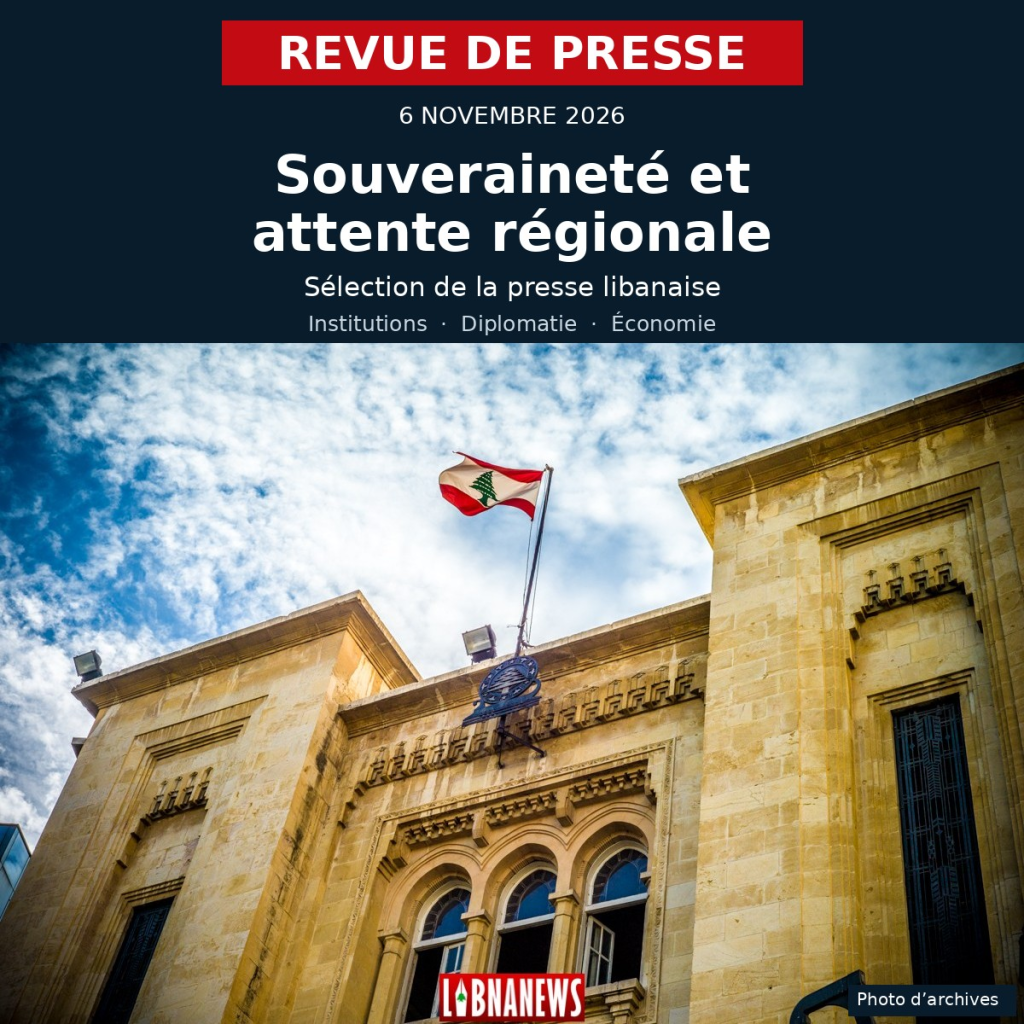
On the front page: Lebanese sovereignty in the face of regional expectations
This selection of the Lebanese press of 6 November 2026 places the decision of war and peace at the centre of the debate. Al Liwaa opened with the support of five embassies in the positions of Joseph Aoun and Nawaf Salam. The daily highlights their demand for a public commitment by MPs and parties to state authority. For his part, Al Joumhouria retained the positive neutrality defended by the President. The newspaper links this position to questions about American politics after the mid-term elections. It does not describe an acquired relaxation.
Al Joumhouria of 6 November presents differing readings of military risk. A former Arab diplomat, unnamed, Judge Donald Trump and Benjamin Netanyahu too forced to start a new war. Other analyses mentioned in the same headline fear an escalation. An anonymous Lebanese official is also planning a long period of blocking. These comments remain assessments, not announced decisions. In his headline posted on November 5 at 10:54 p.m., Ad Diyar also insists on uncertainty. Ibrahim Nassereddine describes actors busy measuring their gains and losses. His diplomatic sources feared that a military initiative would upset the discussions under way. The newspapers thus meet on waiting. They diverge on what it can produce, between diplomatic recovery and heightened tensions.
Local Policy: Returning to the South in Essential Services
Al Liwaa of 6 November 2026 reported on the weekly meeting on the return and rehabilitation of affected areas. Nawaf Salam brought together social leaders and work agencies. The follow-up covers the markets of the Southern Council and the Council for Development and Reconstruction. The immediate needs also concern fuel and financial assistance to families. The newspaper quotes prefabricated housing, particularly in pilot areas. Their use must be accompanied by access to water and electricity. In Nabatiyah, participants examined the rubble near the roads and the Civil Defence Centre project. The report describes the files followed by the government. It does not announce their completion or new overall funding.
In the same edition, Al Liwaa reports the meetings of Nabih Berri with a World Bank delegation. Discussions focused on projects supported in Lebanon and work programmes. The Speaker also received Marwan Hamadé and then representatives of the medical sector. The issues covered include hospital operation and the relationship between the Order of Physicians and the National Social Security Fund. Berri called the Chamber’s office at 10.30 a.m. on Monday, 9 November, in Ayn al-Tinah. This announced meeting should not be confused with a plenary session or with the adoption of a text.
Quotes and speeches: Aoun defends positive neutrality
Al Sharq of 6 November 2026 reports Joseph Aoun’s intervention in the presentation of a book on neutrality. The President said that Lebanon’s sovereignty could not be shared. It presents positive neutrality as a means of protecting the country from regional confrontation. His speech combines this protection with national unity. It is also aimed at young people, emphasizing citizenship and openness to cultures. The point is political and institutional. The newspaper does not report the adoption of a new legal status of neutrality. Michel Pharaoh, who gave him the book, defended an approach within the framework of the Arab League. It links it with respect to the Constitution and the State monopoly on arms.
Another discussion goes through Ad Diyar on November 6. In an analysis signed by Kamal Dibyan, the governance of Palestinian camps is addressed through weapons and civil rights. The author recalls the arms surrender commitments and describes the resistance of several factions. It highlights demands related to work, health, education and property. This reading expresses the angle of the chronicler. It does not prove that a new agreement has resolved these issues. The rapprochement between these pages highlights two requirements often discussed together: the authority of the institutions and the concrete conditions of the inhabitants’ lives.
Diplomacy: Partners call for explicit commitment to the state
The communiqué of the British, American, Australian, Canadian and Japanese embassies occupies a central place in Al Liwaa on November 6, 2026. The five missions support the state’s monopoly on arms and the decision on war and peace. They also request independent judicial proceedings in the Dahr al-Baydar case. Their call is for public engagement by political forces. It is not a court decision. The headline also recalls the timetable presented by the Finul: the end of the term of office at 31 December 2026, then the phase of reduction and withdrawal. Subsequent arrangements are the responsibility of the Security Council. No fixed replacement devices are announced in this report.
An Nahar, November 6, 2026, in a publication at 8:44 a.m., follows Youssef Raji’s visit to Canada. The Minister of Foreign Affairs met with the Speaker of the Senate, Raymonde Gagné. They discussed bilateral relations, negotiations with Israel and the post-Final period. Raji requested continued assistance from the Lebanese army. It linked the return to stability with the Israeli withdrawal, the cessation of attacks and the State’s authority over weapons. Before the Arab ambassadors in Ottawa, he also condemned attacks against the Gulf countries, Jordan and Yemen. Finally, the Minister said that the framework agreement with Israel is organizing future negotiations. He did not present it as a final treaty.
International Policy: An Israeli Transition Still Open
Al Liwaa of 6 November 2026 describes Isaac Herzog’s consultations to nominate a candidate for government formation. The daily reports an announcement expected Sunday. He quotes Israeli press estimates giving Gadi Eisenkot more recommendations than Benjamin Netanyahu. However, a recommendation and a vote of confidence are not the same. The newspaper points out that a training mandate would not guarantee a coalition. Netanyahu retains his position at the head of the outgoing government pending his replacement. The position of the Arab parties remains one of the central points of the debate. Their support for a candidate does not automatically mean their participation in the future firm.
Marco Rubio’s treatment also illustrates the importance of following the updates. On 6 November, the Al Liwaa featured information on the possible departure of the US Secretary of State. The headline of Ad Diyar put online the previous day also takes up this hypothesis. Ad Diyar published a denial of Rubio on 6 November at 7.48 a.m. The newspaper reports its statements to the New York Times: it plans to work with Donald Trump until the end of the mandate. It is therefore not necessary to present his departure as an acquis. The supposed changes of the US team cannot serve as a reliable basis for reading the Lebanese file.
Economy: applicants remain at the heart of the battle of confidence
In Al Joumhouria, November 6, 2026, Fadi Abboud criticizes the management of the banking crisis. He requested a review of the accounts of each institution. Its objective is to distinguish between the amounts held by banks and those transferred to the Bank of Lebanon. He also questioned how deposits could be classified in the draft regulations. The author proposes in particular to mobilize gold and certain assets to return the funds. It is its proposals, not a sales decision or a measure adopted. His rostrum also calls for control of transfers after October 2019. The accusations contained therein are part of the public debate put forward by the author. They should not be transformed into judicial judgements.
Al Liwaa of 6 November reports another response to the crisis of confidence. At the 17th Bosphorus Conference, Yassine Jaber conveyed Joseph Aoun’s message. The text links stability to sovereignty, reform and reconstruction. He cited bank restructuring, depositor rights, and fiscal and customs modernization. The digitization of services is presented as a means of reducing opportunities for corruption. The message also highlights jobs and investment. It considers the recovery to the capacity of the inhabitants to remain in the country and to prepare for their future. No new envelope or timetable for returning deposits is announced in this article. The difference between a political orientation and its execution is therefore essential for reading these economic pages.
Justice: Dahr al-Baidar advances, without trial on the merits
Al-Araby Al-Jadeed, in the article taken up by the NNA on 6 November 2026, reports two detention warrants in the Dahr al-Baydar explosives case. The decision was taken on Thursday, November 5. It concerns Ali Al-Kurdi and Haitham Amhaz, interviewed by Judge Ghada Abu Alwan. A next hearing is scheduled for 17 November. This stage is a matter of instruction. It is not a conviction. The distinction of dates is important: the report belongs to the press on Friday, but the judicial act dates back the day before. The political and diplomatic reactions that accompany it do not alter the procedural nature.
Ad Diyar of 6 November 2026 publishes, under the signature of Roger Abou Fadel, information on new threats against prosecutor Sami Sader. The newspaper places them in the context of operations against drug networks in Mount Lebanon. He claims that they come from foreign numbers. It also presents a review of arrests and searches. These elements are attributed to the newspaper, which does not cite a judicial decision establishing the identity of the perpetrators of the threats. The subject concerns the safety of the magistrate and the work of the services. It does not permit the imputation of such acts to a specific person. The two dossiers thus highlight different issues: the pursuit of a sensitive investigation and the protection of justice actors.
Society: local medicines and diaspora services
Al Liwaa of 6 November 2026 devotes a report to the launch of the campaign for Lebanese medicine. The event took place the day before at the National Museum. Nehmat Aoun advocates a sustainable strategy, involving governments, manufacturers, universities and health institutions. It calls for support for local products to remain linked to quality and safety. Minister of Health Rakan Nassereddine describes a developing industry. It highlights the need for a reference laboratory and a national drug agency. These statements express the priorities of the stakeholders. They do not exempt a product-specific evaluation. The report does not provide a further quantified measure of national market share.
In Al Sharq on November 6, Hassan Choucair signs a forum on links with Lebanese people from abroad. The Director General of General Security insists on consular services. He referred to access to biometric passports and to the reduction of travel required for procedures. It would like to see the services extended, with the controls required to protect the identity of applicants. Its text combines the relationship with the diaspora with concrete administrative improvements. It does not detail the conditions in each country. For users, the applicable procedures therefore remain those communicated by the competent representative.
Culture: writing memory and thinking about mutations
The cultural pages of Al Liwaa of 6 November 2026 give the floor to Mostafa Atiya Gomaa. The interview focuses on the relationship between the novel and history. The researcher distinguishes freedom from literary imagination from respect for established facts. He describes how the narrative forms inherited feed modern novels. Memory does not appear as a mere decor. It provides characters, tensions and ways to tell. The interview also proposes to make visible the references used in historical works.
A supplement published by Al Liwaa on November 5 is interested in Amin Maalouf. Amer Halwani goes back to his TV interview on October 28, around the Century of our metamorphosis. It exposes the gap between scientific progress and collective capacity to guide them. Artificial intelligence and biotechnology play an important role in this reading. The article compares their promises and the social or political risks that they may create. This is not a new intervention by Maalouf on 6 November. In Al Joumhouria on November 6, Nesrine Ballout finally devoted a critical reading to Anne Carson. She insists on the links between poetry, thought and plurality of meaning. These pages thus offer distinct perspectives on the world’s memory, creation and mutations.





Comments