

In South Lebanon, restoring a building is not enough to provide care to the population. It is necessary to be able to reach the hospital, find a team, and then continue the treatment without exhausting the household’s income. The report published on 24 November by Médecins sans frontières sheds light on the breaking of this chain. The results of the Ministry’s health strategy and the health accounts show another: even before the war, the resources to pay for care had collapsed. Both problems require different answers, but cannot be dealt with separately.
In Tyre, a strike that also hurts those who care
On 1 June 2026, an Israeli strike near Jabal Amel Hospital in Tyre injured 127 people, including 39 health professionals, according to Médecins sans frontières. The organisation does not report a bombardment that occurred this week: it returns, in its document of 24 November, on an episode of the spring escalation. His teams participated in emergency care and traumatology in Tyre and Najdeh al-Shaabiyeh hospital in Nabatiyah. They describe the management of serious injuries, burns and explosion injuries, as well as the impact of strikes on ambulances and rescue teams.
The number of injured only measures part of the shock in a hospital. A collective emergency requires additional teams, blood products, examinations and operating rooms at the same time that some of the personnel may be injured or prevented from coming. Needs increase as response capacity declines. Non-emergency services are reduced or suspended to free time and space. For non-emergency patients, the effect appears later: an examination not performed, a delayed intervention or a prescription that expires between two consultations. None of these effects should be counted as a new victim of the strike. However, they are part of the cost of interruptions.
The Ministry can count the equipment delivered and the hospital the rooms made usable. A patient measures something else: the time between arrival and treatment, or the possibility of obtaining the prescribed treatment at exit. If the trauma department works but there is no more transfer available for specialized surgery, the first facility absorbs the consequences of failure of the second. If the return home is possible but the rehabilitation is too far away, the hospital expenditure has produced an incomplete gain. For public finances as for families, the relevant unit is therefore the finished route, not just the open room.
The same applies to first aid workers. MSF notes that teams have had to delay their intervention until conditions allow them to reach the injured. A running ambulance is an available asset; a workable exit when a life depends on it is a service. Consolidating the two leads to adding up means without knowing what intervention they make possible. Damage to a link, from road to operating room, may be sufficient to neutralize functional equipment elsewhere.
The country was already spending much less before the war
To assess the reconstruction effort, the first trap is to take the latest accounts for a description of the current war. The comparable series of aggregate health expenditures used here are closed in 2023. They reflect the currency shock and funding after 2019, not the state of hospitals in November 2026. Their interest is to show with what resources the system has entered into the period of successive conflicts. Field surveys and activity reports then allow us to study what has added to this fragility.
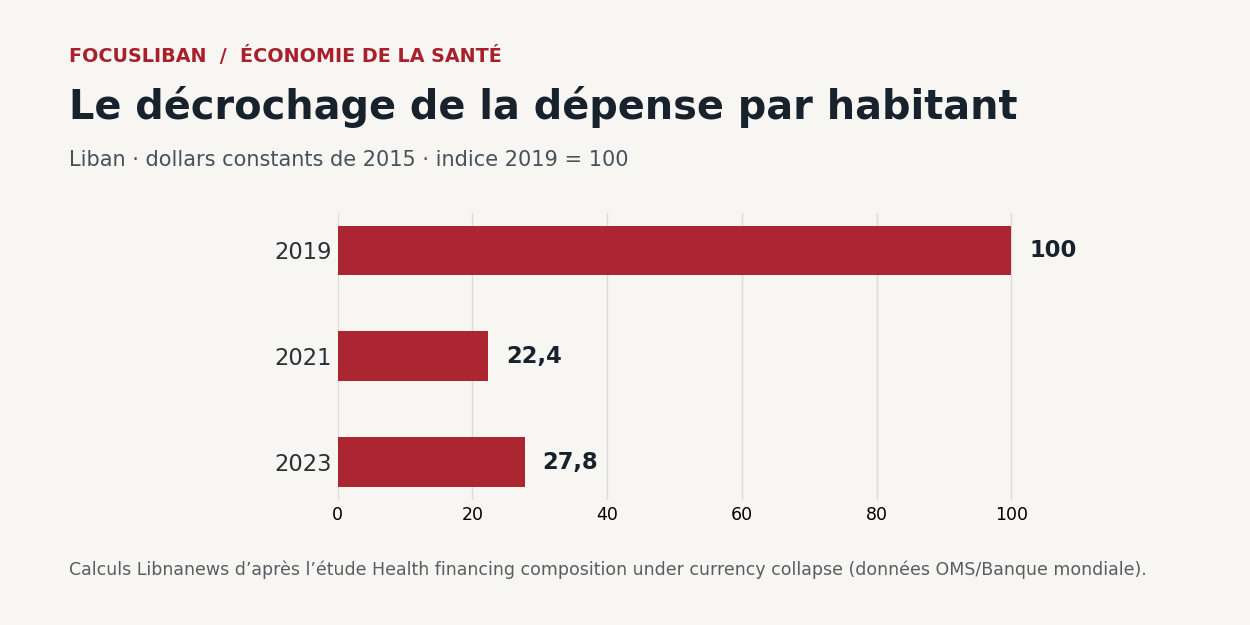
A study based on the annual series of WHO and World Bank estimates that per capita health expenditure declined by 77.6% between 2019 and 2021 in constant 2015 dollars. The decrease also appears, to varying degrees, when using inflation-adjusted Lebanese pounds (63 per cent) or a purchasing power parity measure (75.6 per cent). These three results come from different conventions: they do not add up. To the extent in constant dollars, the 2023 level remained 72.2% lower than in 2019. The rise after 2021 therefore recovered only a small part of the fall measured according to this convention.
A currency that collapses changes both the cost of care, the ability to pay and the accounting. Imported medicines, reagents and certain equipment must be purchased with currency or exchange-sensitive prices. Staff costs do not necessarily follow the same pace. A measure in pounds corrected by the general price index therefore does not indicate how many consumables imported a hospital can buy. Nor can a measure in constant dollars be used to deduct directly the number of consultations it has conducted. But the three methods indicate a contraction, not a simple accounting conversion effect.
Over the same period 2019-2021, the share of health in gross domestic product fell from 8.7% to 4.4% in this study. This is another indicator: GDP is the denominator, and its own decline makes the ratio vary. The share of public health expenditure in current funding has decreased from 49.3% to 26.9% according to the figures studied. In a contracting economy, a lower public share reduces the ability to spread the risk of illness between healthy and sick people, or between periods of high income and periods of low income. This does not mean that any private money has replaced public money. Private amounts also declined.
This distinction between composition and level changes the diagnosis. In a stable system, a change in the share paid directly by households may indicate a transfer of expenses. In a crisis, all sources of payment can decrease together. If only the shares are followed, the table appears to be much less brutal than the amount actually mobilized. National accounts measure what has been spent. They do not identify all the needs that no expenditure has met, nor the difficulties of each region. To decide where to rebuild, it is necessary to combine the two readings, without making them a single indicator.
When the rest of the charge doesn’t say who gave up
Direct household payments accounted for 29.70 per cent of current health expenditure in Lebanon in 2023, according to the WHO health expenditure base issued by the World Bank. The average direct expenditure was 77.46 current dollars per capita. It would be misleading to turn this figure into a standard invoice. A resident who has not been able to consult does not weigh anything in the total direct payments for this consultation. A patient who has paid for expensive hospitalisation and follow-up treatment can, on the other hand, concentrate a high proportion of household expenses. The average does not identify this concentration or abandoned care.
The stability of a share close to 30% since the beginning of the crisis therefore does not infirmate the difficulty of access. The financing study notes that from 2019 to 2021 per capita direct payments have decreased to its extent in constant dollars, like other resources. A household that reduces the purchase of medicines or abandons a consultation because of lack of means reduces the total statistical. It does not protect his health or his future income. To distinguish a decline due to better reimbursement from a decline due to abandonment, data on need, recourse and outcome of care are needed, not an aggregate share.
The humanitarian system provides an indication of what the accounts do not see. In its revised appeal, an assessment of areas in 15 of the 26 Lebanese districts indicated that approximately three out of four said they could not pay for health services. This is not a representative result of all Lebanese. The survey refers to areas and populations assessed as part of the emergency response. Its interest is to reveal a barrier that exists even where a service is physically accessible. The opening of a centre and financial access must be measured separately.
Travel costs are therefore decisive. When more than one consultation is required, the household does not only pay for a ticket, fuel or taxi ride. He must arrange child care, find a companion or lose a day’s income. The same examination price therefore has a different effect in the vicinity of a hospital and in a village for which the round trip mobilizes part of the day. An aid that only reimburses hospitalization can leave the home without a solution that cannot finance the first trip. Conversely, transportation support spent without checking that a specialist has accepted the patient can pay for a trip without producing care.
The problem is particularly visible in the treatment of chronic diseases and in rehabilitation. For regular follow-up, an absence is not automatically an abandonment: the patient may have changed the center, postponed an appointment, or been moved. These situations must be distinguished without exposing personal records. A system that pays the isolated act can repay the acute episode without funding the necessary coordination after exit. The cost is then transferred to the household, to another facility or to an emergency service when a problem that could have been followed comes in a more serious form.
Regions need health chains, not additional projects
The return of inhabitants to areas where services have lost staff or equipment does not bring the system back to its previous equilibrium. Demand varies rapidly depending on return, travel and security conditions. A hospital team does not rebuild at the same pace. It depends on the housing, transportation, income and conditions in which caregivers work. New equipment may remain unused if a trained person is missing to operate it or a company able to maintain it.
At the level of a network, emergency capacity is the sum of the resources that can be actually mobilised at the same time, not the sum of the administrative units. One hospital may need a small electrical redundancy or a safety stock, while another may first see its transfers blocked by the absence of agreements with receiving institutions. It would be ineffective to apply the same shopping basket. An institution that provides a reference service for several districts must be able to maintain a case flow. A front-line centre should be able to treat common needs without systematically sending patients to hospital.
The World Health Organization reported in April a marked increase in demand at Rafic Hariri University Hospital after the closure of hospitals in the southern suburbs of Beirut. The example does not concern the same institutions as MSF’s report on Tyre and Nabatiyah. It illustrates the shift in demand when part of the network no longer provides service. If funding remains tied to pre-crisis buildings or activity volumes, a host hospital may have to take more patients without the necessary credits or teams in good time.
The reorganisation of these pathways must be based on clinical delays, the possibility of conducting transfers and the skills that can be ensured at each level. Primary care is not a substitute for trauma. However, they can resume follow-ups that no longer require hospital treatment, avoid certain treatment breaks and document the needs that do not arise spontaneously in hospital statistics. The result depends on the quality of the connection between the two: a consultation with the hospital is useful only if the centre of proximity has the necessary medicine, examination or orientation capacity.
Distribute risk without simply moving the invoice
The funding of a hospital is based on the possibility of transforming the care provided into predictable revenues. The question seems to be accounting; However, it determines the stock of supplies, the number of guards that can be insured and the time allowed to a family to pay a balance. In a fragmented system, two patients requiring the same treatment can arrive with different covers, or without an identified third-party payer. The establishment does not necessarily benefit from the same rate or refund period for each. It may encounter cash flow difficulties even after entitlement to payment has been recognized.
For an institution exposed to a foreign currency purchase, the date of a claim counts as much as its nominal value. If a rate is expressed in books, inflation between the benefit and payment changes what the recipe allows to buy. A nominal increase in the rate, without correction of the deadlines and the terms of settlement, therefore does not guarantee a real increase in the institution’s means or a lower bill for the patient. But indexing all benefits to a currency indiscriminately would expose the public payer to variations that he cannot finance if his income does not follow. Neither freezing nor automatic indexing of the entire invoice eliminates the risk. They split it apart.
One answer is to examine, for each care group, what costs are truly exchange-sensitive and that providers cannot avoid. A package may cover a share of local costs and a share of imported costs; Both do not require the same adjustments. The cost of the act must then be distinguished from the availability function. An institution may have to provide a night emergency team even on days when few acts are charged. Pay only to the act sub-finances this availability when the activity is irregular. Remuneration without checking that a team is actually available would create the opposite problem. Hence the interest of a service commitment with indicators whose verification does not depend solely on the institution paid.
The patient cannot wait for this pricing work to know what to pay for. A distinction must be made between the advertised price, the rate that the payer recognizes, the amount that he pays and the amount left to the patient. When a centre refers to an imaging provider or a specialist, the information should cover the entire route, not just the price of the first visit. Failing this, an accessible consultation may result in an out-of-scope review or a denied service. This difference becomes visible only if, for comparable indications, the treatment is followed after its orientation.
This problem has a concrete translation in the ministry’s response. A circular dated March 2026 states that public hospitals and designated private hospitals must not charge a supplement for acts covered by the Ministry, in the situations specified in the texts on patients without a cover agency, including displaced persons. The rule does not extend, by the sole effect of this circular, to all private institutions or to any benefits. It shows why a reference to coverage must always be read with its perimeter, participating institutions and recourse procedures.
Contracts with private, public or voluntary institutions can reduce some of these differences without assuming that all these actors have the same cost structure. For a service purchased for the benefit of the public, the items to be published are the scope of the service, the level of remaining liability and the payment period of the payer. The public authority must be able to monitor differences between institutions. It should not ask for an identical circular for each case: the heavy cases and the sparsely populated areas are precisely those where a package applied to the identical risk making the service financially untenable. The principle must be common, reasoned and verifiable adjustments.
In its review of the national health strategy for 2030, the Ministry notes that the virtual pooling of public health funds and the creation of a national insurance authority have not materialized. It is therefore not enough to speak of it as an existing system. A mutualisation can take time because it involves membership rules, long-term financing and different rights depending on the regimes. The immediate project is more circumscribed: to define the common steps and proofs that enable a patient to be guided and to pay the claimant without requiring, at each break in the course, a new family approach.
REAYA: Pay continuity rather than the number of acts
The departmental review measures more concrete progress in primary care. The REAYA programme, supported by the World Bank’s Health Resilience Project, introduced a per-capture payment in about 60 primary health centres. The review describes the continuation of experience and the preparations to contract services from national resources. These steps do not mean that all the centres are financed in this way or that the programme already forms a national health insurance. They show that a different payment mechanism exists and can be assessed.
Capitation consists of paying the claimant an amount for a package of benefits that he must make available to each registrant, rather than paying him only at each consultation. For preventive care and routine follow-up, the recipe becomes more predictable and the center has less interest in multiplying low-use acts to survive. He can spend time finding patients who have broken up. The condition is that the package covers a defined basket, with sufficient transparency on what is included, what must be oriented elsewhere and what the patient must pay.
If the package is too low or does not take into account needs, the centre may need to take fewer heavy patients, space consultations, or send cases too quickly to the hospital. This is not a charge against the REAYA centres; This is a risk specific to the form of payment. The incentives must therefore be checked in practice. For example, comparing the number of registered persons gives an administrative extension measure. Comparing the patients present with the follow-up, the ruptures of medicines, the actual orientations and the remaining expenses borne by the families provide information on the service obtained. The two approaches should not substitute one for the other.
The definition of the populations concerned is as important as the reimbursement formula. The department describes a social program-based targeting and the use of a health identifier for follow-up. A targeted device can provide real assistance to identified persons without reaching a newly displaced person, whose income has fallen rapidly, or who does not have the required documents. If the registration falls within the scope of a list outside the health network, it is necessary to provide for the treatment of changes in the situation, to avoid counting twice those who change places and to allow recourse when access to the programme is denied. An identifier is useful only if the rights attached to that identifier actually follow the person.
An adjustment of the package according to needs may be based on age or a health profile, but the temptation would be to ask for more personal data than necessary. Control does not need to make individual medical episodes public. The assessment may be based on aggregate outcomes by centre or care pool, provided that a small number of patients do not recognize individuals. Similar populations must also be compared: a centre that accepts the most difficult cases should not be punished for a higher readmission frequency if this frequency reflects the seriousness of the situations being dealt with and not a defect in the centre.
Funding for the extension remains a separate challenge from that of the pilot. A loan can finance start-up, equipment or experimentation. The foreseeable payment of the centres involves a recurring expenditure line and a payer who can meet the expected date. The transition to national resources should therefore be judged not by the announcement of a contract but by the first set of payments, their regularity and stability of coverage. An extension that multiplies the entries without the recurrent budget following risks diluting the benefit everywhere. On the contrary, a gradual extension may favour territories where waivers are documented and where there is a guidance solution for cases exceeding the first level.
What emergency aid and reconstruction finance
International amounts are easy to align in a table and difficult to compare. In the revised humanitarian appeal from March to August 2026, partners requested $639.9 million to assist up to 1.4 million vulnerable people from all sectors. The document reported $185.9 million received as at 31 May for the entire appeal. A July newsletter indicated that 17 per cent of the health sector needs in the revised appeal had then been met. The date, numerator and perimeter differ. These figures cannot be used to deduct the amount received in November for hospitals or to calculate the cost per person treated.
The challenge of humanitarian funding is to pay for services that a shock immediately makes necessary: emergency care, medicines, community consultations, mobile teams or continuity of certain treatments. The payment date is crucial because waiting for an order for several months makes a part of the intervention unnecessary. In reconstruction, multi-year procurement and contracts may, on the contrary, be justified by the time required for technical evaluation, clearance or work. Slowing down the emergency to bring all expenses into a reconstruction project deprives the population of care in the meantime. Paying for operations as a series of emergencies in a sustainable manner prevents stable service, reliable contracts and national charges.
The LEAP reconstruction project illustrates these differences. The World Bank describes it as an extensible $1 billion framework, with initial funding of $250 million and a core service scope that includes transportation, water, energy, municipal facilities, education and health. The estimate of $1.1 billion in damage to critical infrastructure and buildings, which it recalls, concerns these sectors taken together, after the conflict of 2023–24. Neither the billion of the framework, nor the 250 million of the initial financing, nor the 1.1 billion of damage constitute a hospital budget of 2026. Their role is to define an architecture and order of magnitude, not to measure services already restored.
The distinction between advertising and performance must be maintained at each stage. Ratification or approval establishes a framework. A commitment reserves an amount for an operation. A disbursement indicates that a movement of funds has taken place. Equipment delivered to a warehouse is not yet installed; installed equipment is not necessarily used. It would be too early to announce that the capacity for care is being restored only in the light of commitments, and too late to wait until all the work is completed to begin addressing the network gaps. In between, the correct method is to link each budget announcement to a date, scope and service expected.
An example of this follow-up is a World Bank restructuring paper on the Health Resilience Project. He mentioned two requests for withdrawal processed, one of $5.355 million with a value date of January 28, 2026, the other of $4.5 million with a value date of March 11. These amounts fall under this specific project, not LEAP; they do not correspond to the cost of two months of care. The same document describes equipment acquisitions and explains that the March escalation disrupted the end of the project. The point of such a document is to be able to locate funds, orders and obstacles without confusing them.
The State and its partners can reduce the risk of financing the same asset twice without asking everyone to follow the same schedule. For equipment or service, it is important to know who finances the installation, who pays for the current costs and who pays for the breakdown. A donation of equipment may remain ineffective if compatible consumables are not available from the purchasing network. Reconstruction is therefore less a competition between projects than work involving capital, operation and access. International funds can accelerate investment; they alone do not replace the ordinary financing necessary to make the investment useful.
What a return-to-care dashboard should show
There is no single statistic from which a minister, hospital and family could judge recovery in the same way. On the other hand, each territorial network can be asked to answer three questions: what service is available, which patient accesses it, and who pays for it? The publication of the results must indicate the date and population concerned. A national figure will not tell whether a reference service accessible in normal time is when a road is no longer practical. Conversely, a local decline in activity does not prove that the inhabitants are better: they may have left the area or be treated elsewhere.
For availability, counting the hours actually covered by a team gives a more useful reading than the only list of services declared open. To clarify whether there is a functional imaging platform, essential drugs, a referral channel and a transfer solution makes information workable. For implementation, follow accepted guidelines and the time between demand and act allows detection of the neck. For financing, measure the payment time and the remainder after reimbursement shows whether the cost has not simply moved. An institution is not intended to make sensitive operational information public; aggregated data may be sufficient to judge continuity of service.
Follow-up to the first consultation is insufficient to assess the outcome. People living with chronic disease may have to renew their treatment over several months. After an injury, part of the cost appears during rehabilitation, accommodation adjustment or return to work. Social and clinical services can contribute to the same result without necessarily falling within the same budget. Requirement of a measurable suite of care is not about asking the hospital to do everything: it obliges different financiers to explain how a patient moves from one service to another and what takes over when a temporary device stops.
The denominator must also be measured. A rate of consultation per registered person depends on the quality of the lists and the stability of the population. If it only concerns registrants, it does not measure access for eligible but not registered persons. A high proportion of honoured appointments can mask upstream filtering if people fail to get it. A very low rate of ruptured medicines can be misleading if only those drugs still listed are followed. Any indicator must be linked to another that checks what might be left out. This precaution applies to both donors and national authorities.
No aggregated follow-up is a substitute for recourse. A person orientated and then refused, or who is asked for an unexpected pay, must be able to obtain an answer without losing access to care. The publication of a volume of claims alone does not allow for the separation of a dysfunctional centre and a centre that makes recourse more accessible. Hence the importance of distinguishing between reasons, resolution times and recurring cases. This information may guide corrections to contracts more precise than decisions taken solely on the basis of the number of acts invoiced.
A reconstruction in which households can see the effect
In the first few months, the State can start by securing the financing of services whose interruption immediately transfers a heavy burden to households or to emergencies: access to medicines from the basket retained, continuity of follow-up, transfers and operation of services designated as references. For each pool, a place of first consultation and a relevant place of appeal must be identified and verified that they have actually accepted referral patients. Credits and assistance can be sequenced accordingly. It is not a question of opening a service where it cannot be operated, but of ceasing to count as restored the benefits which the journey does not succeed.
Secondly, the work should be accompanied by a budget for use and a service contract which covers at least the costs on which the actual opening depends: teams, maintenance, energy and supply. The money of a project may remain on the project as long as certain works are blocked; Alternative services, on the other hand, must have resources during this interval. The challenge is to conduct both front-line operations without asking temporary funding to cover up the shortcomings of the regular budget in a sustainable manner.
Finally, the financial strategy must anticipate the revenue variations observed since 2019. The most exposed population cannot compensate alone for a fall in public funding, as if direct payments could increase mechanically to cover the gap. The accounts indicate that at the height of the crisis, household spending also contracted. When available budgets fall back simultaneously, some of the care is no longer purchased, even if the share of the costs paid directly by households does not move much. This is precisely why health reconstruction must be judged on what changes for patients, not on the proportion of the bill that comes back to them after the fact.
For Tyre and Nabatiyah, this change is read at specific times: the ambulance can reach the wounded; the block can support it; the specialist can accept the transfer; The patient can finish his treatment. MSF’s report documents what happens when one of these links gives way. The health accounts describe the weakness of funding that must now restore it. Both shed light on the same economic policy decision: financing a building is necessary when it is damaged, but it is the continuity of care, to the end of the journey, that must decide what is being financed and allow to verify what the reconstruction has changed.





Comments