

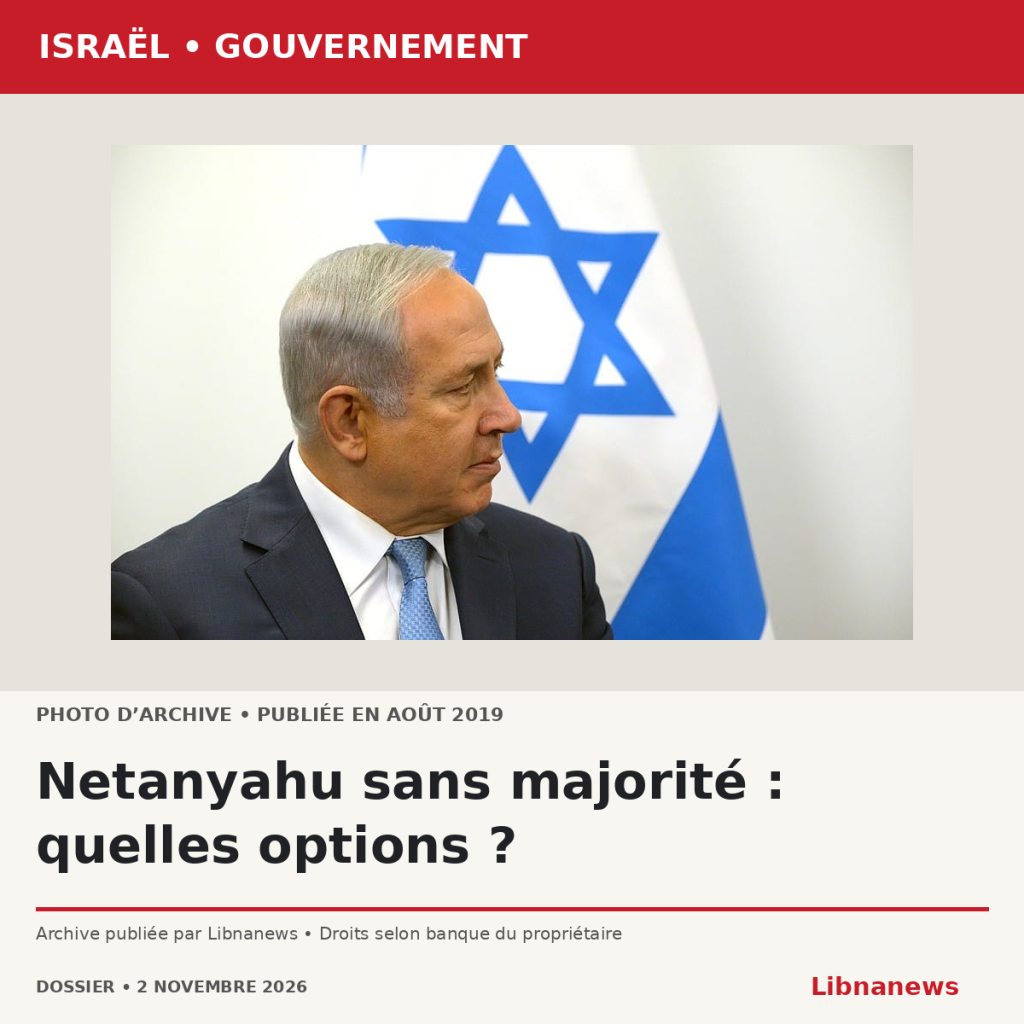
Benjamin Netanyahu retained the first party of the Knesset, but not a majority to renew his government. After the election on 27 October, his block had 53 seats out of 120. Sunday, November 1, a close friend of the Prime Minister pleaded for a government of union with Gadi Eisenkot. No agreement confirms this possibility on 2 November.
The Likud gets 27 deputies. Its partners complete a set that remains eight seats of absolute majority. To turn this result into a new government, Netanyahu must therefore obtain support outside his camp or reach a broader arrangement.
Netanyahu and the hypothesis of a government of union
Benny Biton, Mayor of Dimona and close to the Prime Minister, said on Sunday that Netanyahu wanted a union. He spoke of guarantees that could be provided by President Isaac Herzog and US President Donald Trump to Eisenkot.
This statement describes the position of a Netanyahu ally. It is neither a formal commitment of the two Presidents nor the announcement of a successful negotiation. Caution is also required on a possible rotation at the head of government: no approved arrangements have been made public.
A rapprochement with Eisenkot would encounter a major political difficulty. Yashar’s leader made the replacement of Netanyahu a central goal. Prior to the election, he had excluded him from governing under his authority, including in a rotation formula. A union would therefore require an explicit change of position or an arrangement still unknown.
Eight missing seats, but no acquired partner
The second route is to attract training from the other side. However, adding seats is not enough to demonstrate the feasibility of an alliance. Each party has its own commitments, priorities and relations with the outgoing Prime Minister.
After Bennett Sunday, Liberman announced Monday, 2 November, that his party would recommend Eisenkot, according to the Jerusalem Post. These positions direct their formations towards an alternative to Netanyahu, without establishing a coalition. Liberman also supports Lapid’s candidacy for the Knesset presidency; No vote has yet been taken.
Rasam has eight seats, exactly the number that is missing in the outgoing block to reach 61. This arithmetic coincidence does not draw a coalition in preparation. Netanyahu’s far right partners rejected cooperation with the Abbas Mansour party. An alliance that would leave existing allies would immediately alter the calculation.
Remaining in office does not amount to being renewed
Netanyahu has another institutional reality: his government remains in place during the formation of the next. He must not leave immediately because his camp did not obtain an absolute majority.
This continuity does not give him a new majority in the Knesset. It distinguishes the provisional retention of the executive from the inauguration of a government after the elections. The result can therefore extend its presence in power without resolving its lack of parliamentary support.
Presidential consultations are scheduled to begin on 4 November. The candidate to form a government will have 28 days, with a possible extension of 14 days. If the first attempt fails, the procedure provides for further possibilities before a return to the ballot box.
A new election therefore remains a scenario, not a decision taken. The new Knesset must sit from November 10, even without a coalition. The next formal recommendations of the parties will determine who will obtain the first opportunity to transform the election into a government.





Comments