





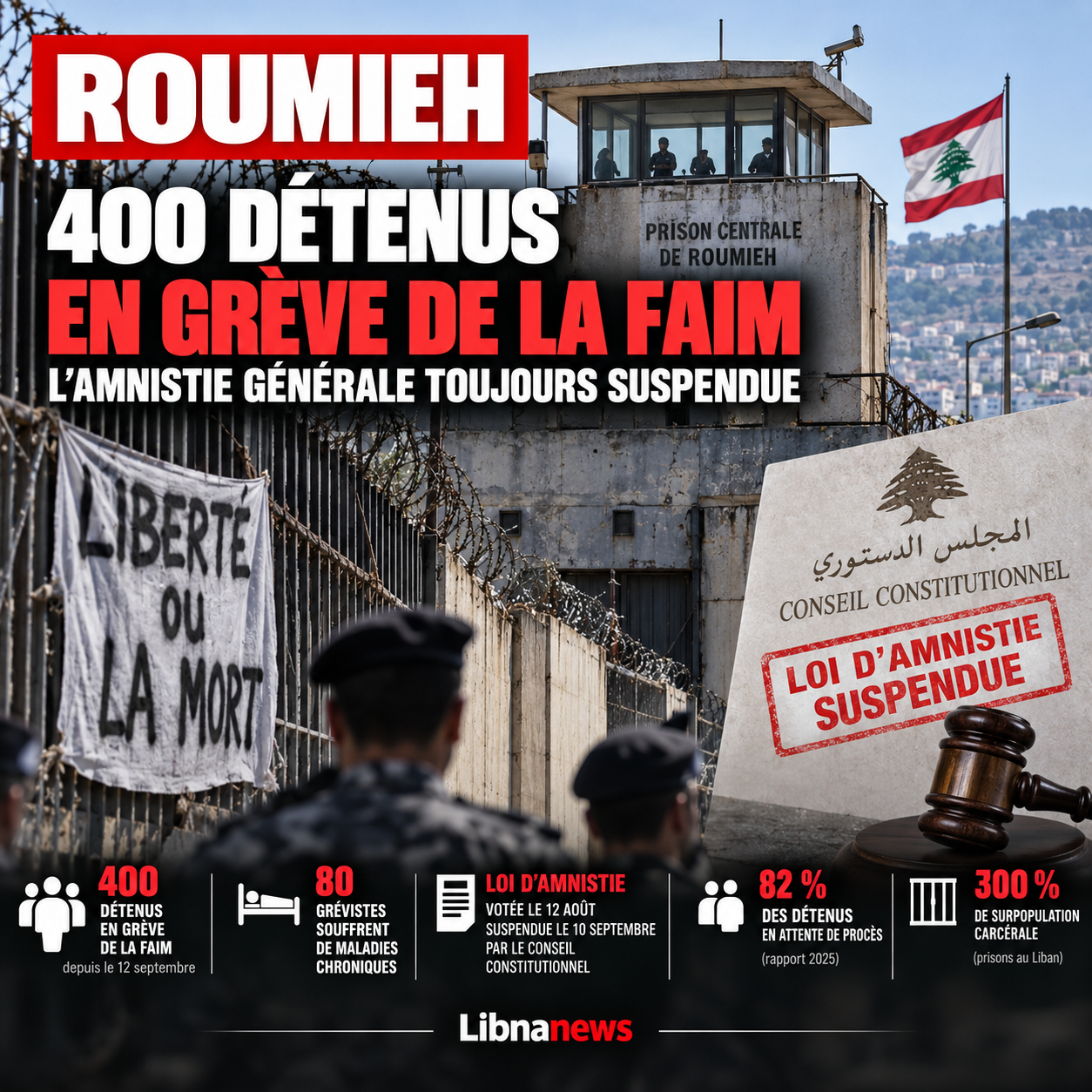
Some 400 detainees in Roumieh Central Prison, the majority of whom are Islamists, continue to be held in prisonhunger strikestarted on 12 September to protest against the suspension of the general amnesty law. Ten days after the beginning of the movement, the health issue is now added to the legal arm: 80 strikers suffer from chronic diseases, while the prison administration monitors their health. At the heart of the crisis is a law passed on 12 August by Parliament and provisionally frozen on 10 September by the Constitutional Council after an appeal has been lodged.
A strike entering a sensitive phase
The mobilization is concentrated in Rumieh, northeast of Beirut, in Lebanon’s largest prison. According to a judicial source cited by a news agency, about 400 detainees, mostly Islamists, have refused to feed since 12 September. Their claim is directly linked to the general amnesty: they demand that the text adopted by the Members be implemented.
After ten days of strike, the duration of the movement itself becomes a risk factor. Prison officials monitor the status of participants, including the 80 prisoners with chronic diseases. Reports in the Lebanese press also indicate cases of exhaustion among strikers. The medical situation can quickly become an additional issue if the movement continues.
Why is the amnesty law suspended?
The Lebanese Parliament adopted the General Amnesty Act on 12 August 2026, after several years of unsuccessful discussions and attempts. This is the first general amnesty measure of this magnitude since the one adopted in 1991 in the aftermath of the civil war.
However, the legislation does not provide for the indistinct release of all detainees. It combines amnesty measures with exceptional reductions in certain sentences, with exclusions in several categories of serious crimes. Its adoption immediately revived an old political and community debate, particularly about the fate of Islamist detainees.
The process changed direction in early September. MPs from the strong Lebanon bloc, linked to the Free Patriotic Current, appealed to the Constitutional Council to challenge the law. On 10 September, the majority decided to temporarily suspend the effects of Act No. 70/2026, while examining the merits of the appeal.
This decision therefore does not at this stage mean that the law has been annulled. It prevents its application during constitutional review. For those prisoners who thought they could benefit quickly from its provisions, this legal distinction has a very concrete consequence: no measure provided for in the contested text can be implemented while the suspension remains in force.
The Constitutional Council at the centre of the crisis
The pressure thus moves towards the Constitutional Council. The institution must determine whether the law complies with the Constitution and whether the complaints in the appeal justify its total or partial annulment. His decision is expected in the coming weeks.
In particular, the appeal raises questions concerning the procedure for adopting the text, the rights of victims and the principles of equality and proportionality. The challengers also defended the need to distinguish between long-term detention without trial and serious crimes.
This distinction is at the heart of the controversy. Part of the public debate presents amnesty as a means of redressing abnormally long judicial situations and reducing prison congestion. On the contrary, its opponents fear that a general measure will allow persons involved in serious acts to obtain remission of sentence or release without a sufficient response to victims’ rights.
For the strikers of Roumieh, however, the institutional calendar has become the main problem. Their movement aims precisely to create pressure during this waiting period. The Constitutional Council must decide according to its own procedures, while the situation within the prison is now evolving at the pace of the strike.
Islamic detainees, the most sensitive point
The issue of Islamist detainees has for years been one of the main obstacles to a political agreement on a general amnesty in Lebanon. Some have been convicted of terrorism-related offences or involvement in armed clashes. Others remain detained in proceedings that have been going on for years.
The case is particularly sensitive when the charges relate to attacks against the Lebanese army. Even before the August vote, there had been strong opposition to the possibility that certain persons convicted or prosecuted in these cases would benefit from the new system.
This dimension explains in part why the debate goes far beyond the walls of Roumieh. Amnesty defenders must distinguish between persons convicted of serious offences and those who have been held in excessive pre-trial detention or whose judicial records have not advanced. For opponents of the text, a reform of the judicial system should not lead to the removal of criminal responsibilities, particularly when military or civilians were killed.
The law passed in August results from a difficult political compromise. It targets several categories of detainees and wanted persons and does not apply exclusively to Islamists. But it is these who crystallize most of the controversy and, in Roumieh, constitute the main nucleus of the current mobilization.
Roumieh reveals a much wider prison crisis
The hunger strike is mainly in a system where pre-trial detention is of considerable importance. In its annual report for 2025, the Lebanese National Human Rights Commission estimated that approximately 82 per cent of detainees were awaiting completion of their judicial proceedings. The Commission’s official data showed 6,212 detainees as at 10 March 2026.
The same institution assessed the occupancy of prisons at nearly 300 per cent of their capacity. This overcrowding is not solely due to the number of convictions. The delays in the courts, prolonged preventive detention, the lack of adequate infrastructure and the consequences of successive crises have contributed to the accumulation of detainees.
Roumieh is the most visible example. Built in the 1960s and officially opened in 1971, the establishment was designed for about 1,300 people. It has long been home to a population well above this initial capacity. The prison has thus become both a place of detention and a symbol of the structural dysfunctions of Lebanese prison policy.
Amnesty can reduce pressure without resolving its causes
It is in this context that the general amnesty was presented by its defenders as one of the means of rapidly reducing the prison population. A release of eligible prisoners or a reduction in certain sentences could actually reduce the number of prisoners. But it alone would not solve the mechanisms that produce overpopulation.
The very high proportion of persons in pretrial detention illustrates this limitation. If procedures continue to extend over long periods and institutions remain insufficient, the effect of an amnesty on the occupation of prisons may remain temporary. The question therefore also concerns the speed of trials, the application of the rules governing pre-trial detention and possible alternatives to pre-trial detention.
This difference between immediate response and structural reform is essential to understanding the current conflict. For prisoners who may benefit from the law, the urgency concerns their individual situation and the entry into force of the law. For the State, the crisis poses a broader question: how can we reduce a prison population that is far beyond the capacity available without weakening the rights of victims or the prosecution of the most serious crimes?
A health and judicial expectation now
In Roumieh, these institutional debates now have a physical translation. Each additional day of strike increases attention to the health status of inmates, particularly those with chronic diseases. The administration must monitor collective mobilisation while maintaining the operation of an already overloaded establishment.
However, the case remains suspended from a legal decision. Until the Constitutional Council decides on the appeal, the general amnesty law will remain frozen and the detainees concerned will not be able to benefit from the measures it provides. A validation of the text would pave the way for its application; full or partial censorship would require political and judicial authorities to review the system.
For the approximately 400 inmates on hunger strike, the schedule is more immediate. Their movement, which began on 12 September, continues as the prison authorities monitor 80 strikers suffering from chronic diseases. The next institutional stage belongs to the Constitutional Council, but the evolution of the situation in Roumieh now also depends on the capacity of detainees to prolong their movement without a major worsening of their health.